Citations: sources and coverage
The Citations page answers a different question from the rest of CitedSpy: which websites are AI engines reading when they answer questions in your category, and do those websites bring you with them?
If the Overview tells you how you are doing, this page tells you where to go and fix it.
Three units, and why they matter
Most confusion on this page comes from mixing up three things that are all displayed as "N x".
| Unit | One of them is |
|---|---|
| A citation | One link inside one AI answer. Three links to the same site in one answer is 3 citations. |
| A run | One prompt asked to one engine once. That whole answer is 1 run. |
| A source | One website. All three of those links belong to 1 source. |
- Sources tracked, the category donut and the engine bars count sources.
- The Cites column and citation share count citations.
- Coverage and the "N x" chips count runs.
The window here defaults to 30 days.
The four KPI tiles
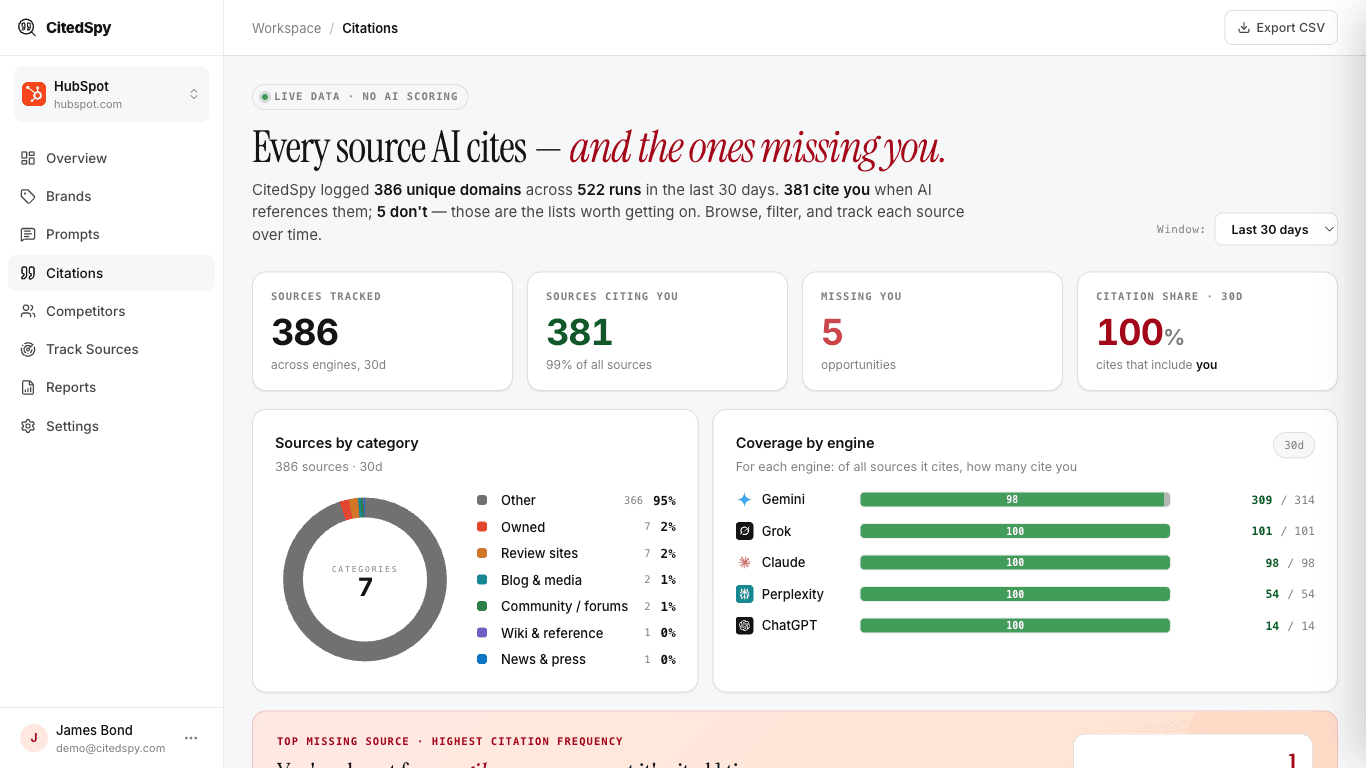
Sources tracked
How many different websites the AI engines pulled from when answering your prompts.
Sources citing you
Of those, how many are associated with your brand appearing in the answer.
This does not mean the website's page has your name on it. It means: in the answers where this source was cited, your brand also appeared somewhere. It measures association, not the page's content.
Missing you
Websites the AI reads regularly, but where your brand never appears in the resulting answer. For most brands this is the most valuable number on the page - it is your outreach shortlist, ranked by how much the AI actually relies on each site.
Citation share
                    citations from sources that cite you
Citation share =  ---------------------------------------  x 100
                        all citations in the window
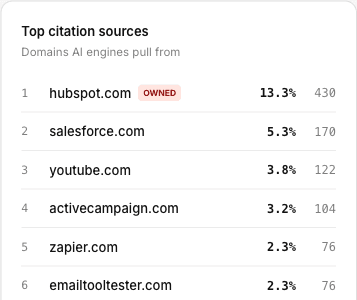
This counts citations rather than sources, so a site cited 105 times weighs 105 times as much as one cited once.
Coverage: the three states
For every website, we compare the runs that cited it against the runs that also named you.
| Coverage | Meaning |
|---|---|
| Cites you | Every run that cited this site also named you |
| Never cites you | No run that cited it named you |
| Mixed 68/69 | 68 of the 69 runs that cited it also named you |
The two numbers in "Mixed" are runs, so they are directly comparable to the "N x" chips beside them.
Sources by category
Every website falls into exactly one bucket: Owned, Wiki and reference, Review sites, Community and forums, News and press, Blog and media, or Other.
The slice counts are websites, not citations. A site cited 500 times counts the same as one cited once. The number in the centre is how many categories have at least one website in them.
This breakdown tells you where to spend effort. A category dominated by community forums needs a very different strategy from one dominated by review sites.
Coverage by engine

                   websites that engine cites which also cite you
Engine coverage =  ---------------------------------------------  x 100
                        all websites that engine cites
The unit is websites, counted once per engine. If one engine is much lower than the others, it is drawing on a corner of the web where you are absent.
The source detail panel
Clicking any website opens a panel that turns a source into an actionable target.
Cited URLs lists the exact pages the AI is linking to, with how many citations each earned. This is what tells you which specific article to pitch, update or respond to.
Prompts that pulled this source shows which of your questions cause the AI to reach for this site, and carries the most useful number on the page:
             runs of this prompt that cited this source
                    AND also mentioned you
You 7/7  =   ------------------------------------------
             runs of this prompt that cited this source
"You 7/7" means the prompt pulled this source in 7 runs and you were named in all 7. "You 3/9" means the source is being read but you only surface a third of the time - a content gap on a site the AI already trusts. When you appear in none of them, it reads "You absent".
Co-cited competitors shows which rivals share the source with you.