How CitedSpy measures everything
Before any number makes sense, three ideas need to be clear. Everything else in CitedSpy is built on them, and almost every misreading comes from missing one.
Prompts, runs, and why the difference matters
A prompt is a question we ask AI engines on your behalf. A run is one prompt asked to one engine at one moment.
The same prompt asked to ChatGPT and Gemini on the same day is two runs. Asked again the next day, that is two more. This is why 17 prompts can produce over 200 runs in a fortnight.
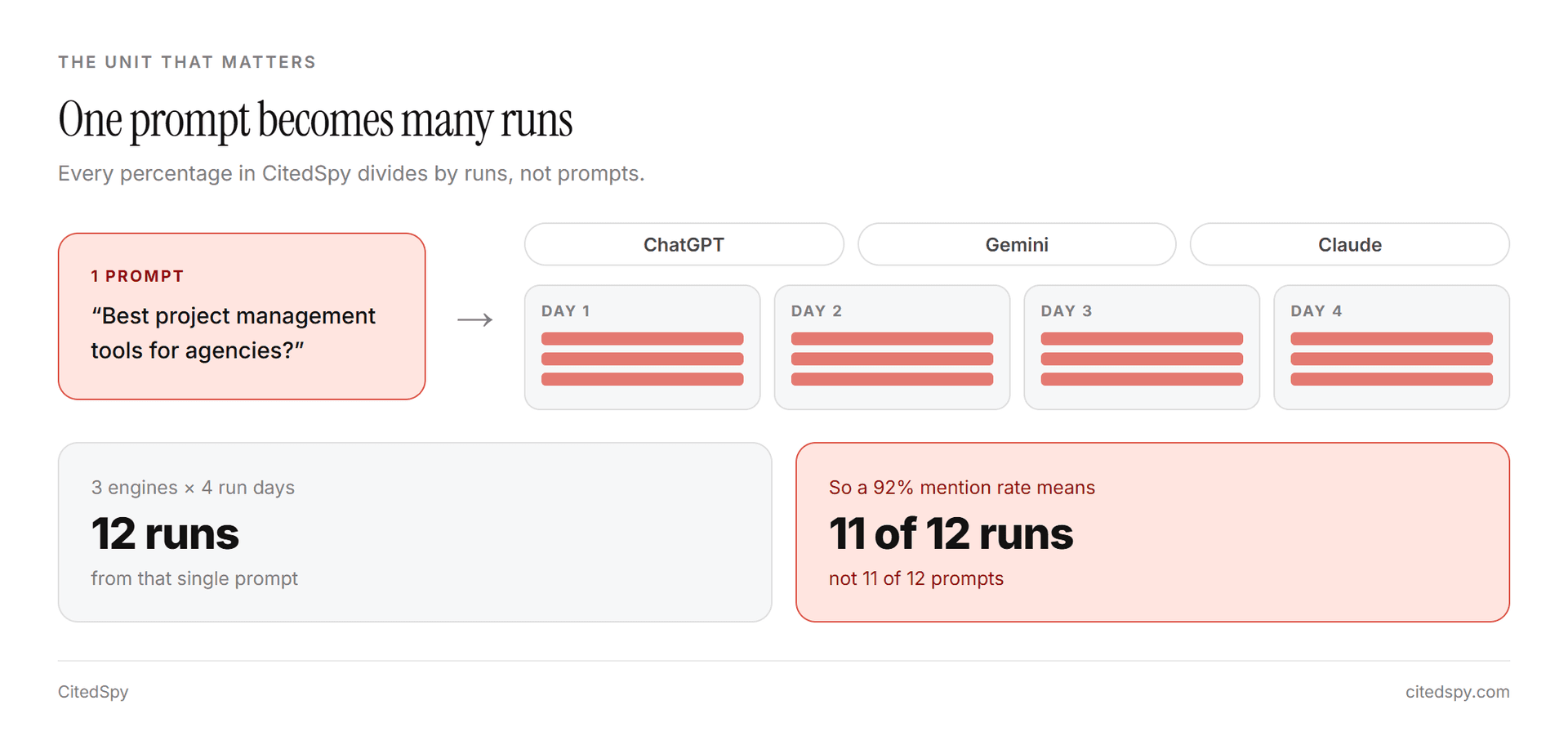
Almost every percentage in CitedSpy divides by runs, not prompts. When a card reads "93% of 10 discovery prompts", the 93% was calculated across the 108 runs those 10 prompts generated. The caption tells you how many questions are tracked; the maths happens over the answers.
The three kinds of prompt
A prompt's type decides which questions we can answer about it, which AI judge scores it, and which numbers appear on its report.
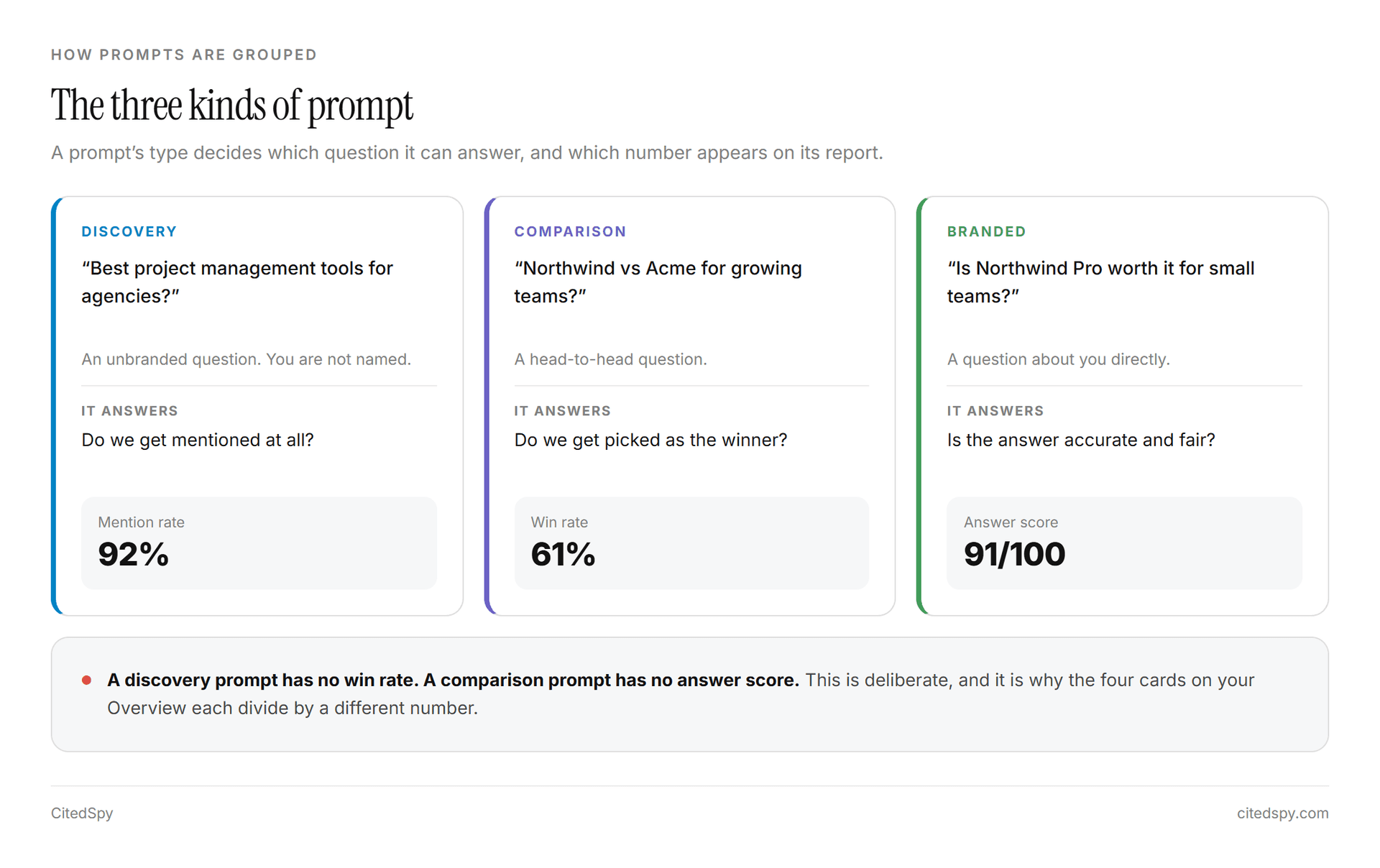
| Type | You are asking | The headline number |
|---|---|---|
| Discovery | An unbranded question, where you are not named | Mention rate |
| Comparison | A head-to-head question against named rivals | Win rate |
| Branded | A question about you directly | Answer score |
A discovery prompt has no win rate. A comparison prompt has no answer score. That is deliberate, and it is why the four cards on your Overview each divide by a different number.
The two ways we detect things
Two separate systems run on every answer. Knowing which one produced a number tells you exactly what it can and cannot mean.
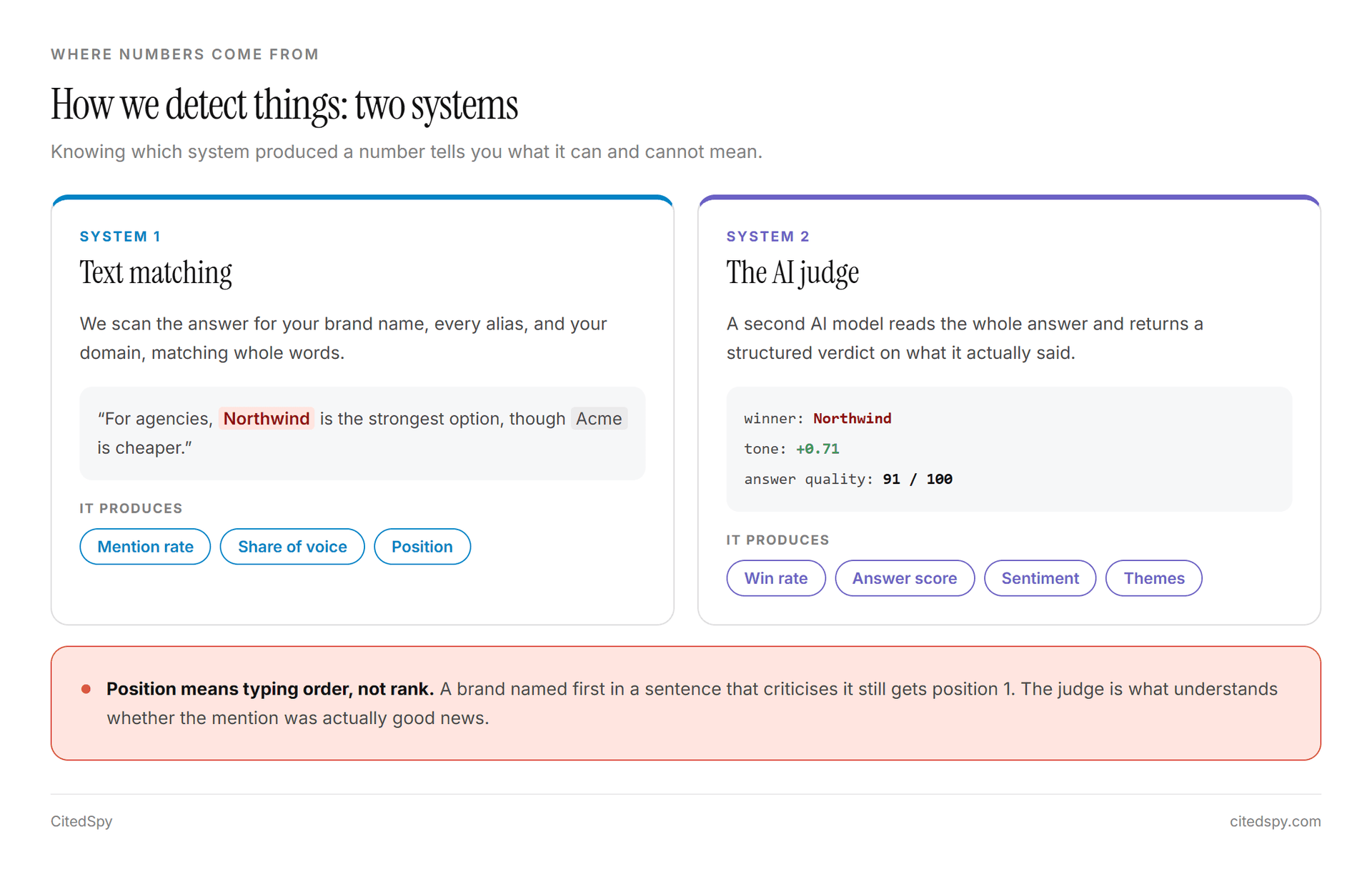
Text matching scans the answer for your brand name, every alias you have added, and your domain, matching whole words only. If it finds one, it records a mention. It also records the order names appear in, numbering them 1, 2, 3 and so on.
The AI judge is a second AI model that reads the full answer and returns a structured verdict: who won a comparison, how positively you were described, how accurate the answer was, and which themes it used.
The rule of thumb:
- Mention rate, share of voice and position come from text matching.
- Win rate, answer score, sentiment and themes come from the AI judge.
They measure different things, so they can legitimately disagree. An answer can name you first and still criticise you.
Two things worth knowing early
Position means typing order, not rank. An average position of 2.6 means you are typically the third company named in the sentence. It is not a quality ranking. A brand named first in a sentence that criticises it still gets position 1.
Aliases are the highest-leverage setting in the product. If an AI writes a variation of your name that is not in your alias list, we miss the mention entirely, and your mention rate drops for a reason that has nothing to do with your visibility. Add abbreviations, common misspellings, spacing variants, and parent company names.