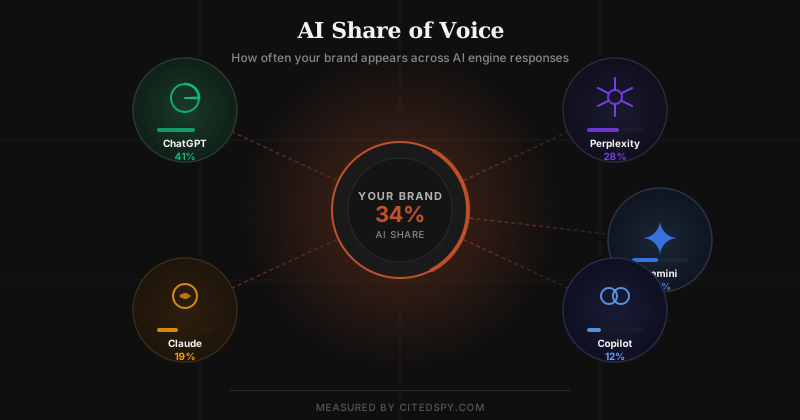
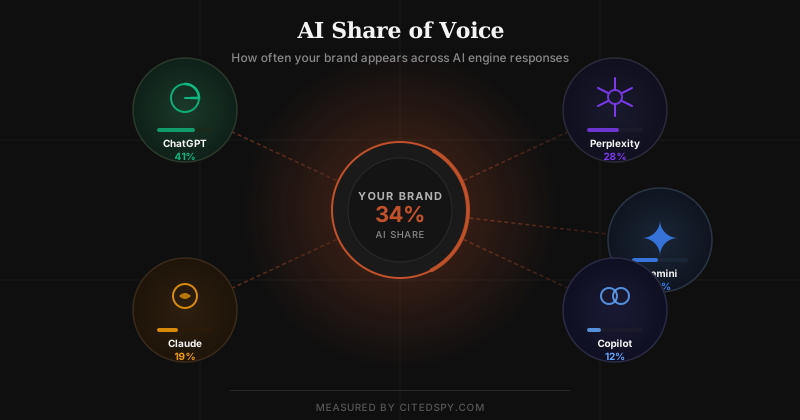
AI share of voice is the percentage of AI-generated answers - across engines like ChatGPT, Perplexity, Gemini, Claude, and Copilot - that cite or mention your brand versus your competitors for a defined set of prompts. It is the AI-era equivalent of traditional share of voice, measured inside answers instead of ad impressions or search rankings.
If you have spent any time on generative engine optimization, you already know that a ranking position no longer tells the full story. Buyers ask an AI a question and get one synthesized answer. Either your brand is in that answer or it is not. AI share of voice - often shortened to AI SOV - is the single metric that tells you how much of that answer space you actually own.
The honest answer to "how do I know if we're winning in AI search?" is that you need a share metric, not a vanity count. Being cited 40 times a month means nothing if your competitor is cited 400 times for the same questions.
Why AI Share of Voice Matters Now
The move to AI search is not a projection anymore. It is measurable, and the numbers are large.
Conductor's 2026 AEO/GEO Benchmarks Report - which sampled 13,770 domains, 17 million AI-generated responses, and over 100 million citations between May and September 2025 - found that blog content was by far the most cited page source in AI answers. That means the answer space is winnable through content, and whoever owns more of it owns more of the buyer's first impression.
The economic case is sharper still. Semrush's June 2025 research, led by Kyle Byers and Rachel Handley, analyzed over 500 high-value digital marketing topics and found that AI search visitors convert at roughly 4.4 times the rate of traditional organic search visitors. A single AI citation is worth close to five organic clicks in conversion terms. When you frame it that way, your AI share of voice is not a soft brand metric - it is a leading indicator of pipeline.
Here is the part most teams miss: AI SOV is inherently competitive. Traditional website analytics tell you about *you*. Share of voice tells you about *you relative to everyone else answering the same question*. In a world where the AI names one, two, or three brands and stops, relative visibility is the only visibility that matters.
And it moves fast. Profound AI's July 2025 study by Josh Blyskal and Sartaj Rajpal, which sampled roughly 80,000 prompts per platform between June and July 2025, measured monthly citation drift at 59.3% for Google AI Overviews, 54.1% for ChatGPT, 53.4% for Microsoft Copilot, and 40.5% for Perplexity. More than half of citations change within a month. Your AI share of voice is a moving target, which is exactly why a one-time audit is not enough.
AI Share of Voice vs Traditional Share of Voice
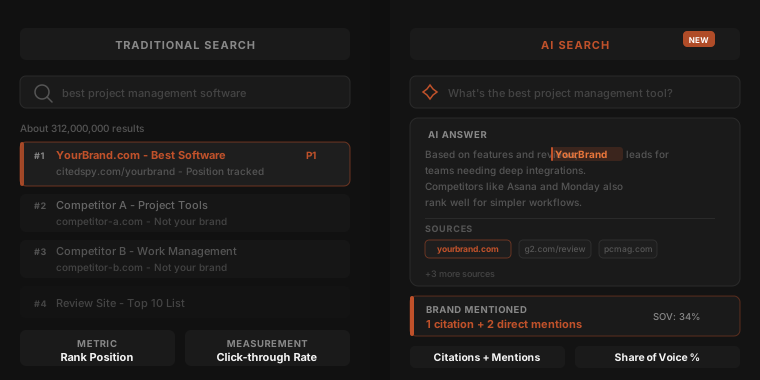
Traditional share of voice came out of advertising and PR. It measured your paid media spend, or your organic ranking presence, against total category activity. AI share of voice keeps the core idea - your slice of the total conversation - but changes almost everything about how it is measured.
| Dimension | Traditional share of voice | AI share of voice |
|---|---|---|
| Unit of measurement | Ad impressions, keyword rankings, mentions | Citations and brand mentions inside AI answers |
| Surface | Google SERP, media coverage, social | ChatGPT, Perplexity, Gemini, Claude, Copilot |
| Result format | Ten blue links, list of results | One synthesized answer citing a few sources |
| Winner-take-all effect | Low - page one has ten slots | High - answers often name one to three brands |
| Volatility | Weeks to months | Over half of citations shift monthly |
| Data source | Rank trackers, media monitoring | Prompt sampling across engines |
The winner-take-all dynamic is the biggest shift. On a traditional search results page, ten organic slots plus ads mean many brands get some exposure. Inside an AI answer, the model frequently names a handful of brands and moves on. That compresses the distribution. Your AI SOV can be zero even while your SEO rankings look healthy - a gap that shows up constantly in a first GEO audit for a new brand.
The second shift is multi-engine fragmentation. Traditional share of voice was effectively a Google story. AI share of voice is spread across at least five engines, each with its own retrieval behavior and its own citation habits. Your brand can dominate Perplexity and be invisible in Gemini. A credible AI SOV number has to be measured per engine and then rolled up, not measured on one platform and assumed everywhere.
How AI Share of Voice Is Calculated
The formula itself is simple. The rigor is in the inputs.
At its core:
AI share of voice = (your brand citations or mentions) / (total citations or mentions for you plus your tracked competitors) × 100
You run a defined set of prompts across your target engines, count how often each brand appears, and express yours as a percentage of the competitive set. There are two common counting methods:
- Mention-based SOV counts every time your brand name appears in an answer, cited or not. This captures brand awareness inside the model's output.
- Citation-based SOV counts only when your domain is linked or attributed as a source. This is stricter and maps to referral traffic and authority. If you want the mechanics of how those links get chosen, our AI citation guide covers it.
Track both. Mention SOV tells you how present your brand is in the conversation; citation SOV tells you how much authority you are actually earning. A brand with high mentions but low citations is being described, not sourced - a fixable problem.
The prompt set is where accuracy lives or dies. A representative prompt set should mix informational queries ("what is the best X for Y"), comparison queries ("X vs competitor"), and problem-led queries ("how do I solve Z"). The Princeton and Georgia Tech study behind GEO - Aggarwal et al. (2024), presented at ACM KDD 2024 - tested over 10,000 queries across 10 AI systems, and the lesson holds for measurement too: a handful of prompts produces noise, breadth produces signal.
How to Measure AI Share of Voice
You can measure AI SOV manually or with tooling. Both are valid; they trade time for scale.
The manual method
The manual approach is a good way to understand the mechanics before you automate:
- Define your prompt set. Write 20 to 50 prompts your buyers would realistically ask. Mix informational, comparison, and problem-led queries.
- List your competitive set. Your brand plus three to eight direct competitors. This is the denominator.
- Run each prompt across each engine. ChatGPT, Perplexity, Gemini, Claude, Copilot. Do it in a clean session with no personalization.
- Record every brand mention and citation. A spreadsheet with rows for prompts and columns for brands works fine.
- Calculate the percentages. Your mentions divided by total mentions, per engine and blended.
The manual method is honest but painful. With 40 prompts across 5 engines, you are running 200 queries per cycle - and because over half of citations drift monthly, one cycle is a snapshot, not a trend. To see movement you have to repeat it weekly, which is where manual tracking collapses under its own weight.
The automated method
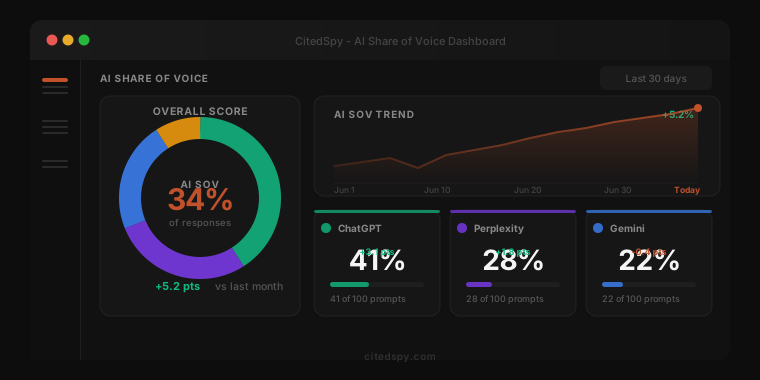
This is the problem CitedSpy was built to solve. Instead of running hundreds of queries by hand, you define your prompts and competitors once, and CitedSpy runs them across ChatGPT, Perplexity, Gemini, Claude, and Copilot on a schedule, then calculates your AI share of voice per engine and blended - with the week-over-week trend line that manual tracking can never sustain. It surfaces which prompts you win, which competitors are gaining, and where your citation share is slipping before it becomes a problem.
Automated AI brand monitoring turns AI SOV from a quarterly project into a live dashboard. That matters because the metric is only useful if you can watch it change and tie those changes to the content you ship.
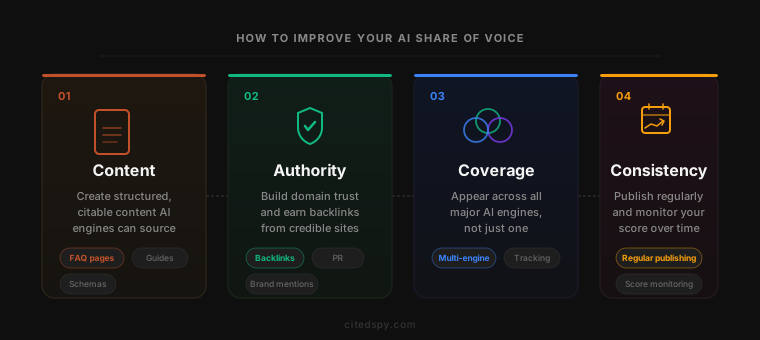
How to Improve Your AI Share of Voice
Measuring AI share of voice is step one. Growing it is the work. Here are the tactics that actually move the number, grounded in the research.
Add statistics and citations to your content
The Aggarwal et al. (2024) study is unusually actionable here. Their controlled experiments found that adding statistics improved AI citation rates by 41%, adding quotations improved them by 28%, and citing authoritative external sources improved citation rates by up to 115% for lower-ranked content. If you want a bigger slice of AI answers, write content dense with cited facts and sourced numbers. AI engines reward content that looks sourced because it is easier to trust and reuse.
Publish comparison and alternative content
AI SOV is decided disproportionately by comparison queries - "X vs Y," "best X for Z," "alternatives to X." These are the prompts where the model has to name brands, which makes them the highest-leverage pages for share of voice. If you are absent from comparison content, you are conceding the exact answers where brands get chosen.
Win the blog layer, not just product pages
Conductor's finding that blog content is the most cited source is a direct instruction. Educational, well-structured articles are the asset class AI engines pull from. Product pages rarely get cited. If your content investment is skewed toward landing pages, your AI share of voice will lag.
Cover the full question, not just the keyword
AI engines synthesize answers, so they favor content that resolves a question completely. Structure matters: clear headings, direct answers near the top, tables, and scannable lists all make your content easier to extract. This is the difference between being crawled and being cited.
Monitor, then double down on what wins
Because citation drift runs above 50% monthly on most engines, the brands that grow AI share of voice are the ones that watch it and react. Track which prompts you win, reinforce that content, and attack the prompts where competitors are pulling ahead. For the full strategy, our generative engine optimization guide goes deeper on each tactic.
Prompt Tracking: How It Works at Scale
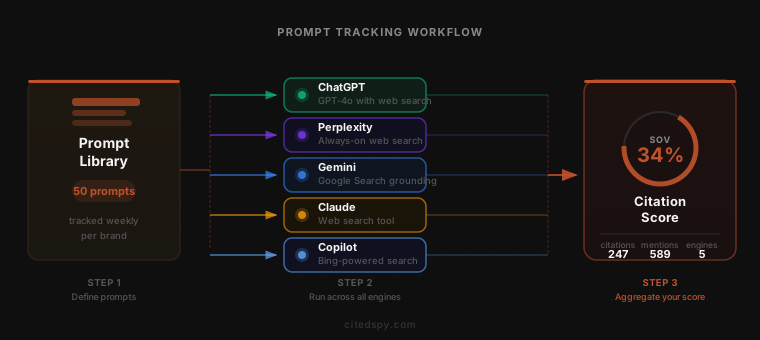
The mechanics of AI share of voice measurement at scale follow a consistent pattern. You maintain a prompt library - the set of questions your buyers actually ask AI engines. These prompts get dispatched to each engine on a weekly schedule. Every response gets scanned for brand mentions and citations. The results feed into a per-engine and blended SOV calculation, with trend lines showing week-over-week movement.
The prompt library is the most important asset in the system. It needs to represent the full range of intent your buyers have: category questions ("what tools help with X"), comparison questions ("X vs Y"), problem questions ("how do I solve Z"), and situation questions ("I'm a [role] trying to [goal]"). A prompt library that only covers direct brand searches misses the context where most AI citations actually happen.
Practical Takeaways
If you do nothing else, do these five things:
- Define a real prompt set. 20 to 50 buyer questions across informational, comparison, and problem-led intents.
- Track both mentions and citations. Mention SOV shows presence; citation SOV shows authority.
- Measure per engine, then blend. Never assume performance on one engine reflects the others.
- Load content with sourced statistics. It is the single best-supported tactic for lifting citation rates.
- Watch the trend, not the snapshot. With citations drifting monthly, weekly monitoring is where the signal lives.
The Bottom Line
AI share of voice is becoming the headline metric for brand visibility in AI search, and for good reason. It captures the one thing that matters when an AI answers a buyer's question: are you in the answer, and how much of it do you own compared to everyone else? Traditional analytics cannot tell you that. A proper AI SOV measurement can.
The brands that win the next few years of AI search will be the ones that treat AI share of voice like a real KPI - measured across every engine, tracked over time, and improved with deliberate content work.