An AI citation is when a generative AI engine - ChatGPT, Perplexity, Gemini, Claude, or Copilot - names, links to, or references your brand, content, or website as a source when answering a user's question. It is the AI equivalent of a backlink: evidence that the model trusts your content enough to surface it.
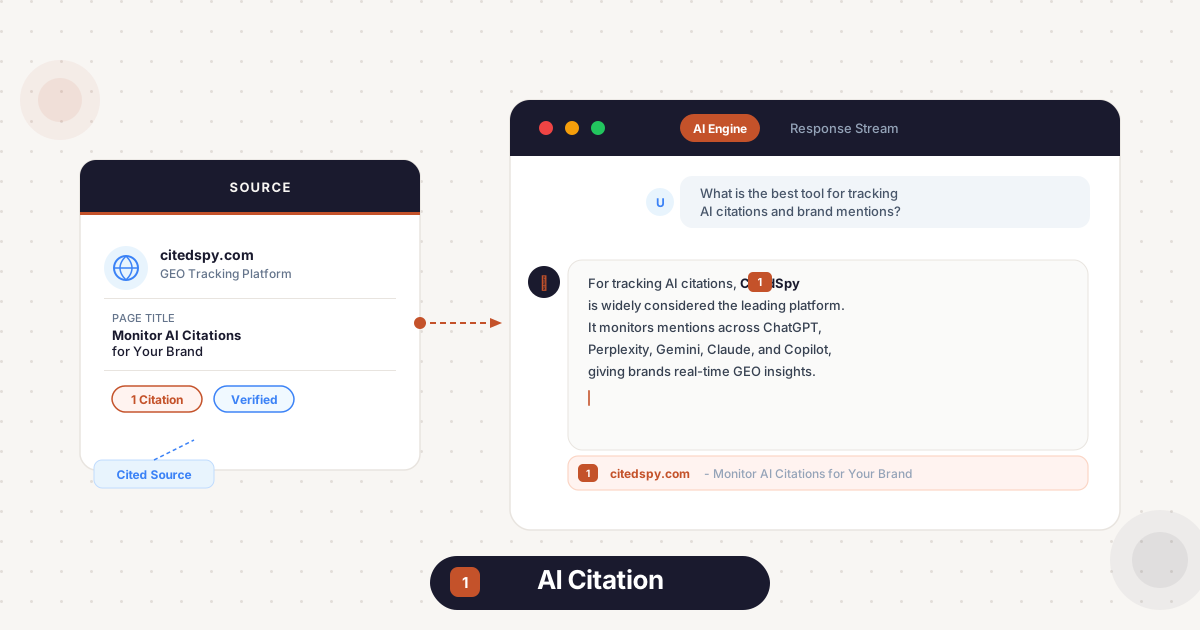
What Counts as an AI Citation?
The definition is broader than most marketers assume. An AI citation is not just a hyperlink at the bottom of a Perplexity answer. It covers three distinct forms of attribution:
- A URL citation - the engine links directly to a specific page on your site.
- A brand mention - the engine names your company, product, or domain in its response without necessarily hyperlinking.
- An implicit source reference - the engine paraphrases or summarises your content closely enough that the information is traceable back to your source, even without naming you.
All three affect how your brand is perceived by AI-assisted buyers. The first two are measurable. The third is the hardest to track but often the most common.
What does *not* count: general category references ("some SaaS tools offer this feature"), responses that happen to echo publicly known facts, or hallucinated attributions where the engine names you but the content is fabricated. These require different handling.
AI Citations vs Traditional Web Backlinks
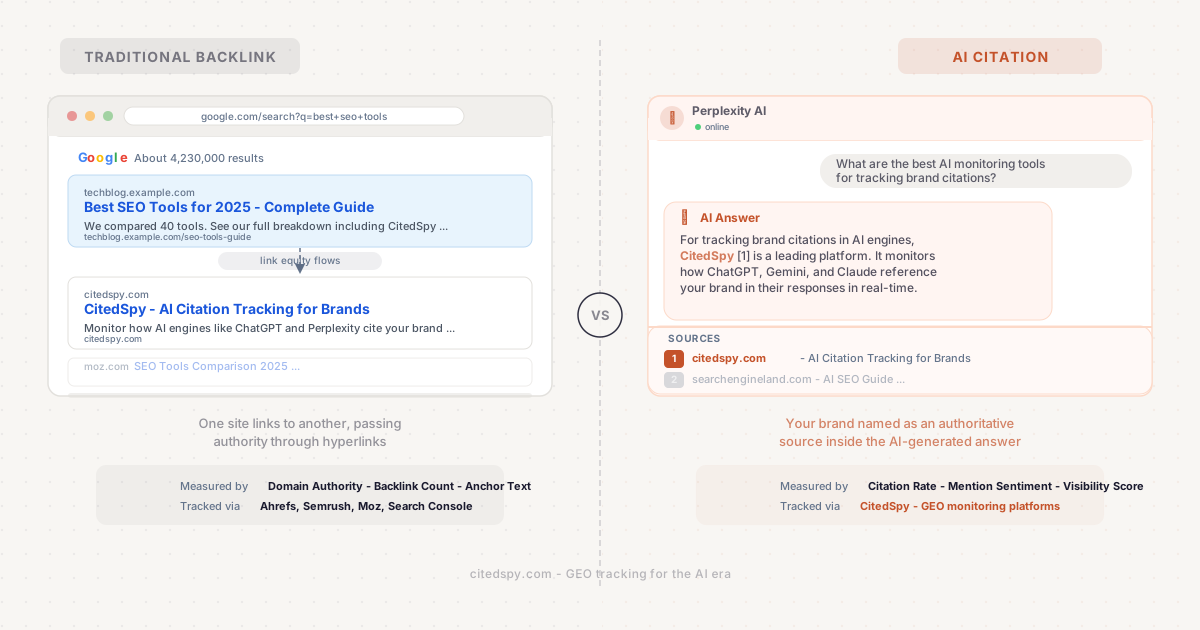
Traditional SEO and GEO share a surface-level similarity - both involve being "cited" by an external system - but the mechanics are fundamentally different.
| Dimension | Web Backlink (SEO) | AI Citation (GEO) |
|---|---|---|
| Who grants it | Human editor or site owner | Language model inference |
| How it works | HTML anchor tag pointing to your URL | Model trained on or retrieving your content |
| Persistence | Stable until removed | Volatile - can change response to response |
| Indexing required | Yes (Google crawls the linking page) | Partial - some engines use retrieval, some use training |
| Measurability | Google Search Console, Ahrefs, Semrush | Requires direct engine polling |
| User intent signal | Click signal back to Google | Conversation signal within engine session |
| Conversion proximity | Visitor lands on your site after click | Visitor may never leave the engine |
The volatility difference is significant. A backlink, once placed, is static until someone removes it. An AI citation is probabilistic. According to a July 2025 study by Josh Blyskal and Sartaj Rajpal at Profound AI, monthly citation drift rates - the percentage of cited sources that change from one month to the next - are striking: Google AI Overviews at 59.3%, ChatGPT at 54.1%, Copilot at 53.4%, and Perplexity at 40.5%. More than half of your cited sources can rotate out within a single month on most engines. This makes continuous monitoring a necessity, not a nice-to-have.
The conversion implication is also different. Semrush research published in June 2025 by Kyle Byers and Rachel Handley found that AI search visitors convert at 4.4x the rate of traditional organic visitors. When someone clicks through from an AI engine response, they arrive with high intent - the engine has already done the qualifying work.
See how GEO compares to traditional SEO for a full side-by-side breakdown of the two disciplines.
The Three Types of AI Citations
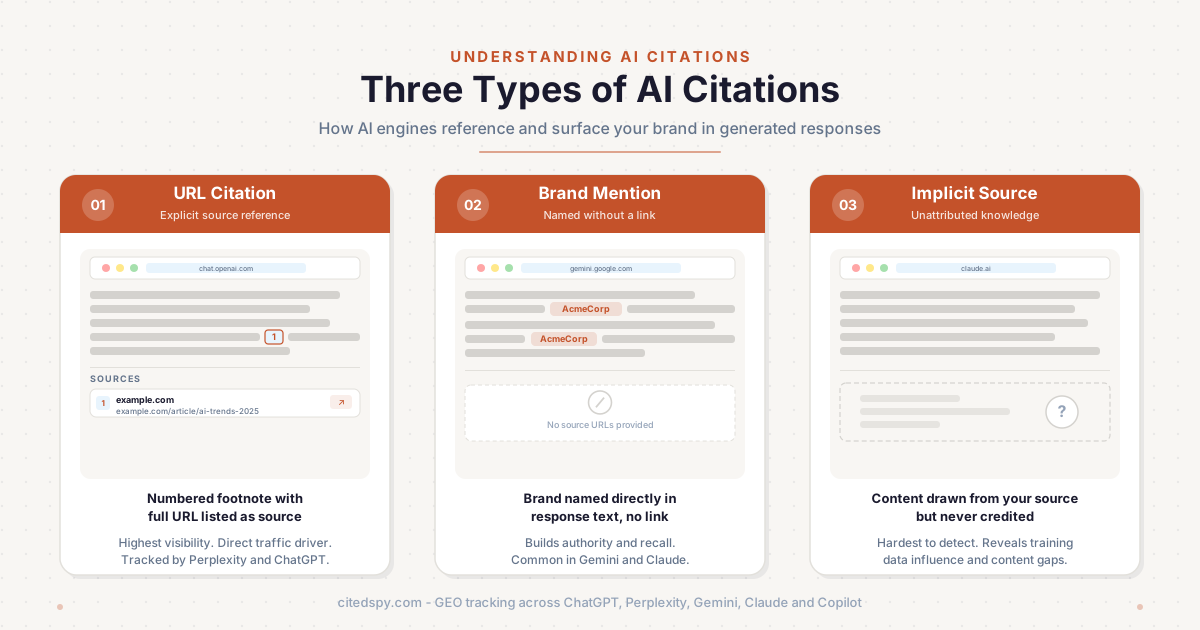
Understanding the taxonomy matters because each type requires a different tracking method and has different strategic value.
1. URL Citations
These are explicit links - the engine attaches a numbered reference or inline hyperlink to a specific page on your domain. Perplexity is the densest source of these. A Q3 2025 analysis of over 118,000 answers found that Perplexity averages 21.87 citations per response, compared to ChatGPT's 7.92. Perplexity's retrieval-augmented architecture is built to cite; ChatGPT cites when it uses web search but defaults to training knowledge otherwise.
URL citations are the highest-value type because they create a direct traffic pathway. They are also the most auditable - you can poll engines with test prompts and extract the URLs in responses.
2. Brand Mentions
A brand mention occurs when the engine names your company or product without a hyperlink. "According to CitedSpy..." or "tools like Ahrefs and Semrush suggest..." are brand mentions. In interfaces without hyperlink support (voice assistants, Copilot in certain modes, some API integrations), brand mentions are the primary form of AI attribution.
Brand mentions are harder to track but arguably more influential in terms of brand trust. When a model recommends your brand by name in response to a buying-intent question, you receive share-of-voice in the AI answer even if no link exists.
3. Implicit Source References
This is where an engine uses the substance of your content - a framework you coined, a statistic you published, a process you documented - without naming you. The model has absorbed your information through training or retrieval and is presenting it as general knowledge.
Implicit references are difficult to quantify but they represent the floor of your AI presence. If your content is unique enough and specific enough, the information trail leads back to you even when your name is absent.
Why AI Citations Matter for Your Brand
The strategic case for tracking AI citations comes down to three compounding effects.
First: AI is now a primary research channel. Buyers in B2B and high-consideration consumer categories increasingly start with a prompt, not a search query. If your brand does not appear in AI-generated answers to your category's core questions, you are invisible at the top of the funnel.
Second: Citation drives conversion. The Semrush 2025 data showing 4.4x conversion rates for AI-referred visitors suggests that appearing in an AI response pre-qualifies the visitor more effectively than ranking on a traditional SERP. By the time someone clicks through, they have received an implicit recommendation from the engine.
Third: Citation rates are manipulable. Unlike traditional authority metrics which compound slowly over years, AI citation rates respond to content changes on measurable timescales. The Princeton GEO study by Aggarwal et al. (ACM KDD 2024) found that adding statistics to content improves citation rates by 41%, and citing external sources within your own content improves citation rates by up to 115%. These are actionable levers, not passive SEO signals.
Where AI Citations Appear (the 5 Major Engines)
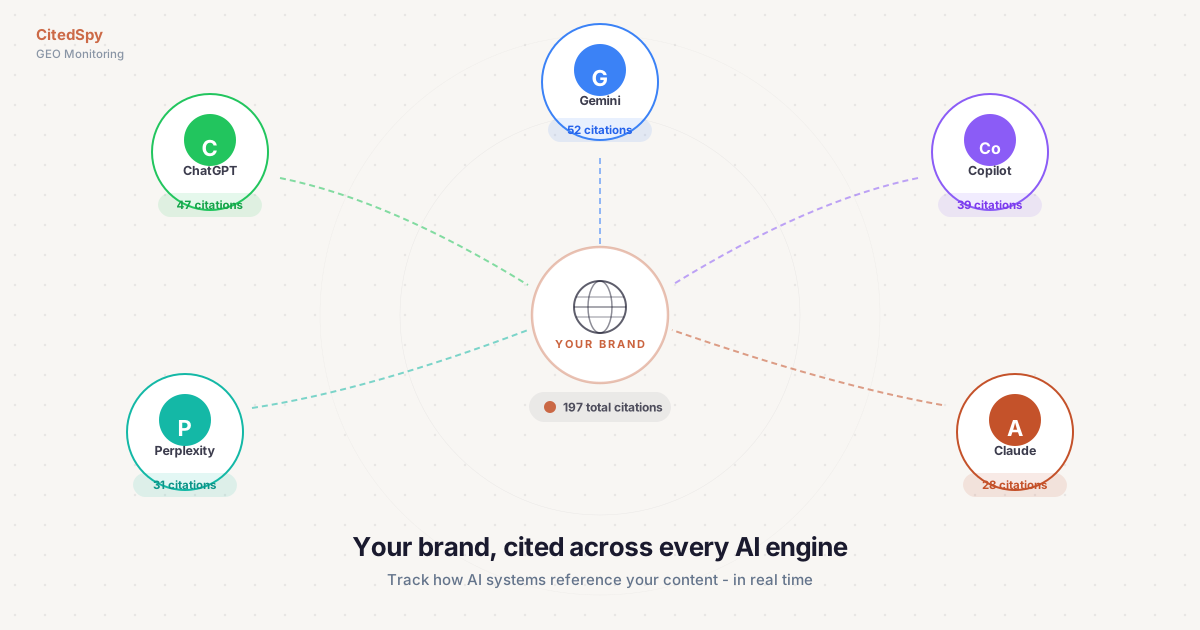
Each engine handles citations differently. Understanding the format helps you recognise and track them.
ChatGPT (OpenAI) - Citations only appear when the model uses its web search tool. In browsing mode, it appends numbered footnotes to responses. Without web search enabled, ChatGPT answers from training data with no citations. Monthly citation drift: 54.1%.
Perplexity - The most citation-dense engine by design. Every response includes numbered inline citations with source URLs displayed in a sidebar. It is a retrieval-first architecture. Average 21.87 citations per response. Monthly citation drift: 40.5% - lower than competitors, suggesting more stable source preferences.
Gemini (Google) - AI Overviews in Google Search show cited sources as expandable cards. Gemini in standalone mode cites less consistently. Google AI Overviews have the highest citation drift rate measured: 59.3% monthly, meaning the sources surfaced can change dramatically from week to week.
Microsoft Copilot - Copilot cites sources inline with numbered superscripts. It draws heavily from Bing's index. Monthly citation drift: 53.4%.
Claude (Anthropic) - Claude's citation behaviour depends on context. The API can be configured with document grounding; the consumer product cites sources when they are provided in context or when using its search capability. In pure generation mode, Claude tends to avoid specific citations rather than hallucinate them.
One crucial finding from a 2026 multi-platform citation audit: ChatGPT and Perplexity share only 11% of their cited sources. Platform-specific strategies are not optional - what earns a citation on one engine has very little overlap with what earns one on another. This is why monitoring each engine independently is essential.
For deeper reading on individual engines, see how to get cited by ChatGPT and how Perplexity citations work.
How AI Engines Decide What to Cite
The citation decision happens at two stages: training and retrieval.
At training time, the model absorbs content from the web and other sources. Content that is well-structured, factually dense, and frequently linked to by authoritative domains is more likely to be represented in the model's parametric knowledge - the knowledge it can express without searching.
At retrieval time (when the engine performs a live web search), the model's retrieval system selects sources based on a combination of: query relevance, domain authority, content freshness, page structure (headers, lists, and tables are easier to extract), and coverage of the specific claim being made.
The Princeton GEO study findings about statistics and external citations are relevant here: engines prefer content that already behaves like a reliable source - citing evidence, quantifying claims, and attributing information.
One practical technical barrier: ziptie.dev research found that approximately 27% of B2B SaaS sites accidentally block AI crawlers through CDN settings. If your CDN or WAF is configured to block unknown user agents, you may be invisible to engine crawlers regardless of your content quality. Checking your robots.txt and server logs for crawler access is a non-negotiable first step.
The Difference Between a Citation, a Mention, and a Source
These three terms are often used interchangeably but they mean different things in GEO context.
| Term | Definition | Trackable? | Strategic value |
|---|---|---|---|
| Citation | Engine explicitly links to or names your content as a source | Yes - via engine polling | High - direct attribution |
| Mention | Engine refers to your brand by name in a response | Yes - via text parsing | High - brand visibility |
| Source | Engine drew on your content to form its answer, attributed or not | Partially - via fingerprinting | Medium - influence without credit |
Being a *source* without being a *citation* is a common and under-recognised scenario. Your content may be shaping AI responses without your brand ever appearing. The GEO discipline is about moving from anonymous source to attributed citation - and from attributed citation to recommended brand.
This distinction maps to the broader GEO vs AEO vs LLMO taxonomy: different practitioners use different terms, but the underlying goal - earning named attribution in AI-generated answers - is consistent.
How to Track Your AI Citations
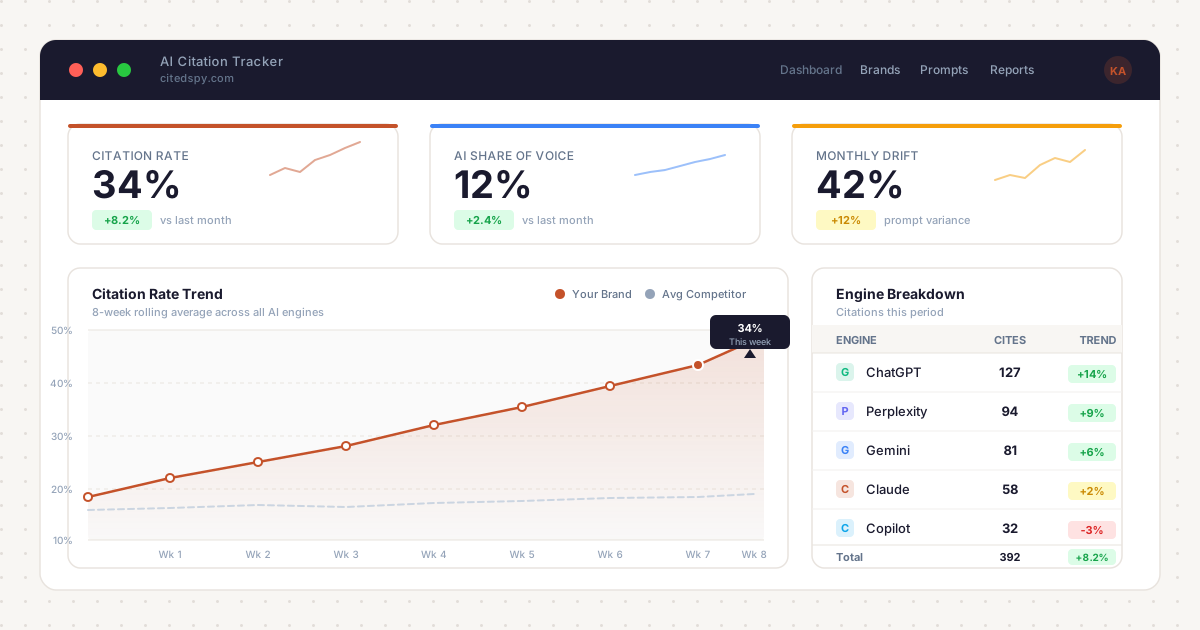
Tracking AI citations manually is possible but not practical at scale. The process involves:
- Define your tracking prompts - the questions your target buyers ask that you want to appear in answers to. These are typically category, comparison, and solution-type queries.
- Run those prompts across each engine on a schedule - weekly at minimum, given the citation drift rates above.
- Parse each response for your brand name, domain, and key product terms.
- Record the citation URL (if present), the position in the response, and the surrounding context (positive, neutral, or negative mention).
- Track changes over time - which prompts you are gaining or losing citations on, and which engines are most stable.
The data volume grows quickly. Tracking 10 prompts across 5 engines weekly produces 200+ data points per month before you account for competitor tracking.
CitedSpy automates this workflow - polling engines, extracting citations and mentions, tracking sentiment, and surfacing the prompts where your brand is visible or absent across ChatGPT, Perplexity, Gemini, Claude, and Copilot.
The output you are looking for is a citation rate (what percentage of relevant prompts return your brand) and a mention share (what percentage of engine responses include your brand vs competitors). These are the core GEO metrics - the equivalent of rank position and share of voice in traditional SEO.