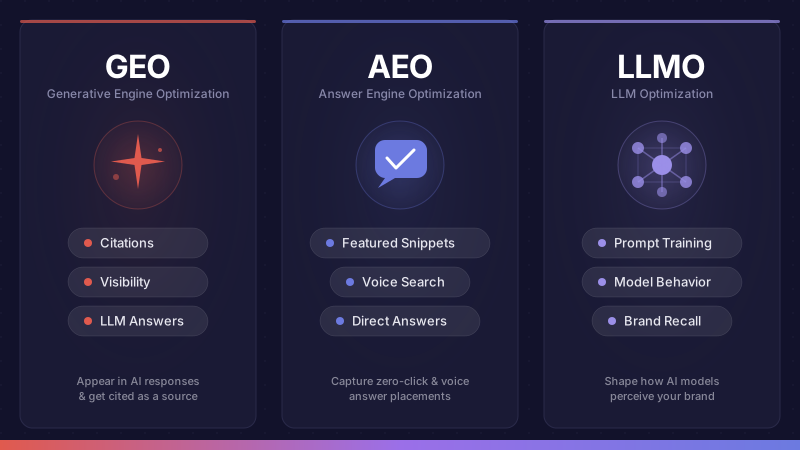
GEO, AEO, and LLMO all describe the same core challenge - getting your content cited, recommended, or surfaced by AI systems - but they differ in scope, origin, and the specific surfaces they target. GEO (Generative Engine Optimization) covers AI-native engines broadly, AEO (Answer Engine Optimization) focuses on Google's answer surfaces, and LLMO (Large Language Model Optimization) addresses how LLMs represent your brand in their parametric knowledge. The terms overlap significantly, which is exactly why the confusion persists.
The Acronym Explosion in AI Search
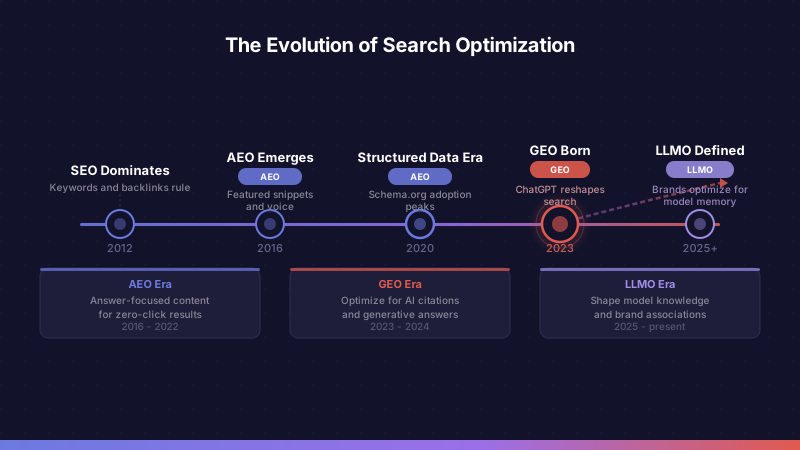
When Google introduced featured snippets around 2014, marketers needed a word for the practice of optimizing to win the "position zero" box. AEO emerged as that shorthand. For years it was niche - useful, but a subset of broader SEO practice.
Then came the generative shift. ChatGPT launched in late 2022 and crossed 100 million users in two months. Perplexity, Gemini, Claude, and Copilot followed. Suddenly there were entire search experiences happening outside of Google entirely, powered by large language models that retrieved, synthesized, and cited content in real time.
That transition created a vocabulary problem. "SEO" felt too narrow. "AEO" was too Google-centric. Researchers and practitioners began coining new terms, and three stuck: GEO, AEO, and LLMO. Each emerged from a slightly different community - academic, practitioner, and technical - and each carries slightly different connotations.
Understanding the distinctions is not just a semantics exercise. The term you use signals which surfaces you are targeting, which tactics you will prioritize, and which metrics matter. Conflating them leads to misaligned strategy and wasted effort.
What is GEO (Generative Engine Optimization)?
GEO stands for Generative Engine Optimization. The term was formally introduced in a September 2024 paper by researchers at Princeton, Georgia Tech, and IIT Delhi titled "GEO: Generative Engine Optimization." The paper defined GEO as "the process of optimizing content for AI-powered search engines that generate responses by synthesizing information from multiple sources."
The researchers were studying a specific phenomenon: when a generative engine like Perplexity or ChatGPT with Browse produces a summary answer, which sources does it cite, and why? Their experiments tested nine content modification strategies - adding statistics, quotes, citations, fluency improvements, and authoritative framing - and measured which caused sources to appear more frequently in AI-generated results.
For a deeper treatment of the academic foundations, see What is Generative Engine Optimization? The Complete 2026 Guide.
What GEO optimizes for:
- Citation frequency in AI-generated responses
- Mention visibility (named as a source even without a hyperlink)
- Ranked position when a response lists multiple sources
- Brand sentiment within AI-generated summaries
Target engines and surfaces:
- ChatGPT (Browse/Search mode, GPT-4o web)
- Perplexity AI (all models)
- Google Gemini (with grounding/web search enabled)
- Anthropic Claude (with web search tool)
- Microsoft Copilot
- Any generative engine that retrieves and synthesizes external content
Who uses GEO: Digital marketers, content strategists, SEO leads at mid-to-large companies, SaaS founders tracking brand visibility in AI tools, and agencies that have expanded beyond traditional search. GEO is the most academically grounded of the three terms and is increasingly used in B2B and SaaS contexts where the audience is technically sophisticated.
What is AEO (Answer Engine Optimization)?
AEO stands for Answer Engine Optimization. Unlike GEO, AEO does not trace back to a single academic paper. It emerged organically from SEO practitioner communities around 2014 to 2016, when Google began prominently surfacing direct answers - featured snippets, knowledge panels, and "People Also Ask" boxes - instead of just ranking blue links.
The core insight behind AEO was simple: if Google's goal is to answer questions without requiring a click, then content should be structured to be the answer, not just a result. This meant writing in clear Q&A format, using structured data markup like FAQ schema and HowTo schema, targeting question-phrased keywords, and earning featured snippet positions.
When Google launched AI Overviews (formerly Search Generative Experience) in 2024, AEO expanded its scope. AI Overviews synthesize information from multiple sources directly in Google Search - making them a generative surface, but one owned entirely by Google. AEO practitioners refocused heavily on winning placements in AI Overviews, which still felt like a natural extension of their featured snippet work.
What AEO optimizes for:
- Google Featured Snippets (position zero)
- AI Overviews (Google's generative search results)
- People Also Ask boxes
- Knowledge Panel mentions
- Voice search answers (which draw heavily from the above)
Target engines and surfaces: Primarily Google. Some practitioners extend AEO to Bing's Copilot, since Bing powers the underlying web results Microsoft Copilot retrieves. But AEO is fundamentally a Google-centric discipline.
Who uses AEO: Traditional SEOs expanding into AI search, content marketers focused on Google traffic, local businesses targeting voice search, and enterprises with significant Google Organic revenue who cannot afford to ignore Google's shifting SERP layouts.
What is LLMO (Large Language Model Optimization)?
LLMO stands for Large Language Model Optimization. It is the newest of the three acronyms and the least standardized. You will encounter it primarily in technical and developer-adjacent communities, used to describe the practice of optimizing how large language models represent a brand or concept in their parametric knowledge - the information baked into the model weights during training, not retrieved at inference time.
This is a meaningful distinction. When you ask ChatGPT about a well-known brand with no web search enabled, the model draws on what it learned during training. LLMO focuses on influencing that representation: making sure your product is described accurately, that you are cited in high-quality training-eligible sources, and that the model has enough signal to answer questions about you confidently.
The debate about whether LLMO is distinct:
Many practitioners use LLMO and GEO interchangeably, which creates confusion. There is a reasonable argument that LLMO is a subset or a complementary discipline to GEO. GEO focuses on retrieval-augmented generation (RAG) surfaces where the engine fetches content at runtime. LLMO focuses on training data influence and parametric representation.
In practice, the tactics overlap substantially. Publishing authoritative, factual content on high-domain-authority sites helps both. Getting cited in Wikipedia, authoritative news outlets, and documentation that training datasets tend to include is both good LLMO practice and strong foundational GEO work.
What LLMO optimizes for:
- Accurate model representation in parametric knowledge
- Mentions in training-eligible sources (Wikipedia, major publications, academic papers)
- Confidence and depth of model knowledge about your brand
- Correct association of your brand with relevant categories and use cases
Who uses LLMO: Technical marketers, developer relations teams, AI-native startups focused on LLM benchmark inclusion, and researchers studying how models represent entities.
GEO vs AEO vs LLMO: Side-by-Side Comparison
| Dimension | **GEO** | **AEO** | **LLMO** |
|---|---|---|---|
| Full name | Generative Engine Optimization | Answer Engine Optimization | Large Language Model Optimization |
| Origin | Princeton paper, Sep 2024 | SEO practitioner community, ~2014-2016 | Technical/developer community, 2023-present |
| What it optimizes for | Citations and mentions in AI-generated responses | Direct answers in Google's answer surfaces | Model's parametric knowledge and entity representation |
| Primary surfaces | ChatGPT, Perplexity, Gemini, Claude, Copilot | Google AI Overviews, Featured Snippets, PAA, voice | LLM training data, model weights (offline) |
| Core tactics | Authoritative structure, statistics, schema, citations, direct answers | FAQ schema, HowTo schema, Q&A formatting, featured snippet targeting | High-authority placements, Wikipedia presence, factual consistency across the web |
| Retrieval type | Real-time RAG (retrieval-augmented generation) | Real-time retrieval (Google index) | Training time (offline) |
| Measurable in real time? | Yes - citation tracking, mention monitoring | Yes - rank tracking, AI Overview monitoring | Partially - entity presence checks, model queries |
| Who uses it | Marketers, SEOs, SaaS founders, agencies | Traditional SEOs, content teams, Google-focused orgs | Technical marketers, devrel, AI-native brands |
| Key metric | Citation rate, mention frequency, sentiment | Featured snippet win rate, AI Overview inclusion | Entity accuracy, model confidence, training source coverage |
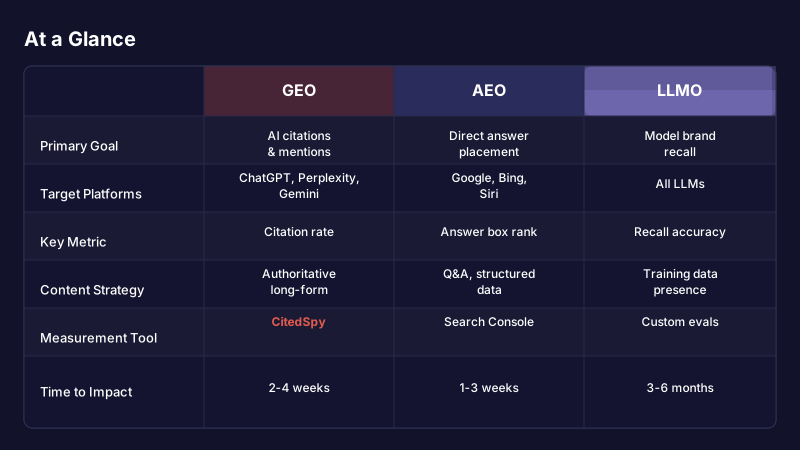
The table makes the distinctions concrete. GEO and AEO are both real-time retrieval disciplines but target different engines and surfaces. LLMO operates at a fundamentally different layer - training data rather than inference - which is why some practitioners treat it as a separate concern entirely.
Where They Overlap
The honest answer is that the three disciplines share more DNA than they differ.
All three are downstream of content quality. Whether you want to win a Google featured snippet, get cited by Perplexity, or be accurately represented in GPT-4o's parametric knowledge, the path runs through the same fundamentals: factual accuracy, clear structure, authoritative sourcing, and direct answers to real questions.
All three reward schema markup and structured data. FAQPage, HowTo, Article, and BreadcrumbList schemas help Google parse content for AI Overviews (AEO), appear as structured citations in generative engines (GEO), and signal credibility to training datasets (LLMO).
All three penalize the same failure modes. Thin content, vague claims, missing sources, poor readability, and slow page speed hurt you across every surface. There is no version of the AI search landscape where these are acceptable trade-offs.
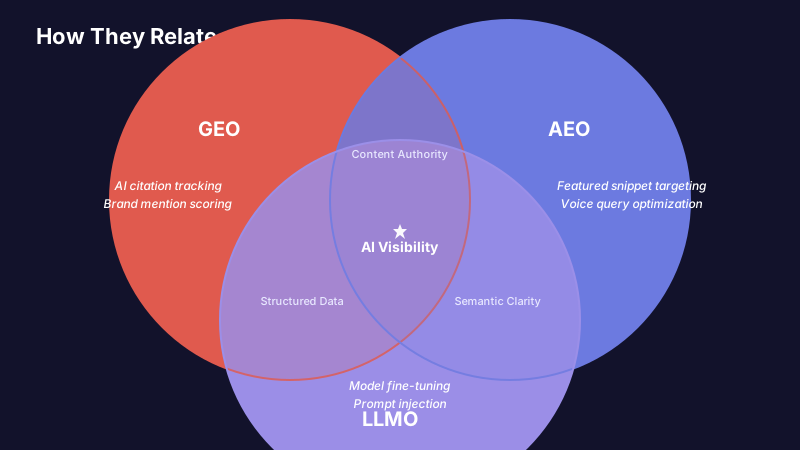
The important nuance is that strong GEO practice typically covers AEO as a byproduct. If your content is structured to be cited by Perplexity's real-time RAG system, it is almost certainly structured well enough to win Google featured snippets too. The reverse is less reliable - AEO-optimized content does not automatically transfer to non-Google generative engines, which have different citation behaviors and ranking signals.
For a direct comparison of priorities, GEO vs SEO: Which Should You Prioritize in 2026? walks through the decision framework.
Which Term Should You Use?
Use GEO when talking to a technically sophisticated audience about AI-native search engines - ChatGPT, Perplexity, Claude, Gemini - and when you want the academically grounded framing. It is the most precise term for the retrieval-augmented generation surface and has the most research backing.
Use AEO when talking to traditional SEO teams or clients who are Google-first and care deeply about AI Overviews and featured snippets. AEO is the most familiar term in those communities and creates the least translation overhead.
Use LLMO when talking to technical audiences about model training, entity representation, or AI benchmark inclusion. It is the right term when you are distinguishing parametric knowledge from real-time retrieval.
In practice, most modern strategy documents use GEO as the umbrella term and treat AEO and LLMO as specific sub-disciplines or surface-specific applications within it. This is the framing most B2B SaaS and growth-oriented marketing teams have converged on as of mid-2026.
When in doubt: if your audience is board-level or general business, say "AI search optimization." If your audience is marketing practitioners, say "GEO." Reserve AEO and LLMO for conversations where the distinction actually matters.
How to Track Progress Across All Three
Tracking GEO, AEO, and LLMO requires different measurement approaches because they operate on different surfaces and timescales.
For GEO (real-time AI engine citations): Run your target queries across ChatGPT, Perplexity, Gemini, Claude, and Copilot on a regular cadence. Record whether your brand or domain is cited, where in the response it appears, and the sentiment of surrounding context. This is labor-intensive to do manually across five engines for dozens of prompts. CitedSpy automates this - running your tracked prompts across all major AI engines, detecting mentions and citations, and alerting you when your visibility shifts. Understanding how each engine surfaces citations is critical; see How Perplexity Citations Work (And How to Earn Them) for a detailed breakdown of one engine's mechanics.
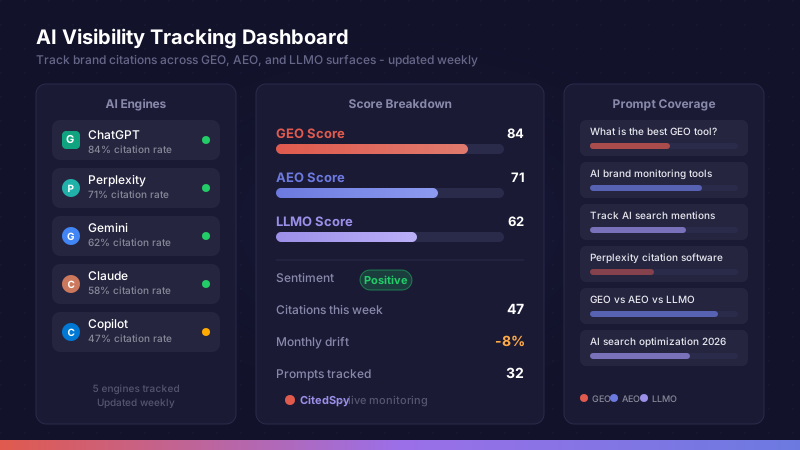
For AEO (Google answer surfaces): Use Google Search Console to monitor impressions and clicks from featured snippet and AI Overview positions. Third-party rank trackers that now flag AI Overview appearances (SEMrush, Ahrefs, Moz) are useful supplementary tools. Track the specific question-format queries where you win or lose answer boxes.
For LLMO (parametric knowledge): Run structured entity-check queries directly against major LLMs with web search disabled. Ask "What is [brand]?", "What does [brand] do?", "Who are the main competitors of [brand]?" and evaluate the accuracy, confidence, and completeness of responses. Audit your presence on Wikipedia, major industry publications, and authoritative databases that training datasets commonly include.
The meta-point is that you need baseline measurements before you can show improvement. Pick a set of 20 to 50 target prompts representative of how your audience searches, establish your starting citation rate, and measure monthly. Chasing AI visibility without measurement is marketing theater.
Frequently Asked Questions
The Bottom Line
GEO, AEO, and LLMO are three lenses on the same underlying shift: AI systems are becoming the primary interface between people and information, and your content either shows up in that interface or it does not. The terms differ in their original context, target surfaces, and the layer of the AI stack they address. But they share a common foundation - authoritative, structured, factual content that answers real questions directly.
The practical guidance is simple: use GEO as your north star if you are building for AI-native search, AEO if Google is your primary channel, and LLMO if you care about how models represent your brand in their training knowledge. In most cases you will end up doing all three, because the tactics reinforce each other and the content you create to win in one surface tends to perform well across the others. Build the foundation right, measure consistently, and the acronym you choose matters far less than the execution behind it.