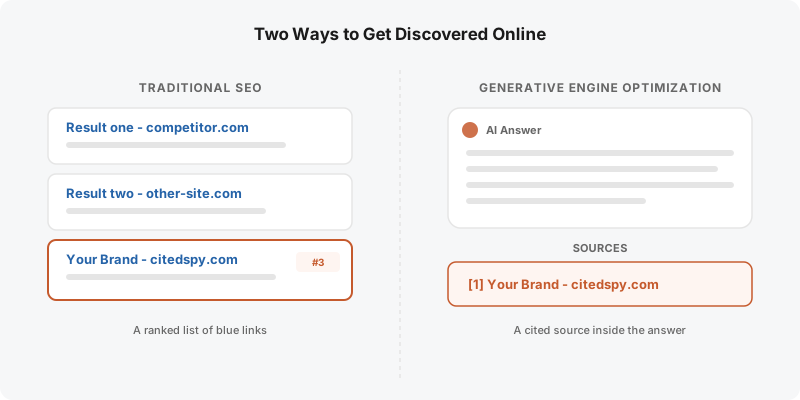
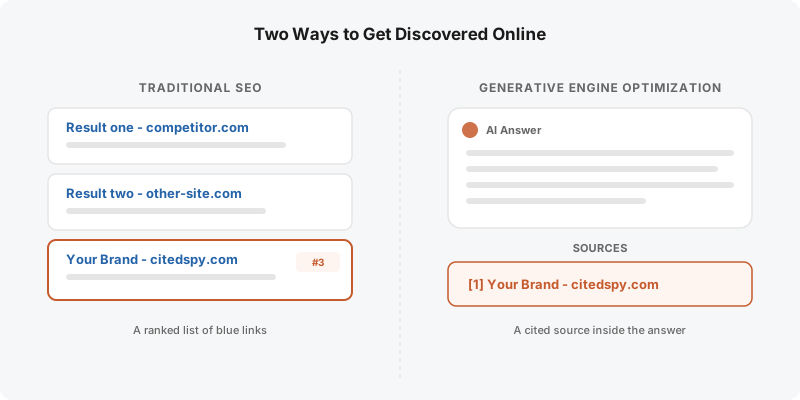
GEO and SEO target different discovery channels - traditional search rankings versus AI-generated answers. Both matter in 2026, and both reward the same underlying asset: authoritative, well-structured content. The question is not which to do, but how to sequence and balance them given your stage and budget.
Why This Question Matters Now
The shift toward AI search is real, and the conversion economics make it concrete. Semrush's June 2025 research by Kyle Byers and Rachel Handley found that AI search visitors convert at 4.4 times the rate of traditional organic visitors across more than 500 high-value marketing topics.
That single number is why the GEO vs SEO debate has moved from theory to budget meetings. But traditional SEO still drives enormous query volume that AI search has not displaced. Most buyers still start in Google for transactional and navigational queries.
So the honest framing is not GEO vs SEO as a winner-take-all contest. They are two complementary channels with different optimization tactics, different measurement, and different time-to-results. The teams that win in 2026 treat AI search vs traditional SEO as parallel investments, not a migration from one to the other.
What is SEO? (A Quick Refresher)
SEO is the practice of optimizing your site so it ranks in traditional search results on Google and Bing. The goal is a high position in the list of blue links, earned through keyword relevance, backlink authority, technical health, and content quality.
You already know this discipline. What has changed is that SEO is now the foundation layer beneath a newer one. For the GEO definition that builds on top of it, see our complete GEO guide.
What is GEO?
GEO, or Generative Engine Optimization, is the practice of optimizing content so AI engines - ChatGPT, Perplexity, Gemini, Claude, and Copilot - cite and recommend your brand inside their generated answers. Instead of earning a ranked link, you earn a citation within the AI response itself.
This is the core of the GEO vs SEO distinction: SEO wins you a position in a list, GEO wins you inclusion in an answer. For the full breakdown, read our Generative Engine Optimization guide.
GEO vs SEO: Core Differences
When you put the two channels side by side, the contrasts are sharp. Here is how GEO vs SEO breaks down across the dimensions that affect strategy:
| Dimension | SEO | GEO |
|---|---|---|
| Goal | Rank in Google/Bing results | Get cited in AI-generated answers |
| Primary channel | Search engines (Google, Bing) | AI engines (ChatGPT, Perplexity, Gemini, Claude, Copilot) |
| Content structure | Keyword-optimized, comprehensive | Answer-first, statistically dense |
| Traffic behavior | Broad query volume | Smaller volume, 4.4x conversion rate |
| Citation volatility | Rankings change slowly | 40-59% of citations change monthly |
| Measurement | Rankings, clicks, CTR, DA | Citation rate, share of voice, sentiment, drift |
| Time to results | 3-12 months | 30-90 days for initial citations |
| Content format | Long-form keyword pages | Conversational Q&A format |
The pattern that emerges from this table is that GEO is faster but more volatile, while SEO is slower but more stable. AI search vs traditional SEO is a tradeoff between speed and durability, not a choice between good and bad.
The Shared Foundation
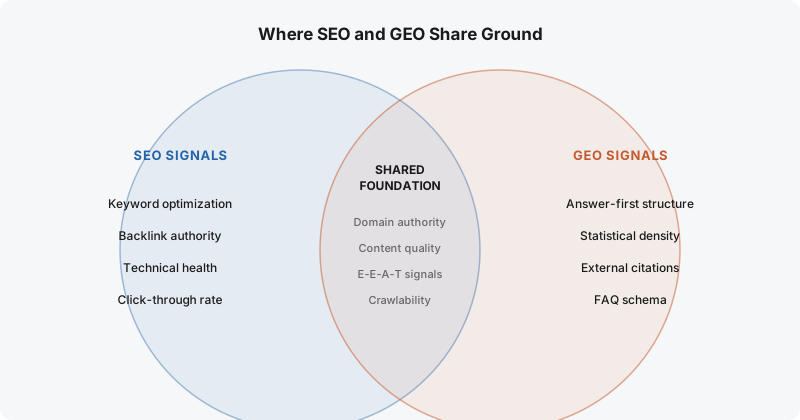
Here is the part that resolves most of the GEO vs SEO anxiety: the two channels share more than they differ. Domain authority, crawlability, content quality, and E-E-A-T signals all help both. The Venn diagram above is mostly overlap.
In our experience, AI engines frequently cite content that already ranks well in traditional search. The retrieval step in most AI engines leans on the same authority signals that SEO has rewarded for years - backlinks, domain trust, technical health. A page that Google considers authoritative is a page an AI engine is more likely to pull into its answer.
That means GEO is best understood as a layer built on top of SEO, not a replacement for it. You do not tear down your SEO program to build GEO. You extend it. The content that earns rankings is the same content that, with the right structure, earns AI citations.
This is why framing the decision as AI citations vs search rankings misses the point. The same authoritative asset can earn both. The work you have already done on domain authority and content quality is not wasted - it is the prerequisite that makes GEO possible at all.
How GEO Content Differs from SEO Content
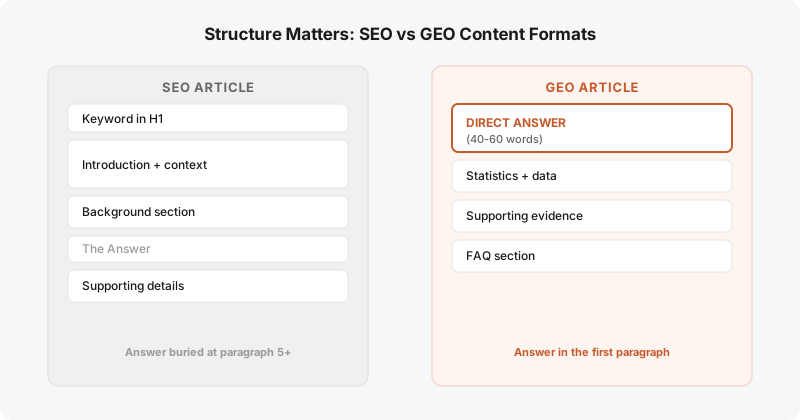
The shared foundation does not mean the content is identical. The structural differences between GEO and SEO content are real, and they are where most of the practical work lives.
Answer-first structure. Traditional SEO content builds toward the answer through an introduction, background, and context. GEO content inverts this. You open with a direct, complete answer in the first 40 to 60 words, then expand. AI engines quote that opening passage, so burying the answer at paragraph five is a GEO mistake even when it is an acceptable SEO habit.
Statistical density. Adding statistics improves AI citation rates by 41%, according to Aggarwal et al. (Princeton and Georgia Tech, ACM KDD 2024). Citing external authoritative sources can lift citation rates by up to 115% for lower-ranked content. Vague claims do not get cited; specific, attributed data points do.
Conversational, longer queries. Semrush's February 2025 research by Luke Harsel, Anna Yudina, and Aleksandr Drozdov found that ChatGPT prompts average 23 words versus 4.2 words for traditional search. People ask AI engines full questions, so GEO content should be structured as answers to specific, natural-language questions.
FAQ schema. Question-and-answer formatting maps directly to how AI engines generate responses. For the tactical detail on earning citations in specific engines, see our ChatGPT citations guide.
The 4.4x Conversion Advantage
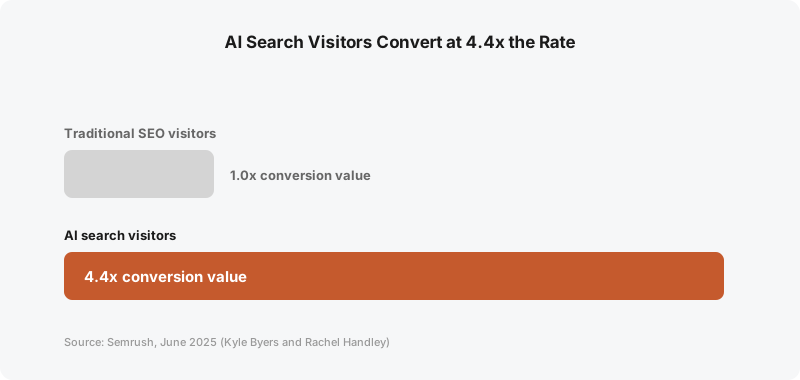
The most important thing to understand about AI search vs traditional SEO is that it is a quality-over-quantity trade. AI search sends less traffic, but that traffic converts far better. Semrush's 4.4x figure reframes the entire ROI calculation.
Why do AI visitors convert so much better? Because the AI pre-qualifies them. When someone asks ChatGPT "which GEO tracking tool should I use?" and gets a named recommendation, they arrive at your site already persuaded. The consideration work happened inside the conversation.
This is the mechanic that makes AI citations vs search rankings a misleading comparison by raw volume. One AI citation can outperform many SEO clicks in conversion terms. A brand that earns consistent citations holds a structural advantage even with a smaller click count, because each click is closer to a buying decision.
For high-LTV businesses, this changes the math entirely. If your average customer is worth thousands of dollars, a channel that delivers pre-qualified buyers at a 4.4x conversion rate deserves serious investment, even though it will never show up as a huge number in your traffic dashboard.
Citation Volatility: The Hidden GEO Cost
There is a real cost to GEO that SEO does not carry to the same degree, and it shapes the "how much should I invest" decision. AI citations are volatile. Profound AI's July 2025 study by Josh Blyskal and Sartaj Rajpal measured monthly citation drift at 54.1% for ChatGPT, 59.3% for Google AI Overviews, and 40.5% for Perplexity.
More than half of AI citations change within a single month on the largest engines. That means GEO is not a one-time project. It requires ongoing publishing and monitoring to maintain and grow visibility, the same way SEO requires ongoing link building and content updates - but on a faster cycle.
This volatility is the key factor when you decide how aggressively to fund GEO. A channel that resets monthly needs a steady content cadence behind it, not a single campaign. Budget for the maintenance, not just the launch.
When to Prioritize SEO First
Not every brand should lead with GEO. If your foundation is weak, fixing it comes first, because AI engines lean on the same authority signals that SEO builds. Prioritize SEO first when:
- Your site is less than one year old
- Your Domain Authority is under 20
- You have fewer than 20 keyword rankings
- Your budget is limited and you can only fund one channel well
In these cases, the overlay does not have a foundation to sit on. AI engines frequently cite content that already ranks, so a brand-new site with no domain authority should build the SEO base first - quality content, backlinks, technical health - before layering GEO-specific tactics on top.
The one exception: answer-first structure and statistical density cost nothing extra to implement from day one. Build those habits in even while SEO is your primary focus.
When to Push GEO Harder
On the other side, some brands are leaving money on the table by under-investing in GEO. Push GEO harder when:
- Your site is two or more years old with an established domain
- Your Domain Authority is over 30
- You run an active content program already
- Your customers have high lifetime value
- You sell B2B SaaS or services where buyers research through AI engines early
For B2B and SaaS especially, AI citations reach buyers at the research stage, before any sales conversation. If your existing SEO baseline is solid, the marginal return on GEO is high because you already have the authority that AI engines reward. This is exactly where AI citations vs search rankings stops being a tradeoff and becomes additive.
Running Both in Parallel: A Realistic Framework
The smartest play in the GEO vs SEO debate is to stop treating it as a choice. Content that ranks in traditional search AND gets cited in AI answers is the single most efficient investment you can make, because one piece of work serves two channels.
Here is the realistic framework we recommend:
- One content calendar, dual optimization. Do not run separate GEO and SEO content programs. Write each piece to rank and to be cited.
- Answer-first by default. Opening with a direct answer does not hurt SEO and materially helps GEO. There is no tradeoff to manage here.
- Statistical density everywhere. Specific, attributed data points improve citation rates and strengthen content quality signals for both channels.
- Schema markup once. FAQPage and Article schema help AI engines parse your content and help search engines surface rich results.
- Measure separately. The channels share inputs but produce different outputs, so track them with different metrics.
The reason this works is that the overlap between GEO and SEO signals is large. You are not splitting your effort in half. You are adding a thin layer of structural discipline - answer-first writing, inline statistics, schema - on top of content you were going to produce anyway. That is the highest-leverage move available in AI search vs traditional SEO.
Measuring GEO and SEO Together
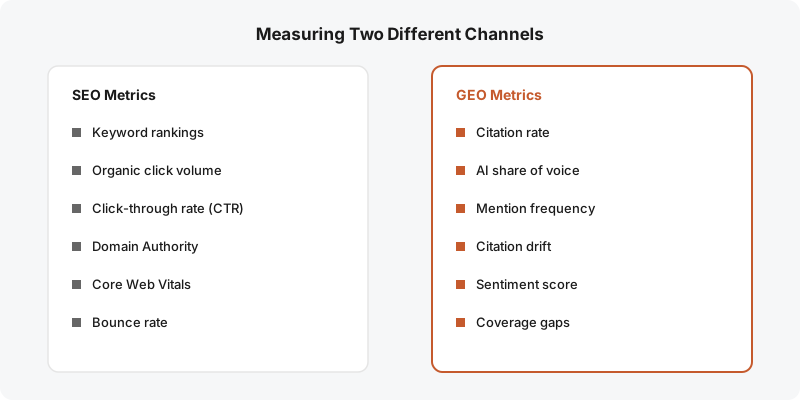
You cannot manage what you do not measure, and GEO and SEO need different instruments. For SEO, you track rankings, organic clicks, click-through rate, and Domain Authority. For GEO, you track citation rate, AI share of voice, mention frequency, sentiment, and citation drift.
The trap is measuring only the SEO side because that is what your existing tools report. AI citations vs search rankings are different signals, and a strong SEO dashboard tells you nothing about whether ChatGPT is recommending your competitor.
Tools like CitedSpy automate the GEO measurement side - tracking citation rate and share of voice across all five major AI engines on a weekly basis, so you can see both channels moving in the same reporting cycle. When your SEO rankings and your AI citations are on the same dashboard, the GEO vs SEO question stops being abstract and becomes a set of numbers you can act on.
Frequently Asked Questions
The Bottom Line
GEO vs SEO is not an either/or decision. SEO is the foundation that earns the authority AI engines reward. GEO is the new layer that turns that authority into citations inside AI answers. The smartest play is content that ranks AND gets cited - one body of work, two channels, dual optimization. Whatever your stage, the move is the same: build the SEO foundation, layer GEO structure on top, and start measuring both. The brands that treat GEO vs SEO as complementary, not competing, are the ones that will own AI search vs traditional SEO in 2026.