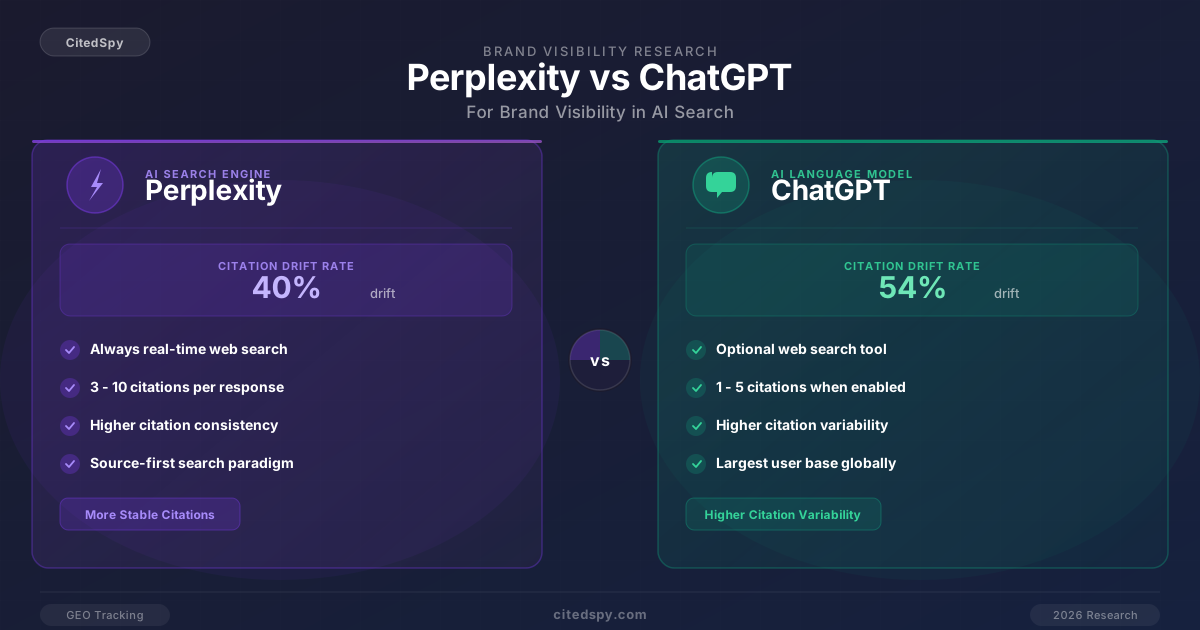
If you are running the same prompt through ChatGPT and Perplexity and getting different brand results, you are not doing something wrong. You are observing the most important structural difference in AI search today. These two engines retrieve information, select sources, and decide which brands to name through fundamentally different mechanisms - and that means a single GEO strategy cannot optimise for both simultaneously.
This matters more than most marketers realise. A brand can rank consistently in Perplexity's citations while being entirely absent from ChatGPT's responses to the same query - and vice versa. The gap is not random. It is predictable, and once you understand it, you can close it deliberately.
This article breaks down exactly how Perplexity and ChatGPT differ for brand visibility: how each engine retrieves and cites sources, how stable those citations are over time, what signals each engine uses to select which brands to mention, and what concrete optimisation tactics work for each.
Why Perplexity and ChatGPT Behave Differently for Brands
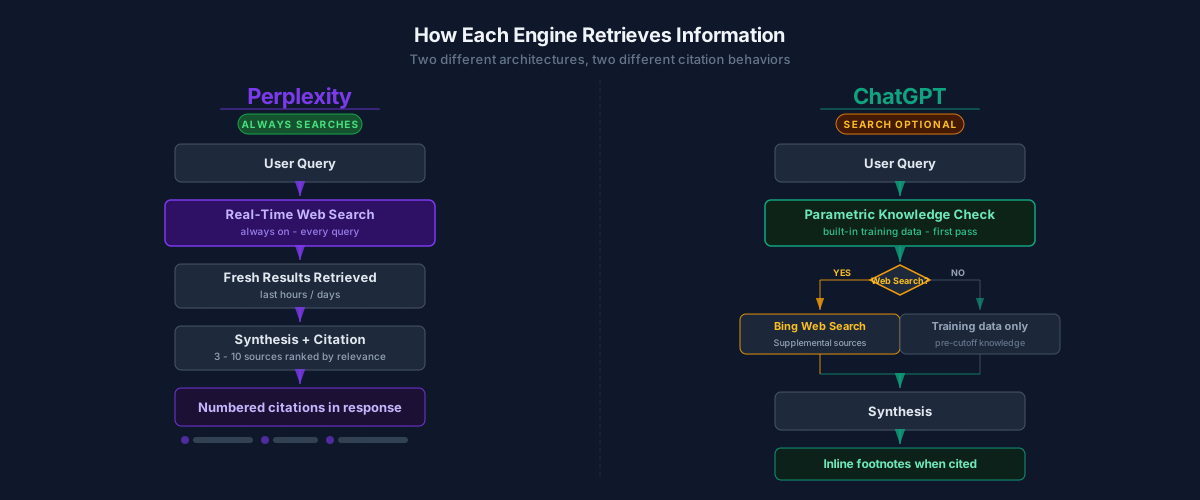
The root of every downstream difference is architecture.
Perplexity is a retrieval-first engine. Every query triggers a live web search before the model generates a response. There is no version of Perplexity that answers from memory alone. This means that Perplexity's knowledge of your brand is, at all times, a reflection of what is currently published and indexable on the web. If your site went down last week, Perplexity knows. If you published a product update yesterday, Perplexity can cite it today.
ChatGPT operates from a large parametric knowledge base - a snapshot of the web baked into the model during training - with web search as an optional layer that can be toggled on or off. For many use cases, web search is off by default. When it is disabled, ChatGPT answers entirely from what it learned during training. Brands that are well-represented in that training data get mentioned. Brands that are not simply do not exist in that context, regardless of how strong their current web presence is.
This creates two distinct visibility problems. For Perplexity, the question is: *can your content be found and ranked highly enough to be retrieved in real time?* For ChatGPT, there are actually two questions: *are you in the training data, and can you get cited when web search is on?*
How Each Engine Cites Sources
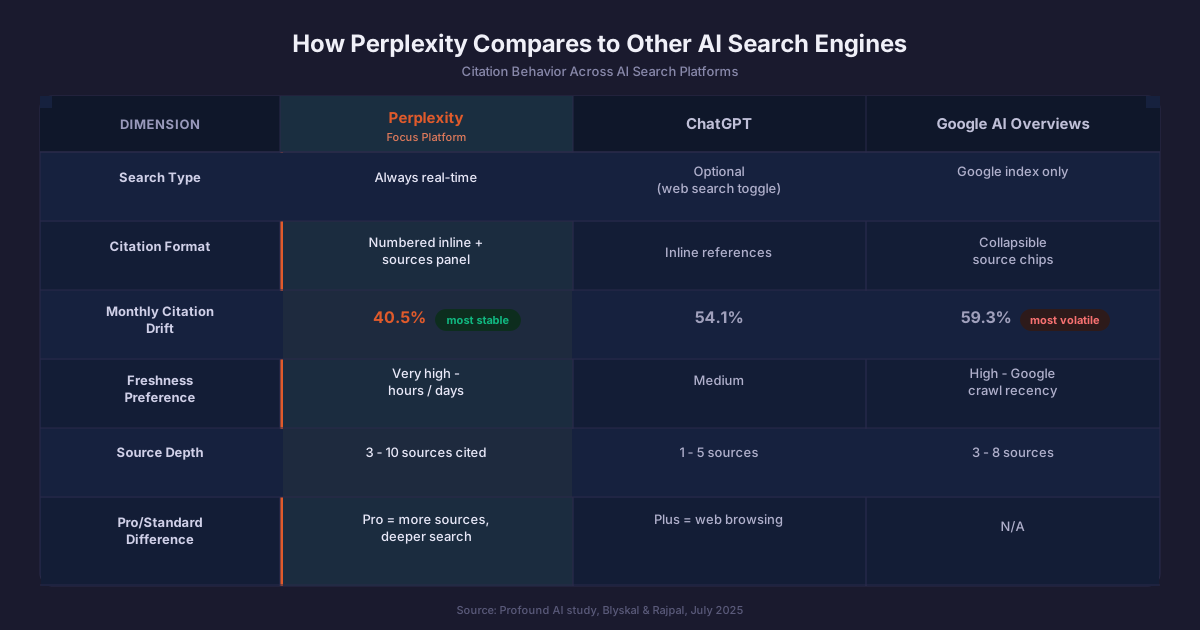
The citation interfaces are different in ways that affect both user behaviour and brand visibility.
Perplexity shows numbered inline citations tied to a persistent sources panel on the right side of every response. A typical Perplexity answer cites 3 to 10 sources, with the sources panel giving each URL its own visible entry alongside the domain name and page title. Users regularly scan and click this panel. Getting cited in Perplexity means your domain name appears in a visible, clickable list alongside every response - a form of brand exposure that exists regardless of whether your brand is mentioned by name in the answer itself.
ChatGPT uses inline superscripts and footnotes when web search is active. Citation volume is lower - typically 1 to 5 sources per response. The footnote list is collapsed by default and fewer users expand it. Brand exposure from a ChatGPT citation is therefore less visible to the reader than a Perplexity citation, even when the underlying URL is the same. Read How ChatGPT Citations Work and How Perplexity Citations Work for a deeper technical breakdown of each.
What this means practically: Perplexity citations carry more passive brand impressions per response because the sources panel is always visible. ChatGPT citations have lower exposure per instance but may carry stronger intent signals when users do click through, since expanding footnotes suggests deliberate engagement.
Citation Stability: The Volatility Gap
One of the most underappreciated differences between these two engines is how stable their citations are over time.
Citation drift measures how often a given URL drops out of an engine's response set from one month to the next, holding the query constant. Perplexity shows approximately 40% monthly citation drift - meaning roughly 60% of citations on a given query persist from month to month. ChatGPT shows approximately 54% monthly citation drift, meaning nearly half of all citations turn over within a single month.
This has direct implications for how you interpret your tracking data.
A Perplexity citation that appears consistently for three months is a meaningful signal that your content has earned a stable retrieval position for that query. A ChatGPT citation that appears this month and disappears next month may reflect web search retrieving different results on different days, or model behaviour variance, rather than a genuine change in your brand's authority.
For brand monitoring, Perplexity is the more reliable leading indicator. Its citations are more stable, more directly tied to retrievable web content, and less subject to the parametric noise that ChatGPT introduces when web search is disabled. This does not mean ChatGPT is less important - it means you need a longer observation window to extract meaningful signal from ChatGPT citation data.
| Signal | Perplexity | ChatGPT |
|---|---|---|
| Monthly citation drift | ~40% | ~54% |
| Citation stability (3-month window) | Higher | Lower |
| Monitoring signal reliability | Strong leading indicator | Requires longer window |
| Noise from parametric knowledge | None (always retrieves) | Present when web search off |
What Each Engine Looks for When Selecting Sources
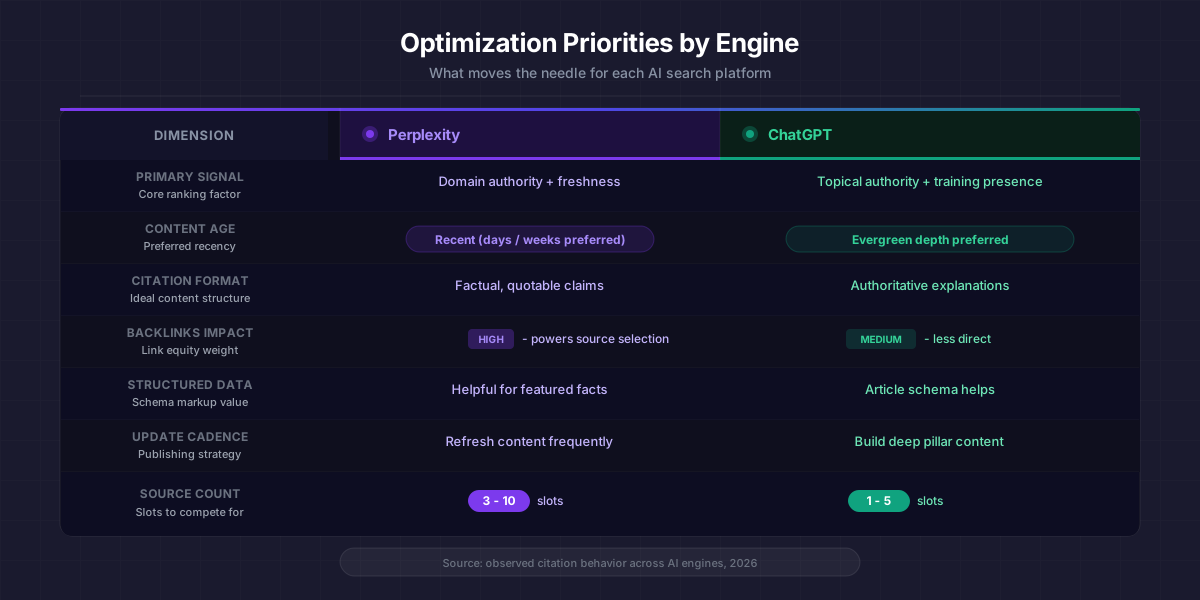
Perplexity's Source Selection Signals
Perplexity's retrieval is explicitly SEO-adjacent. Because it runs a live web search before generating each response, it uses many of the same authority signals that determine Google rankings - and the overlap is strong enough that good traditional SEO practice translates directly.
- Domain authority and backlink profile - high-authority domains with strong link equity get retrieved more reliably
- Freshness - Perplexity weights recently updated content, particularly for fast-moving topics like AI tools and software categories
- Topical relevance and keyword match - content that directly addresses the query terms in clear, structured language ranks higher in retrieval
- Page structure - headers, bullets, and clearly labelled sections help Perplexity extract specific answers from longer content
- Direct answers near the top - Perplexity favours pages that answer the query in the first two paragraphs rather than burying the answer
- Schema markup and structured data - FAQ schema, How-To schema, and Product schema all provide signals that improve retrieval probability
ChatGPT's Source Selection Signals
ChatGPT's brand visibility operates on two distinct tracks depending on whether web search is enabled.
Without web search:
- Training data presence - brands that were heavily cited, discussed, or reviewed on the web before the model's knowledge cutoff are embedded in the parametric knowledge base
- Entity recognition - ChatGPT is better at naming brands it has strong entity associations with, regardless of the specific query
- Topical authority in training data - brands associated with clear problem-solution patterns in training data get recommended in relevant contexts
With web search enabled:
- Source credibility signals - ChatGPT tends to favour authoritative publications and well-linked domains
- Answer directness - clear, structured content that directly addresses the user's question gets selected over dense or ambiguous content
- Named entity density - content that names the brand prominently and consistently within relevant context is more likely to trigger brand attribution
| Factor | Perplexity | ChatGPT (web off) | ChatGPT (web on) |
|---|---|---|---|
| Primary retrieval mechanism | Live web search | Parametric memory | Live web search |
| Domain authority weight | High | N/A | Moderate |
| Content freshness | High | N/A | Moderate |
| Training data presence | Irrelevant | Critical | Supplementary |
| Schema markup | Helpful | N/A | Helpful |
| Entity recognition | Moderate | High | High |
Brand Mention Patterns: Where Each Engine Names Brands
How each engine handles different query types produces very different brand mention distributions.
Comparison queries ("Perplexity vs ChatGPT", "HubSpot vs Salesforce for SMBs") are where the structural difference is most visible. Perplexity retrieves the most-linked comparison content published recently and synthesises it - brands that have strong comparison pages or are frequently compared in third-party reviews get pulled. ChatGPT draws on its parametric knowledge of widely-known comparisons and may supplement with web search. The practical effect: newer brands with strong comparison content can beat older brands in Perplexity but remain absent in ChatGPT's web-off responses.
Recommendation queries ("best tool for X", "what should I use for Y") are ChatGPT's home territory when web search is off. ChatGPT has strong parametric associations between problem categories and established brands. Perplexity retrieves recommendation roundups and review content from high-authority sites - which means brands with consistent G2, Capterra, or TrustRadius coverage have a significant advantage.
Problem-solution queries ("how do I track brand mentions in AI engines", "why is my brand not showing up in ChatGPT") show the largest divergence. Perplexity retrieves the most relevant published guides and tutorials. ChatGPT generates answers from training knowledge and may not surface specific brands unless they have strong parametric associations with the solution category. This is where brands with deep educational content win in Perplexity but may be invisible in ChatGPT.
The consistent finding from AI Brand Monitoring analysis: a brand can appear in 8 out of 10 Perplexity responses for a query while appearing in 2 out of 10 ChatGPT responses for the same query, because the retrieval mechanisms are entirely different. Measuring only one engine gives you an incomplete - and often misleading - picture.
How to Optimise for Perplexity
Because Perplexity is retrieval-first, optimising for it is the most direct extension of content SEO you can do.
- Build domain authority aggressively. Perplexity's retrieval is heavily correlated with backlink equity. Guest posts on authoritative industry publications, digital PR, and getting cited in roundups all directly improve Perplexity citation rates. This is not a metaphor - it is the same mechanism as Google ranking.
- Publish fresh, dated content. Perplexity weights freshness, especially in competitive or fast-moving categories. A guide published in June 2026 will outrank an otherwise identical guide from 2024 for many queries. Update your most important pages quarterly and add a visible updated date.
- Structure pages for direct retrieval. Lead with the answer in the first paragraph. Use clear H2 and H3 headers that echo likely query phrases. Perplexity's extraction logic pulls passages, not whole pages - make your most important statements self-contained.
- Get listed in comparison and review content. Third-party roundups on high-authority sites are some of the most reliably retrieved content types in Perplexity. Prioritise getting on lists like "best [category] tools" on sites with strong domain authority.
- Add FAQ schema. Structured FAQ markup gives Perplexity explicit question-answer pairs to extract. This is particularly effective for informational and comparison queries.
- Write explicitly for comparison queries. Pages titled "[Your Brand] vs [Competitor]" or "[Your Brand] vs [Competitor] vs [Competitor]" get retrieved frequently when users ask comparison questions. Write them honestly and let the content do the selling.
- Monitor citation patterns with specific queries. Run a defined set of queries against Perplexity on a fixed schedule. GEO Prompt Library frameworks apply directly here. Without consistent query tracking, you cannot tell whether your content changes are improving retrieval.
How to Optimise for ChatGPT
ChatGPT optimisation requires a two-track approach because the engine operates in two modes.
- Build training-data-like authority. The brands that appear in ChatGPT without web search are the brands that were discussed, reviewed, cited, and referenced extensively on the web before the model's training cutoff. For newer brands, this means generating as many high-quality mentions as possible now - because the next model version's training data is being assembled continuously.
- Get covered by trusted publications. ChatGPT with web search enabled heavily favours authoritative sources. A single in-depth feature in a credible trade publication can improve ChatGPT brand recall for relevant queries more than dozens of lower-authority mentions.
- Create definitive problem-solution content. ChatGPT rewards topical authority. A 3,000-word guide that thoroughly answers a specific problem creates a stronger topical association than ten 500-word posts on adjacent topics.
- Use consistent entity signals. Ensure your brand name, product names, and category associations appear consistently and clearly across your site. ChatGPT's entity recognition depends on clear, repeated association between your brand and the problem it solves.
- Optimise for natural language, not keywords. ChatGPT reads content the way a sophisticated human reader does. Dense keyword repetition does not help. Write for clarity and completeness.
- Make brand comparisons available and accessible. When web search is active, ChatGPT retrieves comparison content. Write dedicated comparison pages, respond to competitor-comparison questions on your blog, and contribute to third-party comparison discussions.
- Track web-search-on and web-search-off separately. These are functionally different channels. What works for one will not always transfer to the other. Read How ChatGPT Citations Work for a more detailed breakdown of the web-enabled retrieval logic.
Which Engine to Prioritise First
For most teams building a GEO practice from scratch, start with Perplexity monitoring.
The reasons are practical. Perplexity's citations are directly tied to indexable web content, which means the feedback loop is shorter - you publish or improve content, you see citation changes within days or weeks, not months. Perplexity's citation patterns are more stable, so your monitoring data is less noisy. And Perplexity's source selection signals overlap substantially with what you are likely already doing for SEO, so you can build on existing infrastructure rather than starting from zero.
ChatGPT is not less important - in raw query volume, it is the larger engine. But ChatGPT's parametric knowledge layer means that some of its brand citation patterns are inherited from training data you cannot change, and the feedback loop for measuring the effect of content changes is genuinely longer. For most teams, ChatGPT optimisation is a second-stage effort: you build Perplexity presence first, which also generates the authority signals (backlinks, third-party mentions, review coverage) that feed into ChatGPT's web search retrieval and future training data ingestion.
If your brand is already well-established with strong training-data presence in ChatGPT, the calculus shifts. In that case, Perplexity and ChatGPT can be worked in parallel from the start, since you have a baseline to maintain in ChatGPT while building Perplexity coverage.
The broader principle from AI Share of Voice analysis: never assume that performance in one engine predicts performance in the other. They are different retrieval systems with different data sources and different selection criteria. A strong position in Perplexity is a genuine competitive advantage in AI search - and it is entirely separate from your ChatGPT visibility.
Tracking Both Engines Without Manual Effort
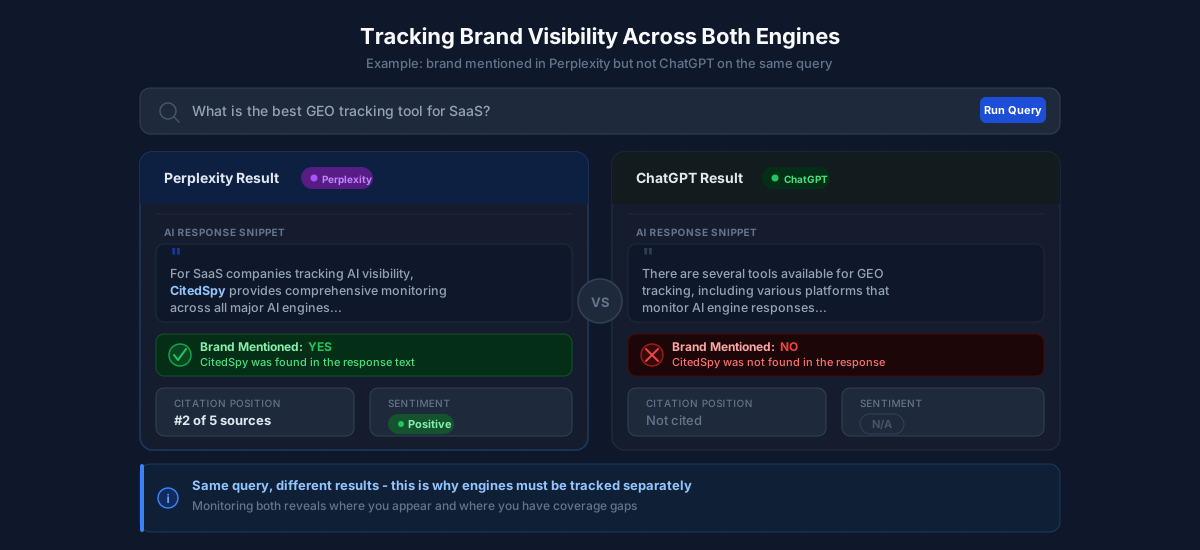
The challenge with monitoring Perplexity and ChatGPT in parallel is operational. If you are running the same set of prompts across both engines manually - copying queries, pasting results, comparing outputs - you are spending hours every week on a process that cannot scale. And because citation patterns drift (40% per month in Perplexity, 54% in ChatGPT), weekly checks are not enough. You need consistent, scheduled execution across a defined prompt library to see patterns rather than snapshots.
This is where CitedSpy fits in: it runs your prompt library across Perplexity, ChatGPT, Gemini, Claude, and Copilot on an automated schedule, tracks citation patterns over time, and shows you where your brand is appearing, being cited, or going missing - across all engines in a single view. The AI Brand Monitoring guide covers how to structure this kind of multi-engine monitoring programme.
The operational point is simple: you cannot optimise what you are not consistently measuring. Perplexity and ChatGPT need to be treated as separate channels with separate tracking, separate content strategies, and separate performance metrics - but managed together so that patterns across engines inform each other.
Frequently Asked Questions
Perplexity and ChatGPT are not interchangeable tools that happen to use AI. They are structurally different retrieval systems with different data sources, different citation mechanics, and different brand visibility logic. Treating them as a single channel - or worse, optimising for one and assuming the other follows - leaves measurable brand visibility on the table.
The good news is that the optimisation strategies for each, while distinct, are not contradictory. Building authoritative, well-structured content earns Perplexity citations and generates the training-data signals that build ChatGPT parametric recall. Getting covered by credible third-party publications improves both. The work compounds.
What does not compound is manual tracking. Start by building a consistent monitoring practice across both engines, establish your baselines, and then optimise - so that every content decision you make is grounded in real citation data rather than guesswork.
*Start your free CitedSpy trial to see your brand's visibility across Perplexity, ChatGPT, and three other AI engines in a single dashboard.*