
Your brand might be invisible to the fastest-growing segment of high-intent buyers - and traditional monitoring tools will never tell you. As AI engines like ChatGPT, Perplexity, Gemini, Microsoft Copilot, and Claude become the first stop for product research, purchasing decisions are being made before anyone visits your website. If an AI engine doesn't mention your brand when a prospect asks the right question, you simply don't exist to them. That is the gap AI brand monitoring is built to close.
The numbers make the business case hard to ignore: AI search visitors convert at 4.4x the rate of traditional organic search visitors, and over 40-54% of AI citations change month to month. This is a volatile, high-stakes channel - and it requires a new category of tool to track it.

What Is AI Brand Monitoring?
AI brand monitoring is the practice of systematically tracking how your brand is mentioned, recommended, cited, and perceived across AI-powered engines - specifically ChatGPT, Perplexity, Gemini, Microsoft Copilot, Claude, and emerging AI search surfaces like Google AI Overviews.
Unlike traditional brand monitoring, which crawls the open web for articles, social posts, and press mentions, AI brand monitoring works by querying AI engines directly with the questions your customers are already asking. It captures what those engines say in response - whether your brand appears, what context surrounds the mention, which pages are cited, and how your presence compares to competitors.
At its core, AI brand monitoring tracks five things:
- Whether AI engines recommend your brand when users ask relevant questions
- Which specific pages AI engines cite when they mention your brand
- How AI engines describe your brand - the sentiment, accuracy, and framing of every mention
- How your AI brand presence compares to competitors across the same query set
- How your AI citation patterns change over time - because what's true today may not be true next month
What AI brand monitoring does not track is traditional web mentions, social media posts, news articles, or search rankings. Those are important signals, but they belong to a different category. AI brand monitoring lives in the space between your content and the AI engine's output - a space that is increasingly shaping purchase decisions.
Why AI Brand Monitoring Matters Now
The rise of AI-assisted research has created a new category of buyer behavior. Prospects no longer rely exclusively on a Google search and a few website visits. They ask ChatGPT "what's the best tool for tracking brand mentions in AI?" or prompt Perplexity to compare their shortlist. The AI engine synthesizes an answer - and the brands it includes in that answer get outsized consideration.
> AI search visitors convert at 4.4x the rate of traditional organic search visitors (Semrush research, June 2025). These are not casual browsers - they are decision-ready buyers.
The traffic volume from AI engines is still growing, but conversion quality is already exceptional. A brand that appears in AI answers is reaching prospects who have framed a specific question, received a synthesized recommendation, and are ready to act on it. That is a fundamentally different intent signal than a Google search result.
The volatility of AI citations adds another layer of urgency. Research from Profound AI (July 2025) found that citation rates change dramatically month over month: Copilot shifts 53.4% of its citations monthly, ChatGPT shifts 54.1%, and Perplexity shifts 40.5%. This means a brand that was cited across a query set in January may be largely absent by March - through no fault of their own and with no warning from traditional monitoring tools.
> More than half of AI citations change every single month. One-time audits are snapshots. Without ongoing monitoring, you're flying blind.
The Conductor 2026 AEO/GEO Benchmarks Report adds another data point worth noting: blog content is the most cited page type in AI responses. This has direct implications for content strategy - the pages you invest in building can drive AI citation rates, but only if you're measuring which content is actually being picked up.
There is also the "dark traffic" problem. When AI engines recommend a brand and a user then navigates directly to that brand's website, the visit often appears as direct traffic in analytics platforms. Without AI brand monitoring, that traffic is invisible at its source - meaning brands are undervaluing an entire acquisition channel.
AI Brand Monitoring vs. Traditional Brand Monitoring
The two categories solve different problems and should be used together, not interchangeably. Here is a direct comparison:
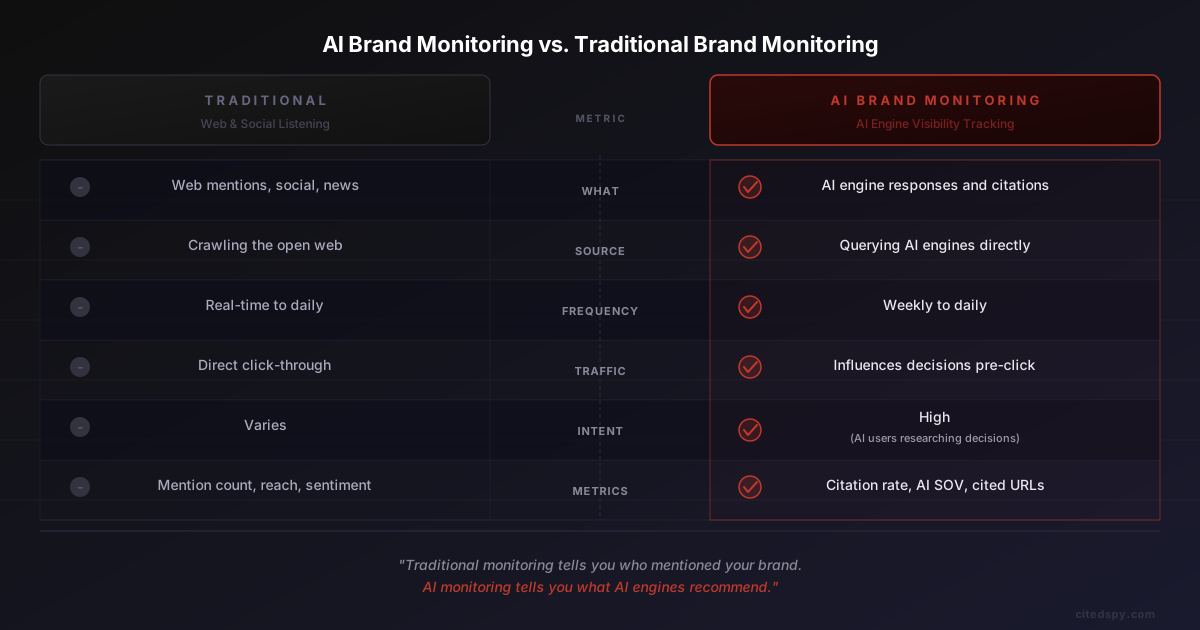
| Factor | Traditional Brand Monitoring | AI Brand Monitoring |
|---|---|---|
| What is tracked | Web mentions, social media, news, reviews | AI engine responses and citations |
| Data source | Crawling the open web | Querying AI engines directly |
| Update frequency | Real-time to daily | Weekly to daily |
| Traffic impact | Direct - user clicks through from the mention | Indirect - AI shapes decisions before the click |
| Intent signal | Varies widely by source and context | High - AI users are actively researching decisions |
| Tools | Mention, Brand24, Google Alerts, Brandwatch | CitedSpy, specialized GEO tools |
| Metrics | Mention count, reach, sentiment score | Citation rate, AI SOV, cited URLs, citation drift |
The key distinction is where buying decisions happen. Traditional brand monitoring tells you what people are saying about your brand after they have found it. AI brand monitoring tells you whether AI engines are surfacing your brand during the research phase - before a prospect has visited your website or made contact.
Both matter. But if you are only doing traditional monitoring, you have a significant blind spot.
What to Monitor: The 6 Core Metrics
Effective AI brand monitoring is built around six core metrics. Together, they give you a complete picture of your AI brand presence.
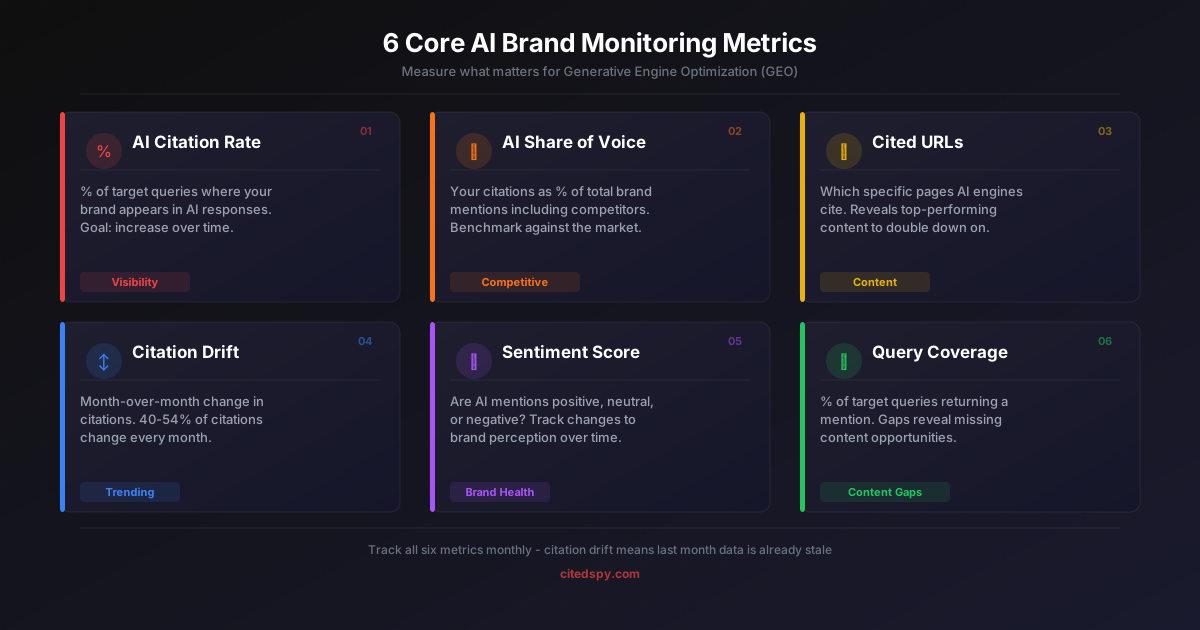
- Citation Rate - The percentage of your target queries where your brand is mentioned by an AI engine. If you track 100 queries and your brand appears in 23 responses, your citation rate is 23%. This is the headline number - the single most important indicator of your AI brand presence.
- Citation URLs - Which specific pages on your website AI engines are citing when they mention your brand. This reveals which content is driving AI visibility and which is being ignored. High citation concentration on one or two pages is a risk signal - if those pages change or get de-indexed, your AI presence drops immediately.
- AI Share of Voice (AI SOV) - How often your brand appears in AI responses relative to your competitors across the same query set. If AI engines mention your brand in 23 responses and a competitor in 41 out of the same 100 queries, your AI SOV is approximately 36%. This is one of the most strategically useful metrics because it puts your performance in context. Learn more about AI share of voice and how to calculate it.
- Sentiment and Context - The framing of every mention matters. Is your brand recommended as a top choice, mentioned as a secondary option, noted with a caveat, or cited in a negative context? Sentiment monitoring catches accuracy problems (AI engines making incorrect claims about your product), brand safety issues, and shifts in how you are being positioned relative to competitors.
- Citation Drift - The month-over-month change in which queries trigger a mention and which URLs are cited. Given 40-54% monthly drift rates, drift monitoring is not optional. A sudden drop in citation rate, a shift in which pages are being cited, or a competitor appearing in queries where they previously did not - these are all drift signals that require a response.
- Query Coverage - The percentage of your target query set that returns at least one brand mention. Queries with no mention are direct content opportunities. If you are not appearing in "best [your category] tools" queries, that is a gap with a known fix: content that directly addresses that question.
How to Set Up AI Brand Monitoring: A 5-Step Process
Setting up AI brand monitoring for the first time does not require a large technical investment, but it does require a deliberate process. Here is the framework.
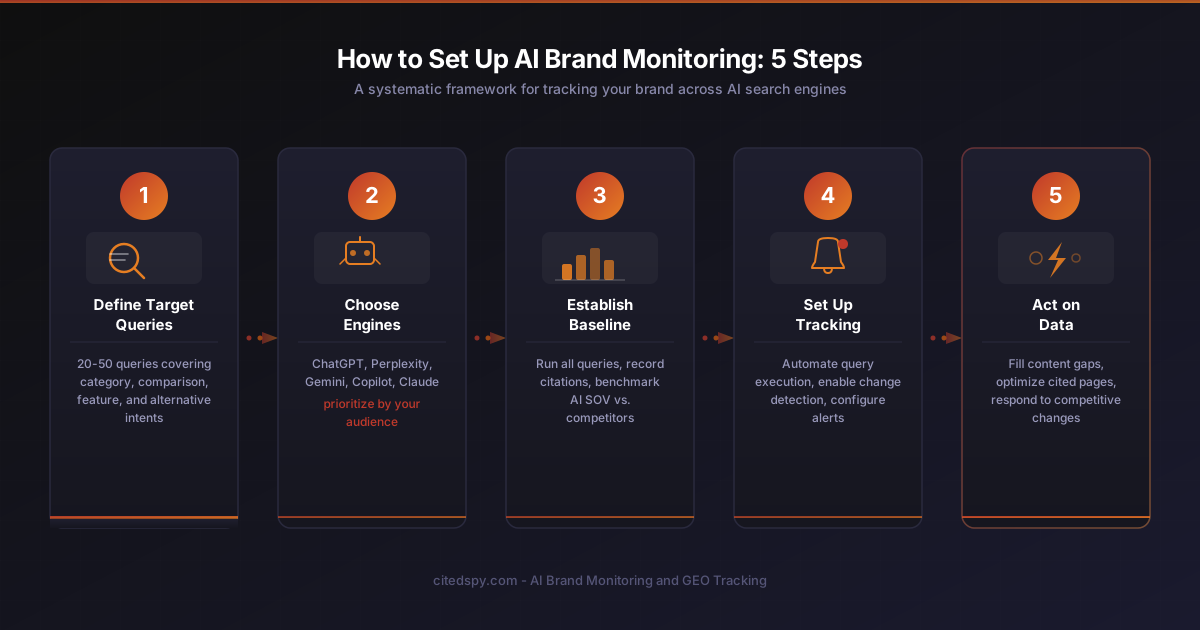
1. Define Your Target Queries
Start by building a list of 20-50 queries that represent how your ideal customers search for solutions in your category. Cover four query types:
- *Category/problem queries*: "how to track AI brand mentions," "what is GEO for brands"
- *Comparison queries*: "best AI brand monitoring tools," "ChatGPT vs Perplexity for research"
- *Feature queries*: "tool that monitors Perplexity citations," "AI engine citation tracker"
- *Competitor alternative queries*: "alternatives to [competitor name]"
The more precisely your query set mirrors real buyer research behavior, the more useful your monitoring data will be. Do not limit yourself to branded queries - the highest-value monitoring happens on category-level queries where you should be appearing but may not be.
2. Select the AI Engines to Monitor
Not all engines matter equally for every brand. A practical priority order for most B2B SaaS brands:
- ChatGPT - largest user base, highest awareness
- Perplexity - highest citation frequency, strong power-user and researcher audience
- Google AI Overviews - directly tied to search traffic impact (see our Google AI Overviews guide)
- Microsoft Copilot - enterprise-skewed audience, high-value decision makers (see how Copilot citations work)
- Claude - growing rapidly, especially among developers, analysts, and technical buyers
Each engine has distinct citation behavior. Perplexity tends to cite more URLs per response. ChatGPT's citation patterns have shifted significantly since the move to the Responses API. Perplexity's citation logic and Gemini's grounding behavior differ in meaningful ways. Monitoring all five gives you full coverage; monitoring two or three still gives you directionally accurate data.
3. Establish a Baseline
Run your full query set across your selected engines before making any content changes. Record:
- Which queries trigger a brand mention
- Which specific URLs are cited for each mention
- How competitors are positioned in the same responses
- The sentiment and context of every mention
This baseline is your benchmark. Without it, you cannot measure the impact of content you create or optimize. A GEO audit is a structured way to run this baseline if you want a systematic starting framework.
4. Set Up Ongoing Tracking
A one-time baseline is a snapshot. Given that 40-54% of citations change monthly, ongoing tracking is where the real value accumulates. Effective ongoing monitoring requires:
- Automated query execution across all engines on a defined schedule (weekly is the standard for most brands)
- Change detection - flagging new citations, lost citations, and shifts in cited URLs
- Competitor tracking on the same query set so you can see relative movement
- Alerts for significant changes: a drop in citation rate over 10%, a competitor gaining on a key query cluster, a new URL suddenly getting cited
Manual monitoring cannot realistically sustain this at scale. For more than 20 queries across more than two engines, the time investment becomes prohibitive within weeks.
5. Act on the Data
AI brand monitoring data is only valuable if it connects to action. The most common actions:
- Content gaps: Queries with no brand mention signal content that needs to be created. A competitor is likely appearing in those responses. Create content that directly addresses the query, and optimize it for AI readability.
- Content optimization: Pages that are already cited are working. Study what they have in common. Pages that should be cited but are not - your best product pages, key comparison content - may need structural changes to be more citable.
- Technical fixes: Sometimes the right page exists but is not being cited. Check whether it is crawlable, whether its metadata is clear, and whether it is structured in a way that makes it easy for AI engines to extract and cite.
- Competitive response: When a competitor gains AI visibility on a query cluster where you have historically appeared, that is an early warning signal. Respond with content investment before the gap widens.
Manual vs. Automated AI Brand Monitoring
Both approaches have a role. The question is which is appropriate given your query volume, engine coverage requirements, and tolerance for time investment.
Manual monitoring is free and requires no setup. You can run queries directly in ChatGPT, Perplexity, Gemini, and Copilot, record what you see, and build a picture of your AI brand presence. For initial audits, exploratory research, and brands with fewer than 20 queries across two engines, manual monitoring is entirely reasonable.
The limitations emerge quickly. Manual monitoring cannot detect drift without historical comparison - you would need to re-run every query at the same frequency, in the same engines, and compare results by hand. At 30 queries across 5 engines, that is 150 individual checks per monitoring cycle. At weekly cadence, that is 600 manual queries per month. The time cost alone makes it impractical for anyone running monitoring as a recurring practice rather than a one-time project.
Automated monitoring tools like CitedSpy run your query set across all major engines on a defined schedule, track citation patterns over time, and surface changes automatically. The advantages:
- Systematic query execution removes human variability and recency bias
- Historical tracking enables drift detection without manual comparison
- Competitor tracking at scale (monitoring 3-5 competitors across 50 queries manually is functionally impossible)
- Alerts surface changes before they become significant problems
- Reporting aggregates data across engines and time periods into actionable signals

For most brands that take AI brand visibility seriously, the choice is not really manual vs. automated - it is "when does manual stop being enough?" That threshold tends to be around 20 queries across 3 or more engines, or any situation where weekly monitoring is required. Beyond that threshold, automation is not a luxury; it is a practical requirement.
How AI Brand Monitoring Differs from SEO Rank Tracking
If you are used to SEO rank tracking, AI brand monitoring will feel familiar in some ways and completely foreign in others. Understanding the differences helps you set the right expectations and avoid applying the wrong mental model.
In traditional SEO rank tracking, you monitor position in a numbered list. Position 1 through 10 on a search results page is a well-defined concept. You know where you are relative to competitors. You can track movement with precision.
AI brand monitoring works differently:
- There is no "position 1." AI engines synthesize a response. Your brand is either mentioned or it is not. The framing within that mention matters enormously - being cited as a recommended solution is categorically different from being mentioned as a comparison point or a caveat.
- The AI writes its own description of your brand. In search, your title tag and meta description shape how you appear. In AI responses, the engine constructs its own language about your brand based on what it has learned from training data and retrieved sources. Monitoring what that language says is a core part of AI brand monitoring.
- Context and competitor co-occurrence matter. In AI responses, your brand often appears in the same sentence as competitors. Whether you are mentioned first, recommended more strongly, or positioned favorably relative to alternatives is a signal that rank tracking cannot capture.
- Drift is a primary metric, not a secondary one. SEO rank tracking assumes relative stability - positions move, but rarely dramatically month over month. In AI brand monitoring, 40-54% monthly citation drift means that tracking change over time is as important as tracking current state. A brand that was cited across 70% of its target queries last month may be at 40% this month with no clear external cause.
- Content is cited, not ranked. When an AI engine references your brand, it often cites the specific page that informed its response. Understanding which pages are getting cited - and which are not - is a form of signal that has no direct equivalent in SEO rank tracking.
For more on how these two disciplines fit together, see our guide to generative engine optimization.
Frequently Asked Questions
Conclusion
AI brand monitoring is not a replacement for traditional brand monitoring or SEO - it is a third discipline that covers the channel those tools cannot see. As AI engines become a primary research interface for high-intent buyers, your presence in AI responses is increasingly a prerequisite for being considered at all.
The good news is that this is a measurable, manageable channel. The six core metrics - citation rate, cited URLs, AI SOV, sentiment, citation drift, and query coverage - give you a complete picture of where you stand. The five-step setup process makes it possible to go from zero to a functioning monitoring program in a matter of hours. And the data connects directly to content action, making it one of the few marketing channels where the gap between measurement and response is short.
The brands that build this practice now - before AI brand monitoring becomes standard - will have a meaningful head start. The citation drift data tells us that AI presence is not static; it requires active management. But it also tells us that the landscape shifts constantly, which means competitors who have AI visibility today can lose it, and brands that invest now can gain it.
Start with a baseline. Track the right queries. Act on the gaps. That is the complete practice of AI brand monitoring.
*Ready to start tracking your brand across ChatGPT, Perplexity, Gemini, Copilot, and Claude? Start your free CitedSpy trial and have your first baseline report in minutes.*