Google AI Overviews select sources primarily from content that already ranks in the top-10 organic results for a query, filtered through Google's E-E-A-T quality signals and structured data. Unlike Perplexity, which crawls live, AI Overviews draw from Google's existing index - meaning traditional SEO is the foundation, not a replacement, for AI visibility.
What Are Google AI Overviews?
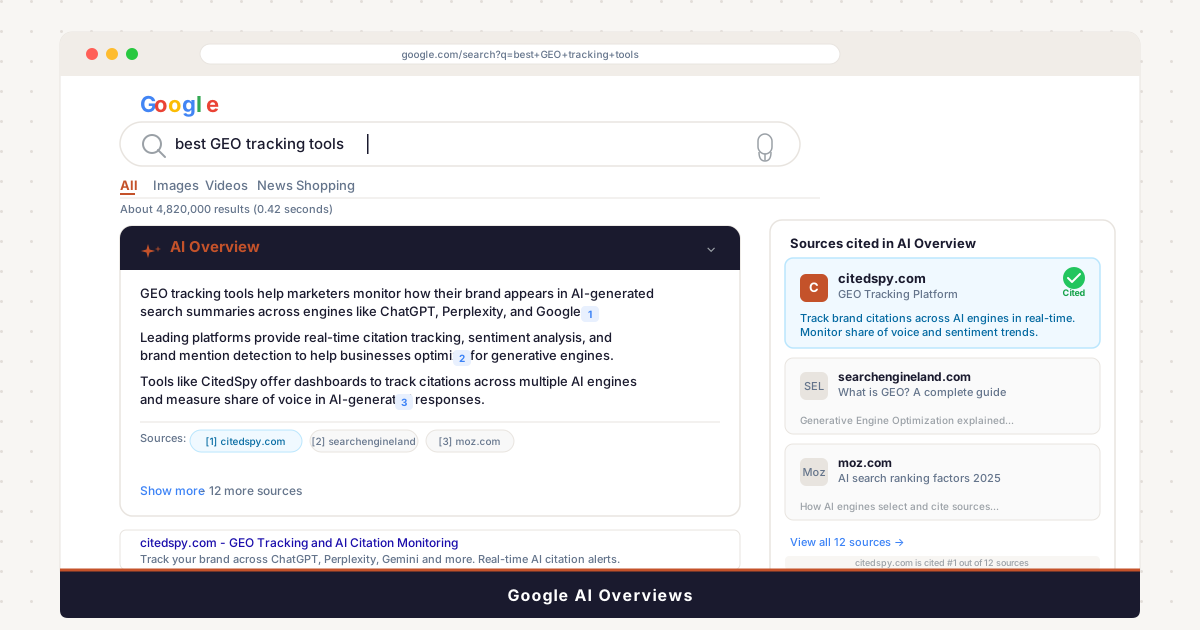
Google AI Overviews launched in May 2024, replacing the earlier Search Generative Experience (SGE) experiment. Powered by Gemini, they appear as AI-generated summaries at the very top of search results pages - above the blue links, above ads, above everything.
The product has expanded aggressively. AI Overviews now appear for roughly 12-15% of all queries, with a heavy skew toward research and informational intent. If someone is searching "how to," "what is," or "best way to," there is a reasonable chance they encounter an AI Overview before they ever see an organic result.
This is a meaningfully different engine from ChatGPT or Perplexity. It is Google - the company that controls roughly 90% of global search volume - wrapping its existing index in a generative interface. That distinction changes the optimization strategy entirely.
If you are building a generative engine optimization strategy, Google AI Overviews deserves its own dedicated playbook.
How AI Overviews Select Their Sources
The most important thing to understand: AI Overviews do not crawl the web in real time. They draw from Google's existing index, which means content that Google has already discovered, crawled, indexed, and ranked. Live content freshness matters less here than it does for how Perplexity citations work.
The crawler that serves AI Overviews and the broader Gemini ecosystem is Google-Extended. This is a separate crawler identity from Googlebot, and some sites have inadvertently blocked it via aggressive CDN or robots.txt rules. Roughly 27% of B2B SaaS sites block AI crawlers through CDN settings, according to research from ziptie.dev - often without realizing it.
Source selection follows a hierarchy:
- Top-10 organic ranking content is the primary pool. If your content does not rank for the query, it is unlikely to appear in the Overview.
- E-E-A-T signals - Experience, Expertise, Authoritativeness, Trustworthiness - are Google's primary quality framework. Thin content, low-authority domains, and pages with no clear authorship are filtered out.
- Structured data provides machine-readable signals that help Gemini parse and extract specific answers from your content.
- Content format matters. The Princeton GEO paper (Aggarwal et al., ACM KDD 2024) found that pages containing statistics had a +41% citation rate in AI search results, and external citations boosted lower-ranked sites by +115%.
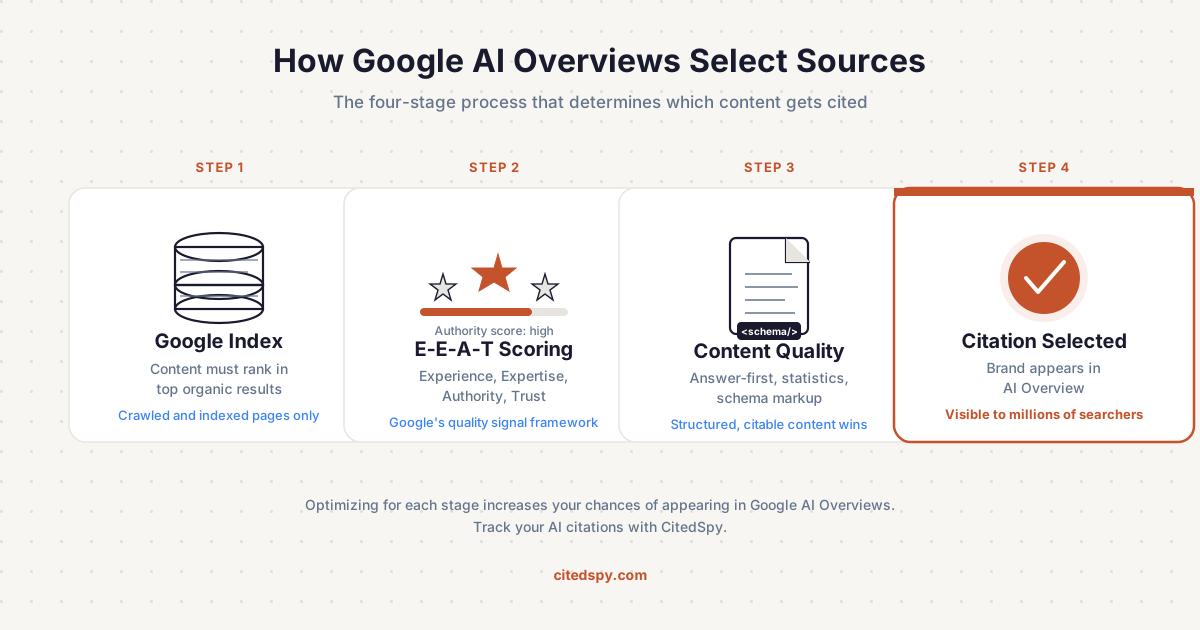
Understanding this selection mechanism is what separates brands that appear consistently from brands that appear occasionally. And consistency is harder than it sounds: AI Overviews sources shift with 59.3% monthly citation drift, the highest of any AI engine tracked (Profound AI, Josh Blyskal and Sartaj Rajpal, July 2025). What gets cited in June may not get cited in July, even if your rankings hold.
Why Your Brand Needs AI Overviews Visibility
The business case is not theoretical. AI search visitors convert at 4.4x the rate of traditional search visitors (Semrush, Kyle Byers and Rachel Handley, June 2025). The person who reads an AI Overview and clicks a cited source is higher-intent than the average organic search visitor.
This matters particularly because AI search users ask more complex questions. The average ChatGPT query is 23 words versus 4.2 words for traditional search (Semrush, Luke Harsel et al., February 2025). While that stat is specific to ChatGPT, the trend holds across AI search interfaces - these are not navigational queries. They are research queries from buyers deep in consideration.
If your brand is not cited in AI Overviews for your category's key research queries, you are invisible at the most expensive moment in the buyer journey. And given the drift rates above, you cannot assume a single win is permanent. Visibility requires active monitoring.
To understand how this compares to other AI engines, the GEO vs SEO breakdown covers what changes and what stays the same across the full landscape.
How to Optimize for Google AI Overviews
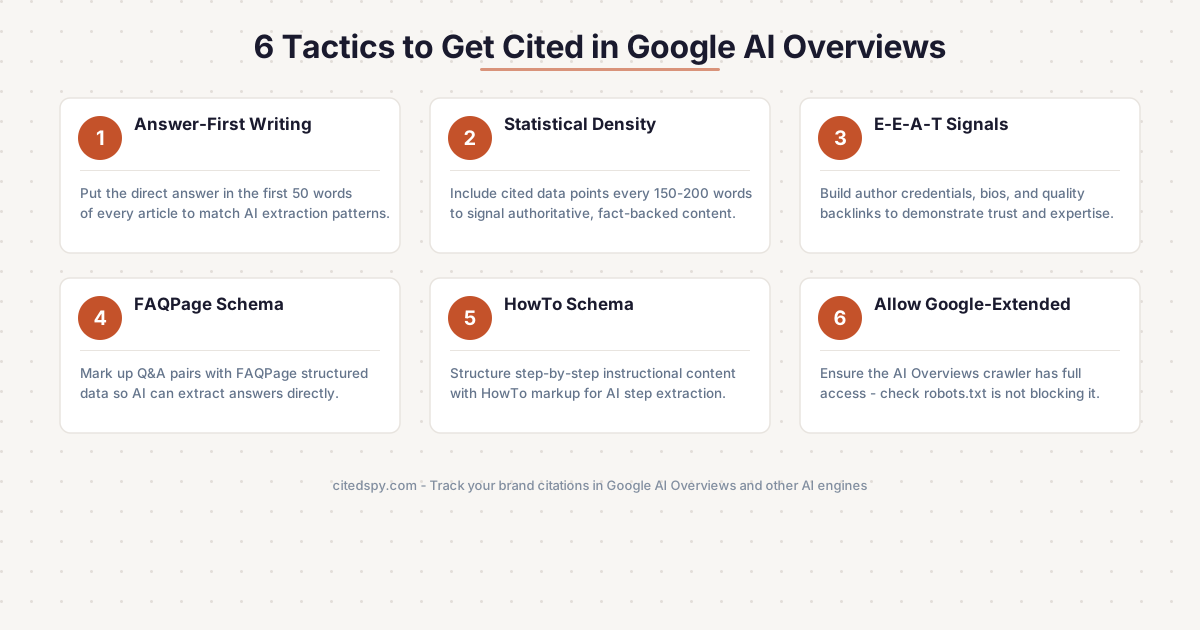
These tactics are ordered by impact. Start with the foundation (organic ranking) before layering on the optimization signals.
1. Achieve top-10 organic ranking for target queries
This is non-negotiable. AI Overviews draw almost exclusively from pages that already rank in the top 10 for the query triggering the Overview. If you are on page 2, you are essentially invisible to AI Overviews for that query. Traditional SEO - technical health, topical authority, backlink profile - remains the prerequisite.
2. Verify Google-Extended is not blocked
Check your robots.txt file and any CDN-level bot-blocking rules. Google-Extended must be explicitly allowed, or it defaults to Googlebot rules (which may or may not be sufficient depending on your configuration). A simple audit:
User-agent: Google-Extended
Disallow:
If this rule is absent and your CDN blocks unrecognized bots by default, you may be blocking the exact crawler that feeds AI Overviews.
3. Write answer-first content with specific facts
AI Overviews are built to give users a direct answer. Content that buries the answer in paragraph five loses to content that surfaces it in the first two sentences. Lead every article, section, and FAQ answer with the direct answer, then add supporting context.
Incorporate specific statistics, sourced externally where possible. The Princeton GEO research found that citing external data sources increased citation likelihood for lower-ranked pages by +115%. Numbers make claims verifiable - and verifiability is a core E-E-A-T signal.
4. Build E-E-A-T signals throughout the page
Google's E-E-A-T framework - Experience, Expertise, Authoritativeness, Trustworthiness - is not a single-page fix. It is a site-wide signal built from author bios with real credentials, original research or first-person experience, citations to authoritative sources, and a clean trust infrastructure (privacy policy, clear contact information, legitimate business signals).
For B2B brands, this means named authors with LinkedIn profiles, original data (surveys, case studies, proprietary benchmarks), and consistent publication of expert-level content over time. Thin content produced at volume actively harms E-E-A-T - volume without quality is counterproductive.
5. Publish blog content as the primary AI Overviews format
The Conductor 2026 AEO/GEO Benchmarks study - analyzing 13,770 domains and 17 million AI responses from May to September 2025 - found that blog content was by far the most cited page source in AI Overviews. Not product pages. Not landing pages. Blog posts.
This aligns with query intent. AI Overviews appear most often on informational and research queries, and blog content is what typically ranks for those queries. If your site is predominantly product and landing pages with minimal editorial content, you are structurally disadvantaged for AI Overviews visibility.
6. Implement FAQ and HowTo structured data
FAQPage and HowTo schema directly improve AI Overviews inclusion. These schema types give Google machine-readable signals that a page contains structured, question-answer content - exactly the format AI Overviews extract and summarize. This is covered in more detail in the schema section below.
7. Build topical authority, not just target-keyword pages
AI Overviews synthesize across multiple sources to construct their summaries. Brands that dominate a topic cluster - covering the main concept and all the adjacent questions comprehensively - are more likely to be cited across multiple related queries. A single well-optimized page is weaker than a site that demonstrably owns a topic.
Link your content internally to signal topic relationships. Map out the full query landscape for your category and build coverage systematically. To understand how this compares to optimizing for other AI engines, the GEO vs AEO vs LLMO breakdown is a useful reference.
Schema Markup That Improves AI Overviews Inclusion
Structured data does not guarantee AI Overviews inclusion, but it removes friction from the source-selection process. Google can extract answers from plain text, but schema makes extraction more reliable and more accurate.
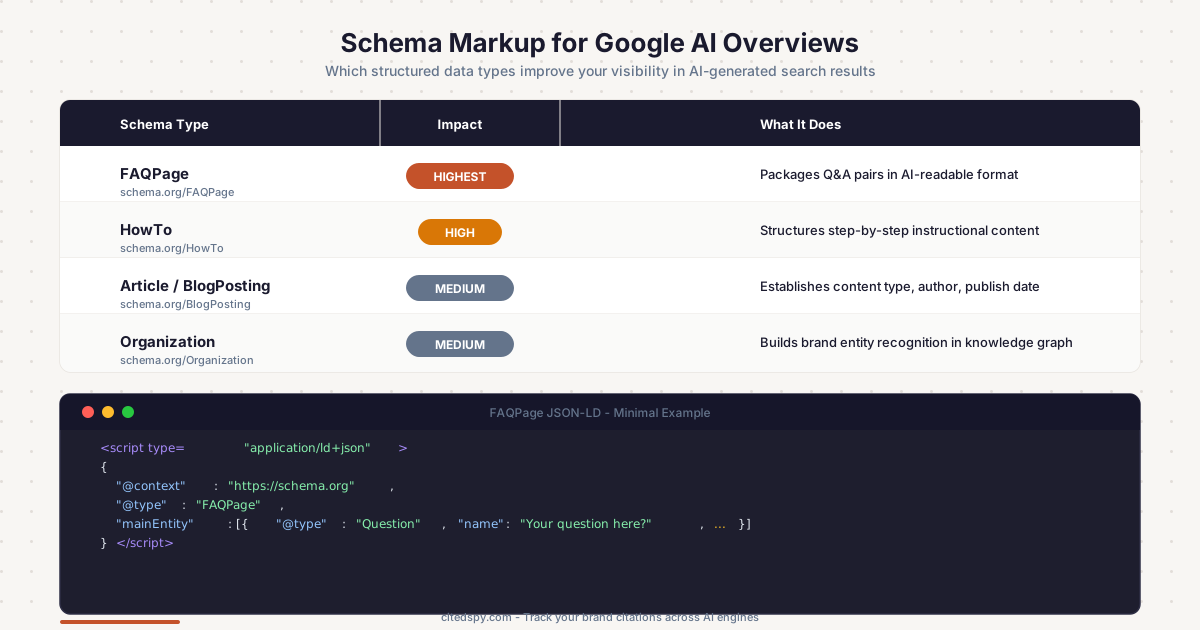
| Schema Type | Use Case | Impact on AI Overviews |
|---|---|---|
| FAQPage | Q&A content, help articles | High - directly maps to Overview Q&A format |
| HowTo | Step-by-step guides | High - maps to process/tutorial Overviews |
| Article / BlogPosting | Editorial content | Medium - establishes content type and authorship |
| Person | Author bios | Medium - supports E-E-A-T authorship signals |
| Organization | Company pages | Medium - establishes entity and trustworthiness |
| Product | Product pages | Low-Medium - more relevant for Shopping than Overviews |
| BreadcrumbList | Site structure | Low - helps with crawl efficiency and structure |
The two schema types with the highest direct relevance to AI Overviews are FAQPage and HowTo. FAQPage structures question-answer pairs that AI Overviews can lift directly. HowTo structures numbered steps in a format AI Overviews use for process-oriented queries.
For editorial content, always implement Article or BlogPosting schema with a named author who has a corresponding Person schema. This connects your content to a real, credible entity - a core E-E-A-T requirement.
Article and Person schema work together to establish authorship authority. An anonymous blog post signals less trust than a post attributed to a named expert with external validation. This is true in Google's quality guidelines and reflected in how AI Overviews weight sources.
If you are unfamiliar with what is an AI citation, the linked guide covers how citations work across AI engines and what it means for your brand to be "cited" versus merely referenced.
Measuring Your Google AI Overviews Visibility
Most standard analytics tools do not expose AI Overviews citation data directly. Google Search Console shows impressions and clicks from AI Overviews under the "Search type" filter (select "AI Overviews"), but it does not break down which queries triggered your citations or how frequently you were cited versus competitors.
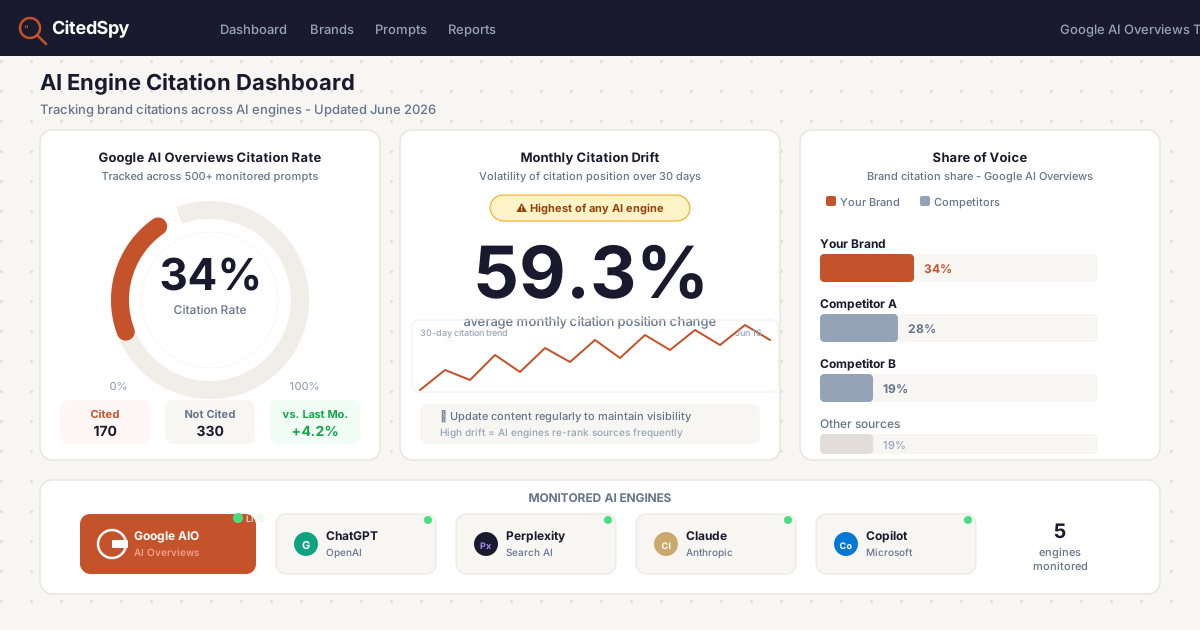
Given the 59.3% monthly citation drift in AI Overviews, point-in-time snapshots are insufficient. You need continuous monitoring across the specific queries that matter for your brand to understand:
- Which queries cite your brand versus competitors
- Whether your citations increase or decrease after content updates
- How your AI Overviews visibility compares to your organic ranking position
Manual tracking - running queries and recording results - is feasible at small scale but breaks down quickly across dozens of target queries and multiple competitors. Systematic tracking also matters for connecting AI Overviews visibility to business outcomes: which cited queries drive traffic, and whether that traffic converts at the rates the research suggests.
For brands serious about GEO, tracking across AI engines - not just Google - gives a fuller picture. AI Overviews, ChatGPT, Perplexity, and Gemini each use different source-selection methods, and dominance in one does not guarantee dominance in others. The guide to how to get cited by ChatGPT covers the different logic at play there.
Frequently Asked Questions
Optimizing for Google AI Overviews is fundamentally about building the kind of content and site authority that Google has always rewarded - but structured explicitly for machine extraction. The brands winning AI Overviews visibility in 2026 are the ones that treated organic SEO as the foundation, layered on structured data, published authoritative blog content, and monitored their citation visibility continuously. CitedSpy tracks your AI Overviews citations alongside ChatGPT, Perplexity, Gemini, and Copilot in one dashboard, so you can see exactly where your brand appears - and where competitors are taking the spot instead.