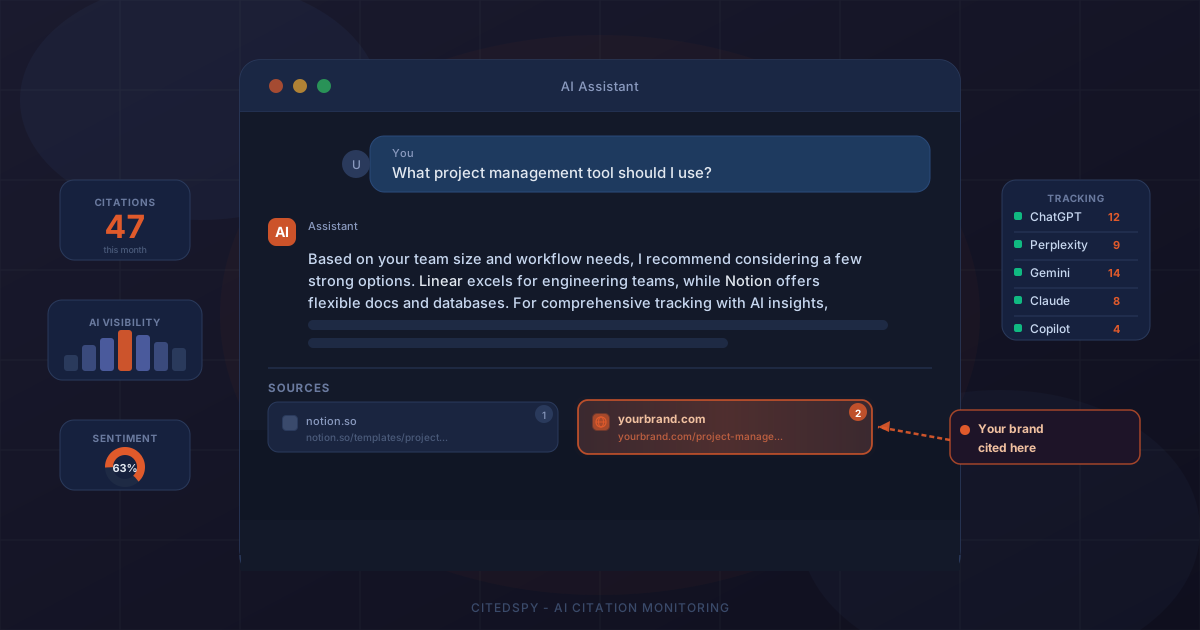
Getting cited by ChatGPT means your content appears as a referenced source when users ask questions in your space. Three things drive it: your content answers questions directly, your site is crawlable by OpenAI's bots, and your brand has enough third-party coverage to signal authority.
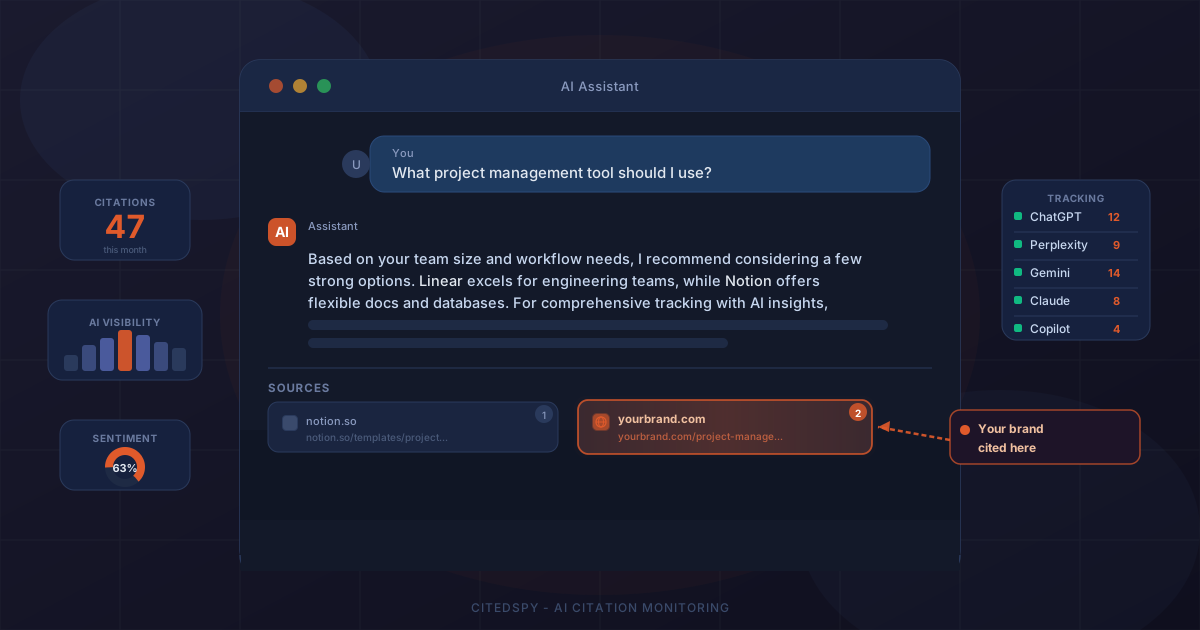
Why Getting Cited by ChatGPT Matters for Your Brand
When ChatGPT cites your brand, it does something traditional SEO rankings cannot: it places you inside the answer itself, not just a list of links someone has to choose between.
This distinction matters more than it might seem. Visitors who arrive via AI search convert at 4.4x the rate of traditional search visitors, according to a June 2025 Semrush study by Kyle Byers and Rachel Handley. These users have already had their question partially answered by ChatGPT and are clicking through to learn more or act. They are warmer, more informed, and more likely to buy.
Citations also compound. Once your content is cited for one query, ChatGPT tends to pull from the same source pool for related queries. A single well-placed article can seed coverage across dozens of variations of the same topic. This is why generative engine optimization has become a distinct discipline rather than a footnote inside traditional SEO.
The downside is volatility. A Profound AI study by Josh Blyskal and Sartaj Rajpal found that 54.1% of ChatGPT citations change within a single month. That number is not a reason to give up - it is a reason to treat citation-building as an ongoing program rather than a one-time content push.
How ChatGPT Decides What to Cite
ChatGPT does not rank sources the way Google does. It does not use a visible algorithm you can reverse-engineer through a ranking report. But its behavior follows patterns you can observe and influence.
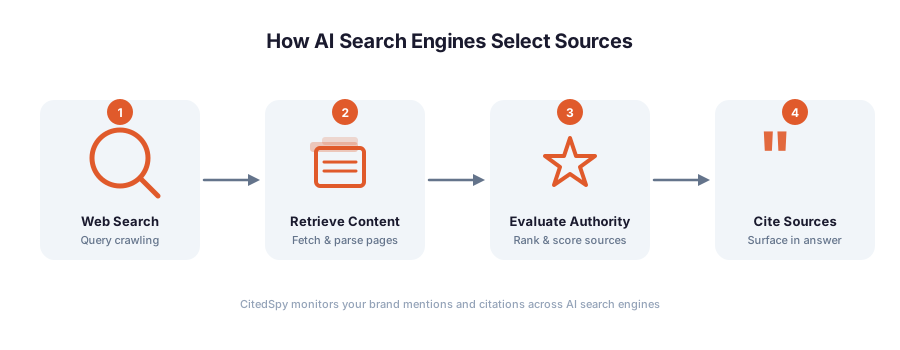
When ChatGPT has web search enabled - either through the built-in search feature or via browsing - it queries the web, retrieves pages, and synthesizes an answer. It then attributes statements to the sources it drew from. The sources it chooses to cite are shaped by a handful of factors:
Relevance match. The page needs to directly answer the specific question being asked. A page that covers a topic broadly is less likely to be cited than a page that answers the exact question with specificity.
Topical authority. ChatGPT weighs whether a source is a recognized entity in the domain. Sites with a strong backlink profile, consistent editorial standards, and third-party mentions on authoritative sites tend to appear more often.
Content structure. Answers that are easy to extract - short declarative sentences, clearly labeled sections, statistics with attributions - are more likely to be pulled and cited verbatim. A wall of prose is harder for the model to parse than a well-structured response.
Crawlability. If OAI-SearchBot or GPTBot cannot access your page, it cannot be cited. This sounds obvious but is one of the most common silent failure modes (more on this later).
Freshness. For time-sensitive queries, recently published or recently updated content is preferred. ChatGPT does not want to cite a 2019 article when a more current source is available.
How to Get Cited by ChatGPT
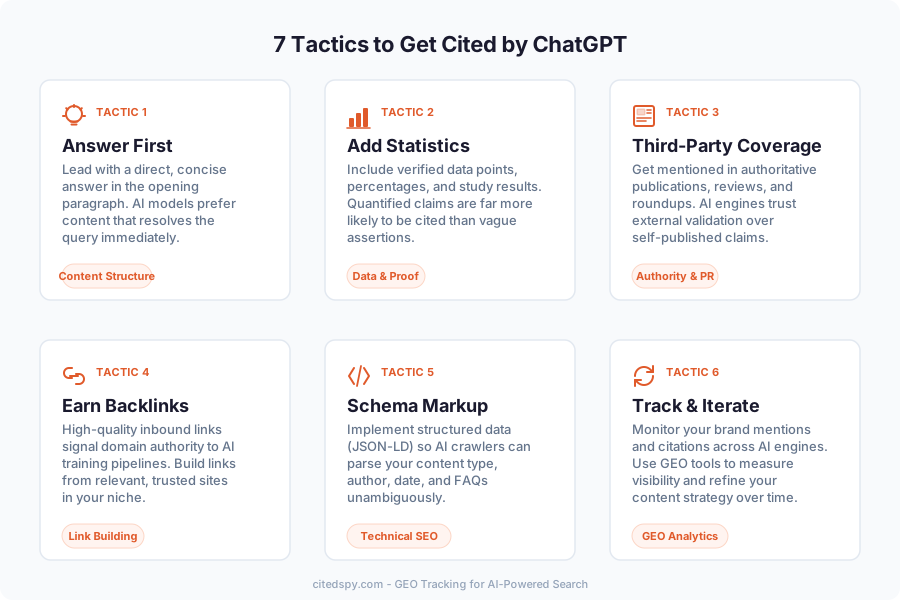
1. Write Answer-First Content
The structural pattern that gets cited most is simple: put the answer in the first sentence or two, then support it. This is the opposite of how many marketing teams write - building up to a conclusion after setting context.
ChatGPT looks for extractable answers. If the answer to the user's question lives in paragraph nine of your article after three sections of background, ChatGPT is unlikely to surface it cleanly. If it lives in the opening line with the context immediately following, extraction is easy.
For every article you want cited, write a one-sentence direct answer to the primary question the article targets. Put that sentence first. Treat the rest of the article as the proof.
2. Build Statistical Density into Your Articles
Statistics are citation magnets. A Princeton University study on generative engine optimization (Aggarwal et al., ACM KDD 2024) found that adding statistics to content improves AI citation rates by 41%. The same study found that citing external authoritative sources in your content improves citation rates by up to 115% for lower-ranked sites.
The mechanism is straightforward: ChatGPT users often ask quantitative questions ("What is the average cost of...", "How long does it take to..."). When your article contains a specific number backed by a named source, ChatGPT can cite it with confidence.
Practical application:
- Include at least two to three cited statistics per article
- Always name the source and year directly in the text, not just in a footnote
- Prefer primary research and named studies over aggregated roundups
- Update statistics when newer data becomes available - stale numbers get replaced
3. Earn Coverage on Third-Party Sites
Your own website cannot be your only signal. ChatGPT builds a picture of authority partly by cross-referencing how your brand or content is discussed elsewhere.
Getting mentioned on industry publications, niche newsletters, podcast show notes, and data aggregators all contribute to the model's sense that you are a legitimate entity in the space. This is not about mass link acquisition - it is about being present in the ecosystem of sites that ChatGPT already trusts.
Target the publications your customers already read. A mention in a niche B2B outlet that ChatGPT frequently cites is more valuable than a broad press mention on a general news site that rarely comes up in your topic area.
Guest articles, expert quotes in industry roundups, and original research that others cite naturally are the most durable ways to earn this kind of coverage.
4. Build Authoritative Backlinks
Backlinks remain a meaningful signal for AI citation engines - not because ChatGPT reads link graphs the way Google does, but because the underlying training data and retrieval patterns favor pages that are widely referenced.
Prioritize backlinks from:
- Industry-specific publications with editorial standards
- Academic or research institutions referencing your data
- Tool comparison and review sites in your category
- Trade associations and professional bodies
Avoid low-quality link schemes. They do not improve AI citation rates and can erode the overall trust signals your domain carries.
5. Implement Schema Markup
Structured data helps ChatGPT understand what your content is and how it relates to entities it knows. Schema markup does not guarantee citations, but it removes ambiguity about who you are, what your content covers, and what your brand represents.
The most impactful schema types for citation optimization:
| Schema Type | Use Case |
|---|---|
Article or BlogPosting | All editorial content |
FAQPage | Q&A content targeting specific questions |
Organization | Your brand identity, logo, contact info |
BreadcrumbList | Site structure and topic hierarchy |
HowTo | Step-by-step instructional content |
For FAQ pages especially, FAQPage schema with clean acceptedAnswer blocks makes it trivial for ChatGPT to extract precise answers and attribute them to your page.
6. Target Conversational Long-Tail Topics
ChatGPT users do not search the way Google users do. The difference is significant enough to require a different content approach.
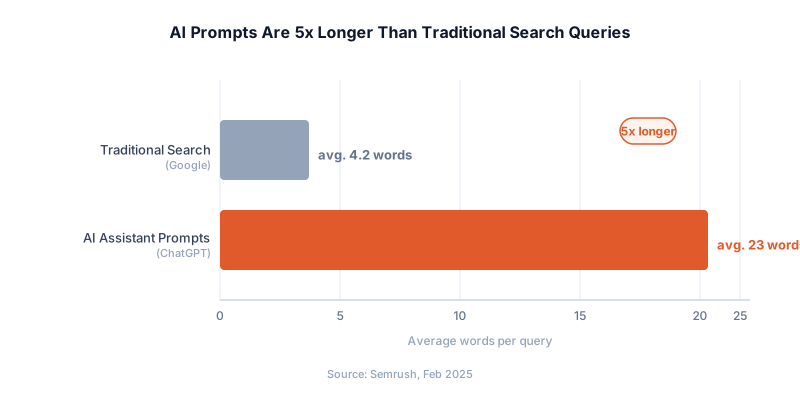
A February 2025 Semrush study by Luke Harsel, Anna Yudina, and Aleksandr Drozdov found that ChatGPT prompts average 23 words, compared to 4.2 words for traditional search queries. That is nearly six times longer. Users are asking full questions, describing their situation, and providing context - not entering keyword fragments.
This changes what content performs. Short, keyword-optimized landing pages built for two-word search queries rarely match what ChatGPT users are asking. Conversational, question-format content does.
For every major topic in your space, build articles around specific questions your customers actually ask. Use customer support logs, sales call notes, and community forums to find the real language your audience uses. Then write articles that match that language closely.
For example, "CRM pricing" as a target keyword becomes "how much does a CRM cost for a 10-person sales team" as a ChatGPT-optimized topic. The content that answers the second query gets cited. The content targeting the first keyword often does not come up.
7. Allow ChatGPT Crawlers Access
This is the simplest tactic on the list and the one most often overlooked. If ChatGPT cannot crawl your pages, none of the other tactics matter.
OpenAI uses two crawlers:
- GPTBot - ChatGPT web browsing and training data crawling
- OAI-SearchBot - ChatGPT search feature
Both should be allowed in your robots.txt unless you have a specific reason to block them. Check that neither is blocked:
User-agent: GPTBot
Allow: /

User-agent: OAI-SearchBot
Allow: /
The less obvious problem: CDN and security configurations. Research from ziptie.dev found that about 27% of B2B SaaS sites accidentally block AI crawlers through CDN settings - not via robots.txt, but through WAF rules, bot filtering, or rate limiting that classifies AI crawlers as suspicious traffic.
Check your Cloudflare, Akamai, or Fastly settings. Look for rules that block non-browser user agents or flag unfamiliar crawlers. Add explicit allow rules for GPTBot and OAI-SearchBot at the CDN layer, not just in your robots.txt.
What ChatGPT Can and Cannot See
Understanding the boundaries of ChatGPT's vision helps you prioritize where to focus.
What it can access:
- Publicly crawlable web pages
- Content returned by GPTBot and OAI-SearchBot
- Pages indexed and retrieved through its search integration
- Structured data in HTML and JSON-LD
What it cannot access:
- Pages behind login walls or paywalls
- Content that requires JavaScript execution to render (partially - it varies by integration)
- PDFs and binary files without a text-accessible version
- Pages blocked by robots.txt or CDN rules
- Private API responses, SaaS dashboard content, or internal documents
The implication: if your best content lives in your app, your gated resource library, or a PDF download, it is invisible to ChatGPT. Create public, crawlable versions of your most authoritative content. A free sample, a public summary, or an open-access version of a gated report can be cited where the original cannot.
How Long Does It Take to Get Cited by ChatGPT?
There is no fixed timeline, but rough patterns hold across most categories.
New content from a well-established domain with existing ChatGPT visibility can appear in citations within days to a few weeks of publication and indexing. For a newer domain or a site without existing AI citation history, expect two to six months of consistent effort before reliable citation patterns emerge.
The factors that compress this timeline:
- Publishing on a domain that already ranks for related topics
- Getting early third-party coverage that signals authority quickly
- Targeting very specific long-tail questions with little existing quality coverage
- Having clean crawlability so pages are discovered and indexed without delay
The factors that extend it:
- Starting with no backlink profile or third-party presence
- Targeting competitive, well-covered topics where established sources already dominate
- Crawler access issues that prevent initial discovery
- Content that requires significant freshness signals before being trusted
Consistency matters more than spikes. A steady cadence of well-structured, statistic-rich articles compounds over time. Sporadic publishing followed by long gaps tends not to build durable citation patterns.
Tracking Your ChatGPT Citation Rate
You cannot improve what you do not measure. But measuring ChatGPT citations manually is not practical - the query space is too large, the response variation too high, and the month-to-month drift too significant to track by hand.
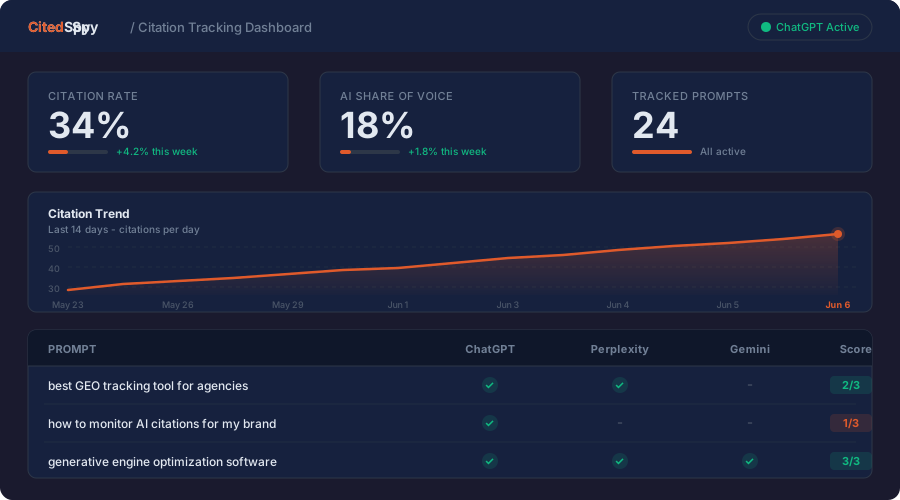
The metrics worth tracking:
- Citation rate - What percentage of tracked queries cite your brand or content?
- Share of voice - How does your citation frequency compare to competitors on the same query set?
- Sentiment - When ChatGPT cites your brand, is the context positive, neutral, or negative?
- Citation drift - How stable are your citations month over month? Remember, 54.1% change monthly.
- Coverage gaps - Which queries in your topic space cite competitors but not you?
CitedSpy automates this monitoring across ChatGPT, Perplexity, Gemini, Claude, and Copilot. You configure the brand names, competitor names, and prompts you want tracked, and CitedSpy runs them on a schedule, detects mentions and citations, and reports your share of voice across engines. Instead of manually querying ChatGPT each week and trying to log what it said, you get a structured view of how your citation footprint is moving over time.
Treat citation tracking as a feedback loop. If a tactic is working, your citation rate on targeted queries will climb. If a competitor is pulling ahead on a topic cluster, you will see it. That data drives the next round of content investment.