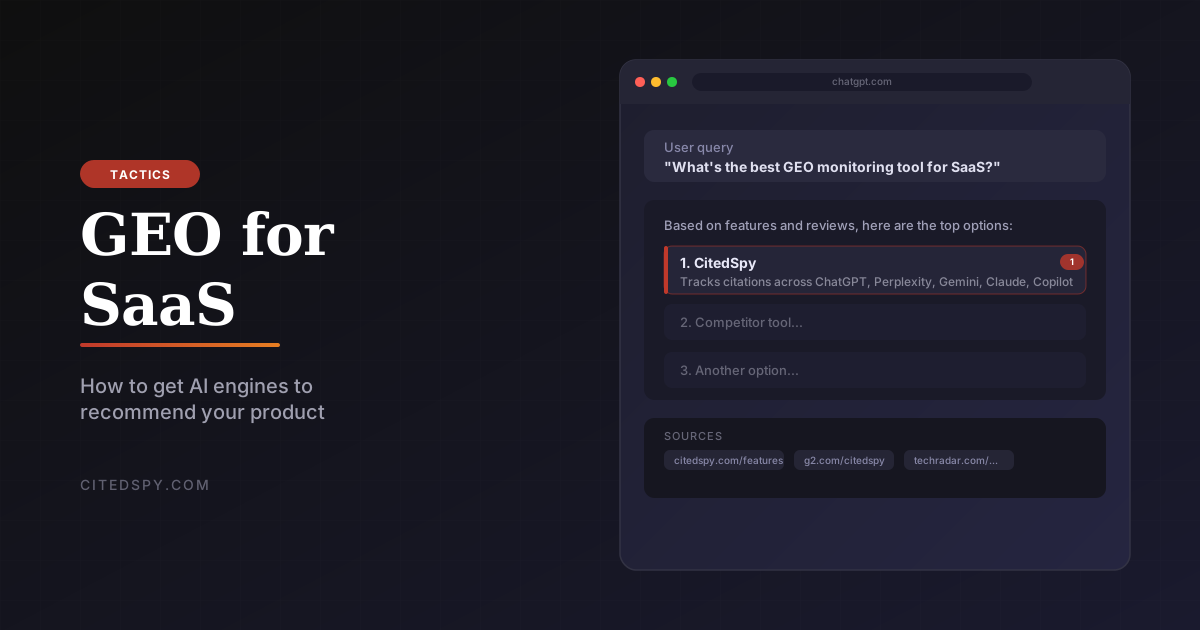
When a buyer opens ChatGPT and types "what's the best project management tool for a remote team of 20?" they are not browsing - they are evaluating. AI engines have become the pre-purchase research channel for SaaS, and unlike Google searches that show ten competing options, AI responses typically name two or three tools. The brands that get named are winning leads before a single sales email is sent.
This is GEO for SaaS: the practice of optimizing your product content and online presence so AI engines cite, recommend, and compare your tool favorably when buyers ask questions your product solves.
This guide covers why SaaS GEO is different from other industries, which content types drive AI citations, and how to build a systematic GEO strategy that compounds over time.
Why GEO Matters More for SaaS Than Other Industries
SaaS buyers use AI engines differently than consumers shopping for physical products. The queries that matter for SaaS GEO cluster around three high-value intent types.
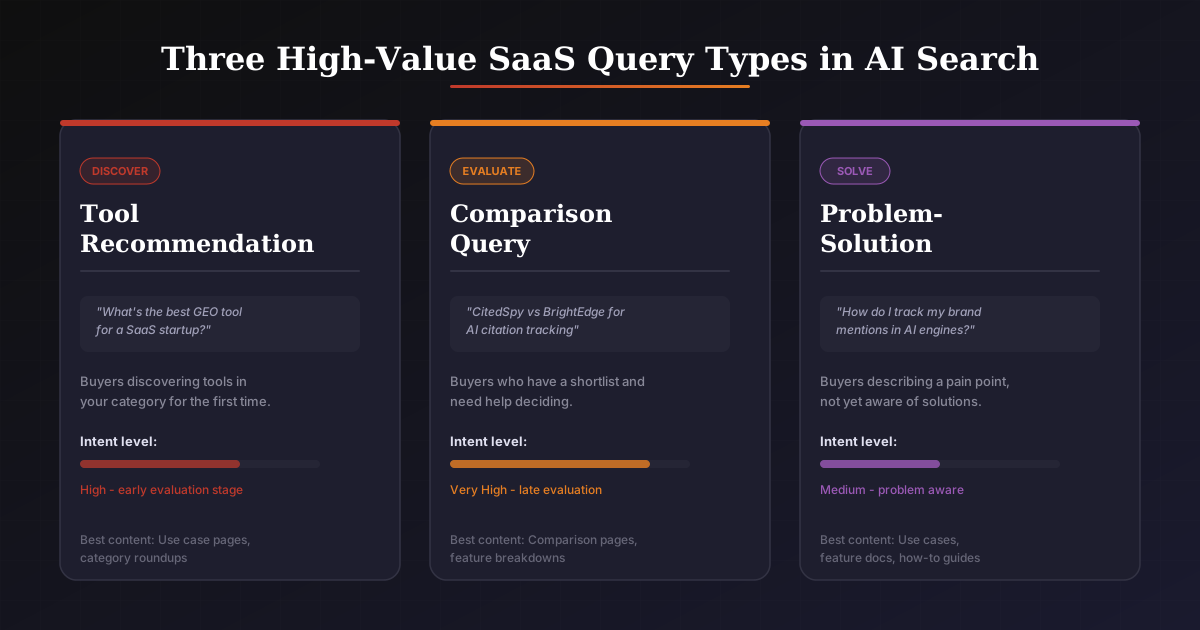
Tool recommendation queries: "What's the best CRM for startups?" "Which project management tool works for agencies?" These are the most direct buying signals in AI search. The buyer is actively evaluating options and asking an AI to shortlist them.
Comparison queries: "Asana vs Monday vs ClickUp." "HubSpot vs Salesforce for small business." When buyers are 70% of the way to a decision, they ask AI to compare their shortlist. Getting included in these comparisons - or being recommended as the answer - is enormously valuable.
Problem-solution queries: "How do I track brand mentions in AI engines?" "How can my team manage customer support at scale?" The buyer describes a problem; the AI recommends a category and often names specific tools. These queries are particularly powerful because the buyer does not yet know what product category they are looking for.
The conversion economics are compelling. Semrush research from June 2025 found that AI search visitors convert at 4.4 times the rate of traditional organic search visitors. When AI already pre-qualifies the buyer through a recommendation, they arrive with intent.
How AI Engines Select SaaS Recommendations
Understanding why AI engines cite certain SaaS tools (and not others) informs every tactical decision.
AI engines do not have a master list of approved SaaS products. They select recommendations by retrieving web content that discusses, reviews, compares, and describes tools in response to the user's query. A few key factors determine whether your product gets retrieved and cited:
Content coverage depth: AI engines retrieve content that comprehensively addresses the query. A product that appears in ten different high-quality articles - review sites, comparison pieces, category roundups, your own documentation - has ten chances to be retrieved. A product with thin coverage has few.
Review and comparison presence: Third-party reviews on G2, Capterra, Trustpilot, and ProductHunt are frequently cited by AI engines, especially for recommendation queries. These sites carry domain authority and structured product data that retrieval systems favor.
Feature-specific content: When a buyer asks "CRM with pipeline visualization," the AI retrieves content that specifically mentions pipeline visualization. Products with detailed feature documentation outperform products with vague marketing copy.
Named problem-solution pairing: Content that explicitly states "Tool X solves Problem Y" performs better in retrieval than content that implies it. AI engines match query intent against specific content claims.
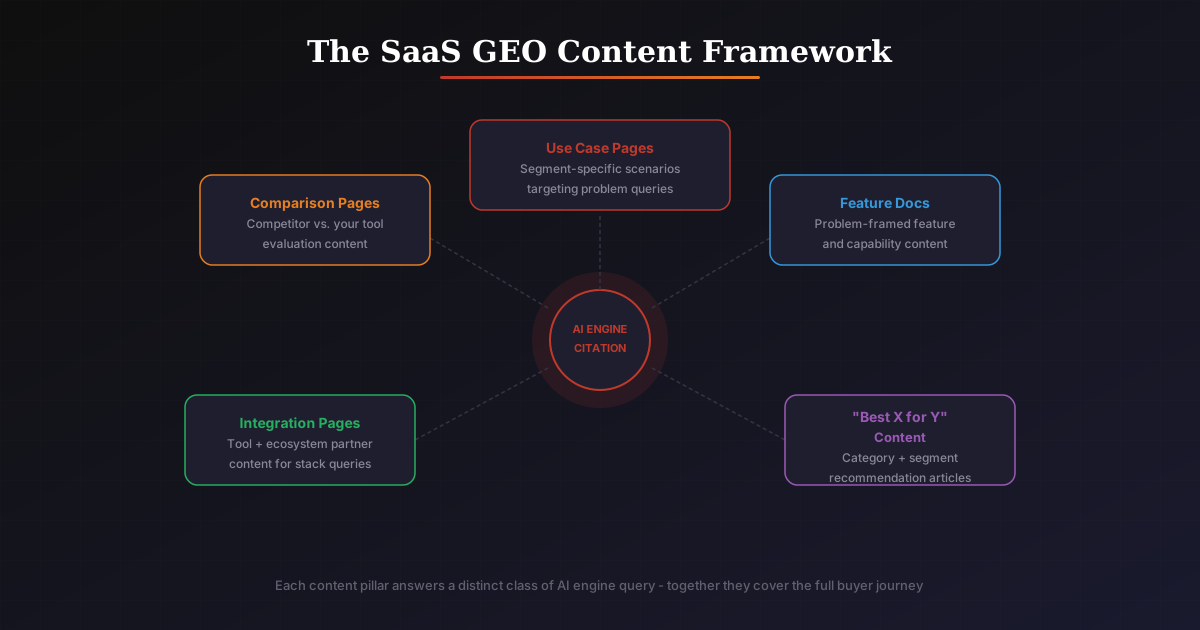
The SaaS GEO Content Framework
SaaS GEO requires a different content strategy than traditional SEO. The goal is not just organic rankings - it is dense, retrievable coverage across every question a buyer might ask an AI engine about your category.
Use Case Pages
Use case pages are the backbone of SaaS GEO. Each page targets a specific buyer scenario: "GEO monitoring for digital agencies," "AI citation tracking for SaaS marketers," "brand visibility monitoring for enterprise teams."
These pages address the problem-solution queries that AI engines see constantly. When a buyer asks "how do digital agencies track AI visibility?", an AI engine will retrieve content that explicitly addresses digital agencies and AI visibility. A well-structured use case page answers that query directly.
Structure each use case page with:
- H1: The use case as a direct statement ("GEO Monitoring for Digital Agencies")
- An explicit problem statement in the first paragraph
- A clear description of how the tool solves the problem
- Specific features relevant to this use case
- Social proof from this segment if available
- FAQ section addressing segment-specific questions
Comparison Pages
Comparison pages serve two purposes in SaaS GEO: they capture comparison-intent queries, and they pre-answer the question buyers will ask AI engines during their evaluation stage.
When someone types "CitedSpy vs BrightEdge" into an AI engine, it will look for content that directly compares these tools. If you have a well-structured comparison page, you are a primary source. If you do not, the AI will cobble together a comparison from third-party reviews - which may not reflect your best positioning.
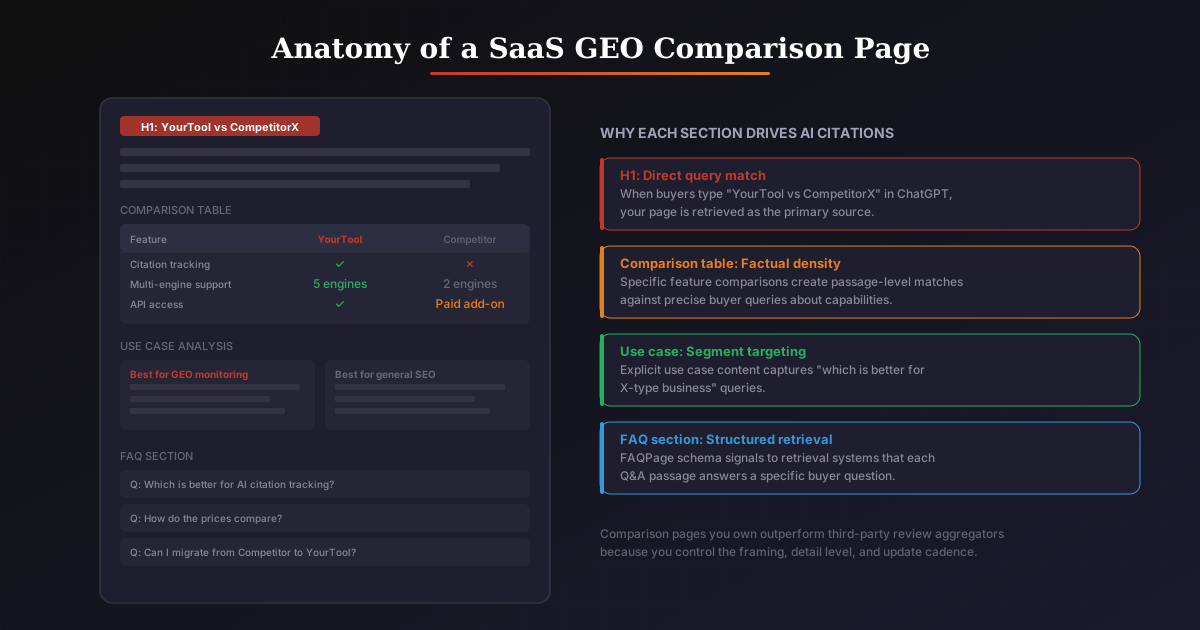
High-value comparison page types:
- Direct competitor comparisons ("YourTool vs CompetitorA")
- Category comparisons ("YourTool vs alternative approaches")
- Upgrade path comparisons ("Manual tracking vs automated monitoring")
- Tier comparisons ("YourTool for startups vs enterprise")
Each comparison page should be honest and specific. AI engines are pattern-matching against buyer queries that often come from informed prospects. Overselling or misrepresenting features creates a mismatch that erodes credibility.
Integration Pages
Integration queries are underserved by most SaaS companies' GEO strategies. Buyers routinely ask AI engines: "Does X integrate with Slack?" "CRM that works with HubSpot?" "Tool that connects to my existing stack."
An integration page for each major integration creates a direct answer to these queries. The page structure is simple: what data flows between the systems, step-by-step setup instructions, use cases enabled by the integration, and a FAQ with common integration questions.
This content is highly specific and highly retrievable. AI engines match these pages against integration-intent queries with high precision.
Feature Documentation
Comprehensive feature documentation is the foundation of SaaS GEO, but most SaaS companies write documentation for existing users, not for AI retrieval.
Documentation written for AI retrieval should:
- Use the exact vocabulary buyers use in queries (not internal product names)
- State explicitly what problem each feature solves
- Include comparisons to common alternatives or manual processes
- Answer the FAQ questions buyers ask about this type of feature
- Link to related features and use cases
The difference between "Managing Prompts in CitedSpy" and "How to Track AI Engine Citations Automatically" is the difference between documentation for users and documentation for AI retrieval. Restructure your help content to answer the questions buyers ask.
The "Best X for Y" Content Program
"Best [category] for [use case/segment]" is one of the most common query patterns AI engines see for SaaS products. Buyers ask: "Best GEO tool for agencies?" "Best CRM for Shopify stores?" "Best project management tool for design teams?"
Most SaaS companies assume these queries will be answered by third-party review sites. That is partially true - but your own site can capture some of this intent by publishing "best X for Y" content that positions your product honestly and specifically.
This content is not a product page. It is a genuine exploration of which tools work best for a particular use case, in which your product is a strong recommendation. The key is that the article provides real value beyond the product mention - comparison tables, criteria explanation, use case specifics.
Optimizing Your Core Product Pages for AI
Product pages are often the weakest link in SaaS GEO strategy. They are written for human conversion, which means they are heavy on value proposition and light on the specific, retrievable information AI engines look for.
To optimize product and feature pages for AI retrieval:
Replace vague value propositions with specific claims: "Powerful analytics" does not retrieve. "Real-time citation tracking across ChatGPT, Perplexity, Gemini, Claude, and Copilot" retrieves when a buyer asks "how do I monitor my brand mentions in AI engines?"
Add FAQ sections to every product page: FAQ schema and the structured Q&A format help AI engines identify and retrieve specific answers from your pages. Answer the five to ten questions your sales team hears most often.
Include explicit problem-solution statements: Structure these as direct answers: "If you are running a GEO strategy and need to know whether your optimization changes are increasing citations, CitedSpy tracks citation frequency over time across all five major AI engines."
Use H2s as retrieval anchors: Each major H2 on a product page is a potential passage retrieved independently. Frame H2s as question answers - "How CitedSpy Tracks Citations" retrieves better than "Our Tracking System."
Third-Party Presence: The Citations Your Pages Can't Generate
Your own pages can only do so much. AI engines weight third-party mentions heavily - they are signals that a source beyond the vendor itself confirms the product's capabilities.
For SaaS GEO, the most impactful third-party presence comes from:
Review platforms: G2, Capterra, Trustpilot, and GetApp are frequently cited by AI engines when answering recommendation queries. Actively collect reviews, respond to them, and ensure your profile information is complete and keyword-rich. The review text itself - written by users - contains the natural language AI engines match against buyer queries.
Integration directories: Zapier's app directory, Make's app directory, and platform-specific marketplaces (Shopify App Store, Salesforce AppExchange) carry strong domain authority. Being listed with complete descriptions increases your retrieval surface.
Roundup articles: "Best [category] tools in 2026" articles on Capterra, G2 Grid Reports, TechRadar, PCMag, and industry publications are high-citation targets for AI engines. Identify the top 10-15 roundup articles in your category and pursue inclusion through outreach, product review programs, or PR.
Journalist and analyst mentions: A single mention in a Wired, TechCrunch, or Forrester piece can generate AI citations for months. PR efforts that target publications AI engines frequently cite are amplified compared to generic link-building.
Technical Foundations for SaaS GEO
Effective GEO content requires solid technical foundations. Without these, the best content may not be retrieved:
Structured data markup: Implement SoftwareApplication schema on your product pages. This signals to retrieval systems what your product is, what it does, and how it is categorized. Add FAQPage schema to FAQ sections and HowTo schema to tutorial content.
Indexing speed: AI engines like Perplexity and Copilot depend on fresh web indexes. Content that is slow to be indexed is slow to be cited. Submit your sitemap to Google and Bing Search Console. Use IndexNow to push new and updated URLs to Bing immediately.
Content freshness signals: AI engines with strong freshness bias (Copilot, Perplexity) will deprioritize content that has not been updated in 6+ months for time-sensitive queries. Build a content refresh schedule: revisit major product pages, use case pages, and comparison pages quarterly to update statistics, add new features, and refresh examples.
Mobile and page speed: Core Web Vitals influence rankings across Google and Bing, which flow into AI citation probability. SaaS marketing sites that perform well on CWV have a structural advantage in AI retrieval.
Measuring SaaS GEO Performance
Traditional SEO metrics - rankings, organic traffic, keyword positions - are incomplete measures of GEO performance. You need to know whether AI engines are recommending your product, not just whether your pages rank.
The key SaaS GEO metrics to track:
Citation rate: How often does your product get mentioned when AI engines answer queries about your category? This is your baseline visibility metric.
Query coverage: Which buyer queries generate citations for your product? Which relevant queries return competitors instead? The gap is your content roadmap.
Competitor AI share of voice: How does your citation rate compare to direct competitors across the major AI engines? AI share of voice is the GEO equivalent of market share tracking.
Sentiment in AI responses: When AI engines mention your product, is the context positive, neutral, or negative? AI engines sometimes surface negative reviews or criticisms as part of their answers. Monitoring sentiment helps catch reputational issues before they compound.
Citation drift: What percentage of citations change month over month? High drift means AI engines are cycling through different sources. If your citations are disappearing, freshness or ranking changes are likely causes.
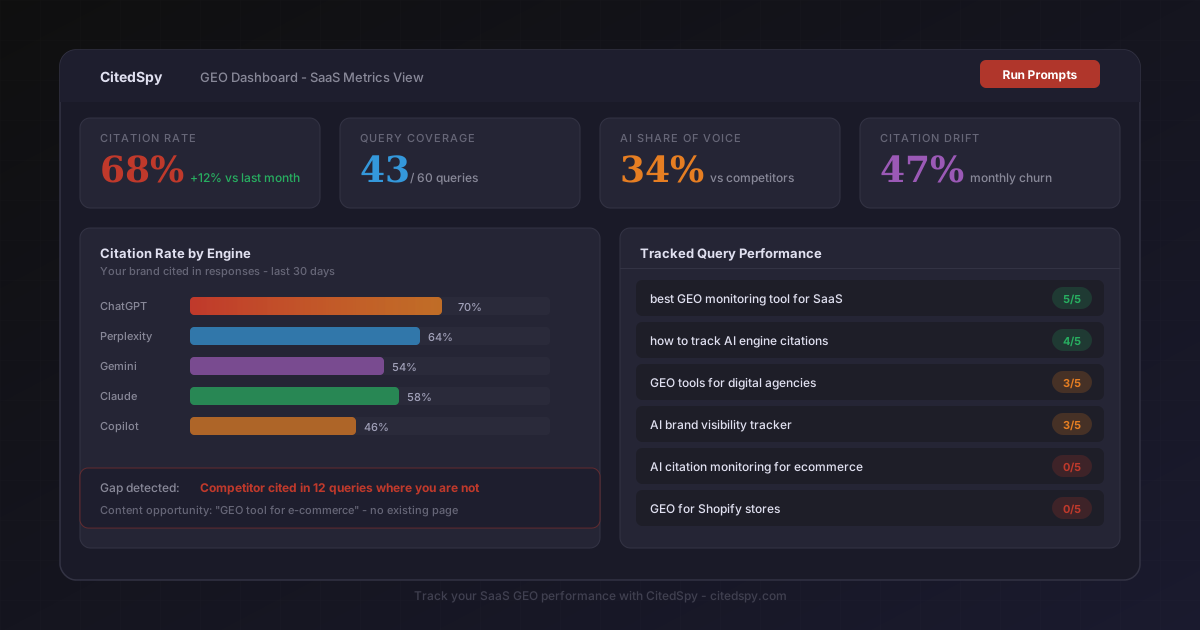
CitedSpy is built specifically for this kind of measurement. It runs your target prompts - the questions buyers in your category are asking AI engines - across ChatGPT, Perplexity, Gemini, Claude, and Copilot on a regular schedule, then logs citations, mentions, and sentiment over time. For SaaS companies running a GEO program, having this data is the difference between guessing and optimizing.
Common SaaS GEO Mistakes
Treating GEO as a one-time audit: GEO is a continuous channel, not a project. Monthly citation drift in AI engines runs at 40-54% depending on the engine. Citations you earned last month may be gone this month. The brands with stable AI visibility are publishing, refreshing, and monitoring continuously.
Writing only for search engines: Content optimized purely for search rankings often performs poorly in AI retrieval. The passage-level retrieval systems in AI engines favor direct answers and specific claims over SEO-optimized structures built around keyword density.
Ignoring the long tail of use cases: SaaS companies often focus GEO efforts on their primary category keyword ("best CRM") and ignore the long tail ("CRM for freelancers," "CRM for real estate agents," "CRM that works offline"). AI engine retrieval handles the long tail well, and these specific queries often have higher purchase intent.
No review strategy: Review platforms are major citation sources for AI engines. Companies that ignore review generation and management are ceding one of their most important AI citation surfaces to competitors.
Publishing and forgetting: Content published without a refresh schedule goes stale. AI engines with strong freshness biases (Copilot, Perplexity) will gradually deprioritize content that has not been updated, regardless of its initial quality.
Frequently Asked Questions
Conclusion
GEO for SaaS is the practice of ensuring AI engines recommend your product when buyers are researching your category. The channel matters because AI search visitors convert at 4.4x the rate of traditional organic visitors - they arrive pre-qualified. The opportunity is real and early: most SaaS companies are not yet running systematic GEO programs.
The tactics are clear: build use case pages, comparison pages, integration pages, and feature documentation that answer the specific questions buyers ask AI engines. Establish third-party presence on review platforms and integration directories. Optimize your core product pages for AI retrieval. And measure your AI citation rates consistently so you know what is working.
GEO is a long game, but every piece of well-structured, AI-retrievable content you publish today is a citation source for the buyers who will ask AI engines about your category tomorrow.