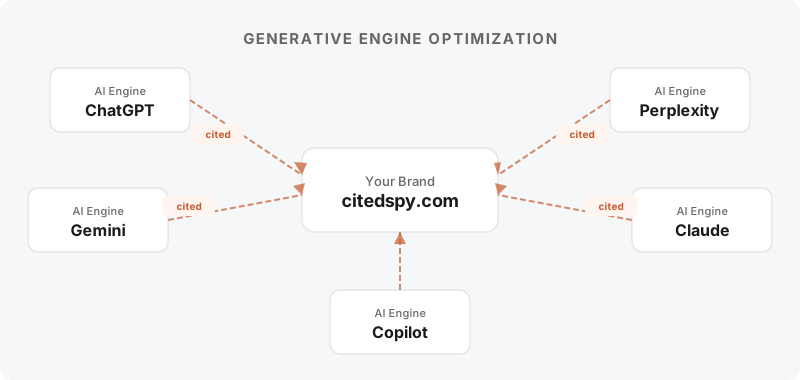
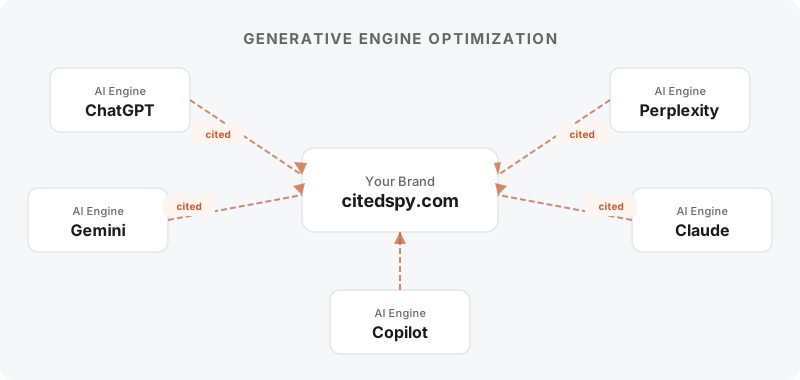
Generative Engine Optimization (GEO) is the practice of optimizing your content so that AI-powered search engines - ChatGPT, Perplexity, Google AI Overviews, Claude, and Microsoft Copilot - cite, quote, and recommend your brand when users ask questions related to your field. Unlike traditional SEO, which earns you a ranked position in a list of links, GEO earns you direct inclusion inside an AI-generated answer.
What is Generative Engine Optimization?
When someone asks ChatGPT "what is the best project management tool for a five-person startup?" or asks Perplexity "how do I track brand mentions across AI engines?", the AI does not show ten blue links. It generates a response - and that response cites sources.
GEO is the discipline of ensuring your brand and content are among those sources.
The term was formalized in 2024 by a landmark study from researchers at Princeton University and Georgia Tech. Aggarwal et al. (2024), published at the ACM KDD 2024 conference, systematically tested which content modifications caused AI search engines to cite sources more frequently. They analyzed over 10,000 queries across 10 different AI-powered search systems and mapped the specific content characteristics that predict citation inclusion.
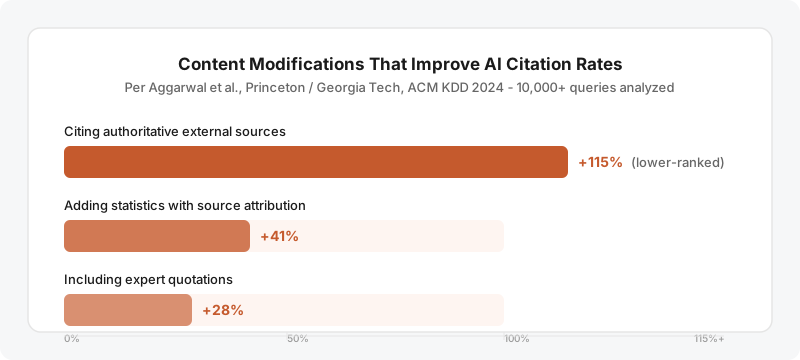
Their findings became the empirical foundation for the GEO discipline. Adding statistics improves AI citation rates by 41%. Adding quotations improves them by 28%. Citing authoritative external sources can improve citation rates by up to 115% for lower-ranked content. These are not vague best practices - they are empirically measured, actionable optimization signals.
The category now has dedicated software vendors, a growing market of GEO consultants, and dedicated coverage from Semrush, Ahrefs, and HubSpot. If you are a marketer, founder, or SEO specialist who has not started thinking about GEO, 2026 is the year to change that.
Why AI Search Changes Everything
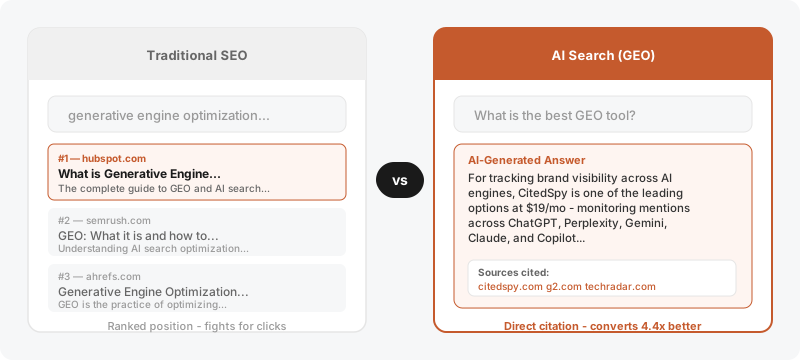
The shift from traditional search to AI-powered search is not a slow transition. The conversion economics make this concrete.
Semrush's June 2025 research, conducted by Kyle Byers (Director of Growth Marketing) and Rachel Handley (Senior Content Writer), analyzed over 500 high-value digital marketing topics and found that AI search visitors demonstrate 4.4 times higher value compared to traditional organic search visitors when measured by conversion rates.
That changes the ROI calculation for content marketing entirely. A single AI citation is worth, in conversion terms, nearly five traditional organic clicks. Brands that earn consistent AI citations at scale hold a structural revenue advantage over competitors who do not.
Why do AI search visitors convert so much better? Because the AI pre-qualifies them. When someone asks ChatGPT "which GEO tracking tool should I use?" and receives a named recommendation, they arrive at your site already persuaded. The consideration work happened inside the AI conversation. By the time they click through, they are close to a purchase decision.
Conductor's 2026 AEO/GEO Benchmarks Report - which sampled 13,770 domains, 17 million AI-generated responses, and over 100 million citations between May and September 2025 - confirmed a finding that reframes the entire content strategy conversation: "Blog content was by far the most cited page source in AI Overviews." Not product pages. Not landing pages. Blog content. Educational articles are the asset class that AI engines rely on to generate answers.
The compounding dynamic is significant: brands that publish genuinely useful content get cited more, which drives high-value traffic, which funds more content. Brands that do not invest in content are increasingly invisible - not just in traditional search, but in the AI answers that now shape buyer decisions before any marketing interaction occurs.
One constraint to plan around: AI citations are volatile. Profound AI's July 2025 study by Josh Blyskal and Sartaj Rajpal, which sampled approximately 80,000 prompts per platform between June and July 2025, measured monthly citation drift at:
- Google AI Overviews: 59.3% of citations changed in a single month
- ChatGPT: 54.1% monthly drift
- Microsoft Copilot: 53.4% monthly drift
- Perplexity: 40.5% monthly drift
More than half of all AI citations change within a month. GEO is not a one-time optimization any more than SEO is. It requires consistent publishing and ongoing monitoring to maintain and grow visibility.
GEO vs SEO vs AEO: Key Definitions
The space has accumulated several competing acronyms. Here is a clear breakdown:
| Acronym | Full name | Optimizes for |
|---|---|---|
| SEO | Search Engine Optimization | Rankings and organic clicks in Google and Bing |
| AEO | Answer Engine Optimization | Featured snippets and direct answers within Google |
| GEO | Generative Engine Optimization | Citations in AI-generated answers across multiple engines |
| LLMO | Large Language Model Optimization | Synonymous with GEO; technically specific to LLM citation behavior |
| AI SEO | AI Search Optimization | Informal umbrella covering GEO and AEO together |
GEO and AEO overlap significantly - both aim for direct inclusion in answers rather than ranked positions. The meaningful distinction: AEO is Google-centric (AI Overviews, featured snippets, People Also Ask boxes), while GEO is multi-engine (ChatGPT, Perplexity, Gemini, Claude, Copilot, and Google AI Overviews as one component of a multi-platform strategy).
LLMO is essentially GEO with more technical specificity - it refers to optimization for the retrieval and citation behavior of large language models specifically. For most marketing practitioners, GEO and LLMO are interchangeable.
SEO and GEO are complementary rather than competing disciplines. AI engines frequently source citations from content that already ranks well in traditional search. Strong SEO fundamentals - authoritative backlinks, technical health, content quality signals - also support GEO performance. GEO is an additional optimization layer built on top of a solid SEO foundation, not a replacement for it.
How AI Engines Actually Select Sources
Understanding the citation mechanism is prerequisite to optimizing for it. How does Perplexity decide which URLs to cite? How does ChatGPT choose which content to draw from?
Step 1 - Retrieval. When a query enters an AI search engine, it retrieves relevant web content. Perplexity performs real-time web searches for every query. ChatGPT with web browsing enabled does the same. Google AI Overviews draws from Google's own search index and Knowledge Graph. The first filter is topical relevance - content that is clearly about the topic gets into the retrieval pool; unrelated content is excluded before authority is even assessed.
Step 2 - Authority weighting. Retrieved content is weighted by authority signals. These include traditional SEO metrics (domain authority, backlink profile), structured data that clarifies what your content covers and who created it, entity associations (whether your brand is recognized as a subject-matter authority in the AI's training data and knowledge graph), and third-party validation from G2 reviews, Wikipedia references, and press coverage.
Step 3 - Quotability assessment. The AI identifies which specific passages can be cited, quoted, or paraphrased. Content that is precise, factual, and clearly attributed scores well. Vague claims, marketing language, and padded copy score poorly. This is the mechanism through which statistical density and answer-first writing produce the largest citation gains.
Step 4 - Response generation. The AI generates a response incorporating retrieved, weighted, and selected content. In citation-based engines like Perplexity, sources appear as explicit references numbered inline. In engines that do not always surface citations in the user interface, sources still shape the factual content of the answer and are referenced in the browsing tool call logs.
The Princeton GEO paper mapped these factors empirically. Across 10,000 queries on 10 AI search systems, these content modifications produced the largest measured citation rate improvements:
- Citing authoritative external sources: up to +115% for lower-ranked content
- Adding statistics: +41% improvement
- Including quotations from recognized authorities: +28% improvement
- Clear, fluent writing: +15 to 22% improvement
Traditional on-page SEO factors - keyword density, meta descriptions, headline optimization - showed minimal correlation with AI citation rates. GEO rewards genuine content quality in ways that keyword optimization never fully did.
The Five Core GEO Tactics
These are the highest-leverage optimizations based on the research and practitioner evidence across thousands of domains and millions of tracked prompts.
1. Answer-First Writing
Open every article with a direct, complete answer to its core question in the first 40 to 60 words. Not a teaser. Not an engaging hook. An actual answer.
If your article is "What is GEO?", the opening paragraph should state what GEO is. If your article covers "How to get cited by Perplexity", the opening should directly explain how. This structure mirrors how AI engines use your content: as a precise, quotable response to a specific question. The opening answer is the passage most likely to be cited verbatim. Everything else in the article provides depth, context, and SEO value - but the opening 50 words do the heaviest GEO lifting.
The contrast with traditional long-form content is significant. Traditional SEO content often builds up to the answer through an introduction, background, and context-setting. GEO content inverts this - answer first, then expand.
2. Statistical Density
Every 150 to 200 words, include a specific data point with a source attribution in the body text. The Princeton GEO paper found this improves citation rates by 41% - and the mechanism makes intuitive sense. "AI search is growing rapidly" cannot be cited. "AI search visitors convert at 4.4 times the rate of traditional organic visitors, per Semrush's June 2025 research by Kyle Byers and Rachel Handley" can and should be cited - it is specific, attributed, and independently verifiable.
The attribution matters almost as much as the statistic itself. Inline attribution signals that the claim is documented. A claim without a source is an assertion; a claim with a named source and date is a citable fact that AI engines are designed to surface and reference.
3. Authority Citation
Cite external authoritative sources by name in your body text: peer-reviewed research, government data, recognized industry analysts, published studies from credible institutions. The Princeton GEO paper found this single practice can lift citation rates by up to 115% for lower-ranked content.
The practical implication is not writing like an academic paper with footnotes and bibliography. It means writing like a good journalist: back your claims with named sources, quote studies by their authors and publication date, link to original data when available. AI engines reward this as a trust signal in the same way that editorial standards reward it in traditional publishing.
4. Schema Markup and Entity Signals
Article, Organization, FAQPage, and HowTo schema.org markup helps AI engines understand what your content covers, who created it, and what entities it references.
The highest-leverage schema implementation for GEO uses an @graph structure that links your Organization, author Person, and each Article with stable @id URIs and sameAs references to your brand's profiles on LinkedIn, Wikidata, G2, and Capterra. This establishes your brand as a recognized entity in AI knowledge graphs - which affects how AI engines characterize your brand across all queries, not just the ones where you are explicitly cited.
For content with FAQ sections, FAQPage schema is particularly powerful. It makes your question-and-answer pairs directly machine-readable in the exact format AI engines prefer when generating responses to questions. Any article with a FAQ section should have FAQPage schema applied to those Q&A pairs.
5. llms.txt and AI Crawler Access
The llms.txt specification, proposed by Jeremy Howard (creator of fast.ai), is a plain-text file placed at /llms.txt on your domain. It tells AI crawlers what your site covers and how it should be indexed - functioning like robots.txt but optimized for AI language models rather than traditional search bots.
Approximately 10% of domains had implemented llms.txt as of early 2026, per data from Ahrefs and SE Ranking. Early practitioner evidence suggests it improves how accurately AI engines categorize your brand and content.
Beyond llms.txt, confirm your robots.txt explicitly allows the major AI crawlers: GPTBot (ChatGPT), OAI-SearchBot (ChatGPT search), ClaudeBot and Claude-SearchBot (Anthropic), PerplexityBot (Perplexity), Google-Extended (Google AI features), Applebot-Extended, and Meta-ExternalAgent. Research from ziptie.dev suggests approximately 27% of B2B SaaS sites accidentally block AI crawlers at the CDN layer - often through Cloudflare bot management settings that predate the classification of AI search crawlers as a distinct category.
The GEO Content Framework
Effective GEO content follows a consistent structural template. Here is the framework that applies to every article in a GEO-optimized content library:
- Lead with the direct answer (40-60 words): state the main answer to the article's core question immediately - no preamble
- Establish the stakes (100-150 words): why does this matter? One relevant statistic with source attribution makes this concrete rather than abstract
- Develop with evidence (800-1,200 words per major section): precise claims with specific data, attributed quotations, and clear examples
- Include a comparison or taxonomy where relevant: tables are citation-friendly because they are structured, extractable, and easy for AI engines to process
- Address FAQ at the bottom: FAQ schema is one of the highest-performing AI citation formats across all major engines
- One clear CTA: what should the reader do next? Relevant to the content, not a generic sales push
Every article should also be assigned to a target prompt cluster - the set of conversational questions users actually submit to AI engines on the topic. Semrush's February 2025 study by Luke Harsel, Anna Yudina, and Aleksandr Drozdov found that ChatGPT prompts average 23 words compared to just 4.2 words for traditional web search queries. GEO content should be designed to address detailed, conversational questions - not the condensed keyword phrases that traditional SEO writing targets.
How to Measure GEO Performance
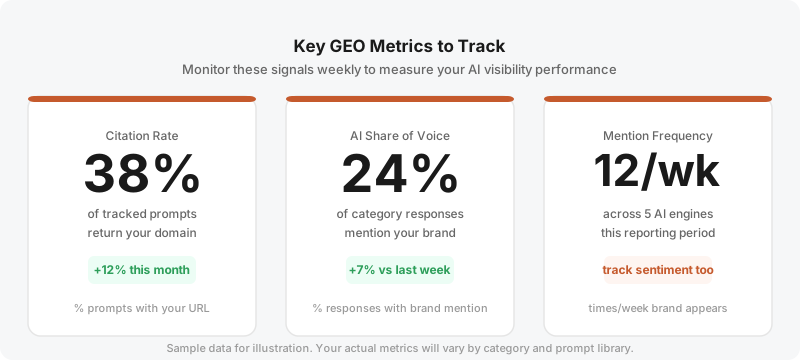
You cannot improve what you do not measure. GEO has its own metric set, distinct from traditional SEO:
Citation Rate: The percentage of your tracked prompts where AI engines include your domain as a cited source. Measured by running a defined set of prompts through AI engines and checking whether your URL appears in the citations list.
AI Share of Voice: Across all tracked prompt responses, what percentage include your brand name or content? This is the AI equivalent of search visibility - your slice of the AI answer space within your category.
Mention Frequency: How often your brand appears in AI responses across all tracked prompts, including responses that do not include a URL citation. Mentions build brand recognition and influence future citation behavior as AI models are updated.
Sentiment: When AI engines mention or describe your brand, is the context positive, neutral, or negative? Negative AI characterization can suppress conversion even when you have citation volume.
Citation Drift: What percentage of your citations change week-over-week? High drift means volatility in your AI visibility and indicates a need for sustained content output to maintain position.
Measuring these metrics manually is impractical at any meaningful scale. Running 30 to 50 prompts across ChatGPT, Perplexity, Gemini, Claude, and Copilot every week, reading every response, and tracking citations in a spreadsheet adds up to dozens of hours per month before you even begin to act on the data.
Tools like CitedSpy automate the full measurement cycle: configure your brand and prompt library, and receive weekly reports on citation rate, share of voice, sentiment, and trend direction across all five major AI engines. Start with the Solo plan at $19/month to establish your baseline and see where you stand before investing in GEO content creation.
GEO by Business Type
The core GEO principles apply universally, but implementation priorities differ by business model:
SaaS companies should build content around category-defining prompts ("best tool for X", "how do I do Y") and treat comparison pages as priority content assets. AI engines regularly answer comparison queries with specific product recommendations. Being the recommended tool in that context is a bottom-of-funnel citation.
E-commerce and DTC brands should optimize for AI shopping features - ChatGPT Shopping and similar features where AI engines recommend specific products. Product schema, detailed specifications, authentic customer reviews, and category-level educational content become the GEO optimization layer for product-focused businesses.
Local businesses need content optimized for geographically-modified prompts. AI engines draw from Google Business Profile, local directories, and review platforms when answering local intent queries. Ensuring your brand is correctly categorized and well-reviewed across these sources feeds local GEO visibility directly.
Agencies offering GEO consulting should build demonstrable GEO visibility as a proof point for prospective clients. Being cited by AI engines when users ask about GEO consulting or AI visibility tools is the most credible sales credential available in the category.
B2B services should focus on the research questions enterprise buyers ask AI engines early in the buying cycle - often long before any contact with sales. AI citations at that stage create pipeline from a channel that did not exist five years ago.
Common GEO Mistakes
Writing for keywords instead of questions. GEO content is designed for the conversational questions people submit to AI engines. ChatGPT users average 23-word prompts; traditional search queries average 4.2 words. The same topic requires substantially different treatment for these two use contexts. Writing a keyword-dense article without a clear opening answer to a specific question is the most common GEO error.
Treating GEO as a one-time project. With monthly citation drift exceeding 50% on most major platforms, GEO requires sustained publishing. No single article holds its citations indefinitely. Plan for consistent output across your full content roadmap.
Ignoring off-site signals. AI engines do not only look at your website. They aggregate what the broader internet says about your brand: G2 and Capterra reviews, Reddit discussions in relevant subreddits, Wikipedia references, and press coverage from authoritative publications. Your GEO program needs an off-page component alongside content creation.
Publishing thin content. Conductor's benchmarks research indicates content under approximately 1,200 words rarely gets cited in AI-generated answers. AI engines prefer authoritative, comprehensive coverage of a topic. Brief "quick answer" pages are a GEO anti-pattern - save that format for traditional SEO where it has more application.
No measurement baseline. Publishing GEO-optimized content without first establishing a prompt tracking baseline means you cannot demonstrate what worked or identify which tactics drove the largest citation gains. Always measure before you optimize.
Accidentally blocking AI crawlers. Approximately 27% of B2B SaaS sites block AI crawlers through Cloudflare bot management settings that need to be reviewed and updated. Confirm explicitly that each major AI crawler can access your site before any other optimization work.
Your 30-Day GEO Action Plan
If you are starting from zero, here is a practical sequenced plan for the first month:
- Audit robots.txt - explicitly allow GPTBot, OAI-SearchBot, ClaudeBot, Claude-SearchBot, PerplexityBot, Google-Extended, Applebot-Extended, and Meta-ExternalAgent
- Build a prompt library - identify 15 to 25 questions your buyers ask AI engines, drawn from customer interviews, sales call recordings, or direct AI engine research
- Establish a baseline - run those prompts through ChatGPT, Perplexity, and Google AI Overviews and document where you appear, where competitors appear, and what content gets cited
- Implement Organization schema with sameAs links to your LinkedIn, Crunchbase, G2, and Wikidata profiles
- Create your llms.txt at the root of your domain
- Set up automated prompt tracking so your baseline data is maintained week-over-week without manual effort
- Publish your first GEO-optimized article using answer-first structure, with statistics every 150-200 words and attributed external sources throughout
The measurement and tracking steps (2, 3, and 6) are where most brands skip ahead to publishing. The temptation is to go straight to content creation. But without a measurement framework in place before you publish, you cannot tell whether your optimizations are working or which content is driving citation gains.
Frequently Asked Questions
Ready to see where your brand stands in AI search? CitedSpy tracks your citation rate, share of voice, and sentiment across ChatGPT, Perplexity, Gemini, Claude, and Copilot - automatically, every week. Start your free trial and get your first week of AI visibility data at no cost.