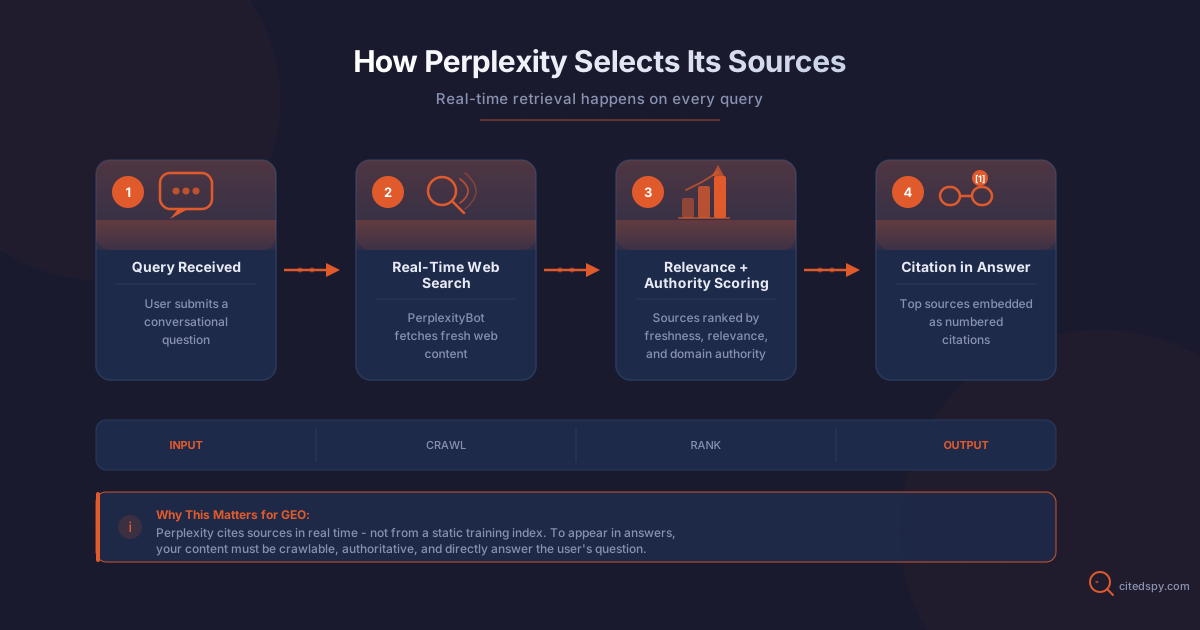
Perplexity selects sources through a real-time Retrieval-Augmented Generation (RAG) pipeline that fires on every single query - not just sometimes, not when the model lacks confidence, but always. Every response is grounded in live web content retrieved moments before the answer is written. Whether you get cited depends on whether your content clears a sequential set of retrieval and ranking gates.
Key Takeaways
- Perplexity runs real-time web search on every query - there is no knowledge-only mode.
- Perplexity averages 21.87 citations per response vs ChatGPT's 7.92, per a Q3 2025 analysis of 118K+ answers.
- Perplexity has the lowest monthly citation drift of any major AI engine at 40.5%, making it the most stable and predictable citation target (Profound AI, July 2025).
- Content published or updated within the last 30 days consistently outperforms older content in Perplexity citation rates.
What Makes Perplexity Different from Every Other AI Engine
Perplexity performs a live web search for every query - no exceptions. ChatGPT has two modes: knowledge-only (no search) and browsing-enabled (real-time search). Perplexity does not have a knowledge-only mode. That distinction matters because it means your content's freshness, crawlability, and real-time retrievability are always in play, not just for certain query types.
This is also why Perplexity is a different optimization target than ChatGPT. The research from ziptie.dev, which analyzed Perplexity's answer pipeline in depth, identified a six-stage RAG process: query intent parsing, real-time hybrid retrieval (BM25 lexical matching combined with dense vector embeddings), a multi-layer ML reranker, structured prompt assembly, LLM synthesis, and final citation attachment. Each stage filters the candidate source pool further. A page that reaches synthesis has already passed semantic relevance, freshness, structural quality, authority, and engagement checks.
The practical consequence of this architecture is a citation model that is strictly binary. Unlike Google's graduated ranking (positions 1 through 100, each with diminishing traffic), Perplexity's system produces winners and invisible. Content either clears all the gates and earns a citation, or it earns nothing.
How Perplexity Retrieves and Ranks Sources
Step 1 - Real-Time Web Search
When a query enters Perplexity, the Sonar model (the engine behind all Perplexity search-grounded responses) immediately issues web search requests. According to a 2025 audit of Perplexity's behavior, Sonar visits approximately 10 relevant pages per query before narrowing to three to four cited sources. The retrieval is hybrid: BM25 keyword matching catches exact-match signals while dense vector embeddings capture semantic relevance. Both must score well for a page to make the retrieval pool.
Perplexity processes approximately 780 million monthly queries as of early 2026, up 239% from 230 million in August 2024, according to data tracked by ziptie.dev. At that volume, the retrieval step is optimized for speed - pages that are fast, crawlable, and clearly structured are retrieved more reliably than pages that require significant processing to parse.
This is where PerplexityBot enters the picture. PerplexityBot is Perplexity's proprietary web crawler, and it is distinct from the Perplexity-User agent that browses on behalf of live users mid-session. PerplexityBot identifies itself with the user-agent string: Mozilla/5.0 AppleWebKit/537.36 (KHTML, like Gecko; compatible; PerplexityBot/1.0; +https://perplexity.ai/perplexitybot). It respects robots.txt directives, but with an important nuance documented in Perplexity's help center: if a page is blocked via robots.txt, Perplexity may still index the domain, headline, and a brief factual summary - just not the full text content. That partial visibility does not produce citations.
Unlike GPTBot (ChatGPT's crawler), PerplexityBot is explicitly not used for training AI foundation models. Its sole purpose is indexing content that will be referenced in search results. That distinction affects how practitioners should think about allowing or blocking it - blocking PerplexityBot removes you from live search retrieval, not from any model's training corpus.
Step 2 - Authority and Relevance Scoring
After retrieval, the multi-layer ML reranker scores each candidate page on a set of signals before deciding what survives into synthesis. The top signals, in approximate order of weight based on practitioner analysis:
Freshness sits at the top of the stack for Perplexity in a way it does not for most other AI engines. Research tracking Perplexity citation behavior found an 82% citation rate for content updated within 30 days, dropping sharply to 37% for older content. That gap is larger than any single structural or authority variable. Publishing regularly - and updating existing content with fresh data - is not optional for sustained Perplexity visibility.
Topical authority and domain signals come second. Perplexity's reranker weighs traditional authority indicators: domain-level backlink profile, whether the domain is recognized as a subject-matter publisher on the topic, and whether the specific page has been corroborated by other sources. Earned media from recognized publications - an Entrepreneur feature, a TechCrunch mention - creates authority signals that lift citation eligibility across everything in your content ecosystem.
Semantic relevance is scored by dense embeddings that capture meaning, not just keyword presence. Content that is topically focused on a narrow subject scores better than broad, multi-topic pages where the relevance signal is diluted.
Content structure is a direct input to the reranker. Research into Perplexity's citation behavior found that schema markup presence correlates with significantly higher top-3 citation rates (47% with schema vs 28% without). Answer placement in the first 100 words correlates with 90% of top citations. The reranker is effectively rewarding content that is easy to extract, parse, and quote.
Step 3 - Source Selection and Citation
Perplexity's citation format is distinctive: numbered inline superscripts appear immediately after every factual claim in the generated response, with a visually prominent sources panel displayed to the right of the answer. Each source in the panel shows a title, URL, and site favicon. The ordering in the sources panel reflects the reranker's confidence in each source for the specific claim it supports.
There is also a "Related" section below each answer that shows additional sources consulted but not directly cited in the primary response. Getting into the Related section is a secondary citation opportunity - it represents pages that cleared some retrieval and ranking gates but did not reach the final citation pool. It is a diagnostic signal worth watching when you are building Perplexity visibility.
Perplexity Pro Search - the enhanced mode available to paid subscribers - runs additional queries, revisits terms, and checks more domains before synthesizing. Standard search retrieves with shallow processing optimized for speed; Pro Search reads more sources with greater depth. For topics where more thorough research is expected (technical comparisons, investment decisions, academic questions), Pro Search users tend to receive more diverse citation sets. From a content perspective, the same signals drive both - Pro Search simply raises the bar for what clears each gate.
Key Differences from ChatGPT and Google AI Overviews
Understanding Perplexity's behavior against the backdrop of the other major engines clarifies where to focus optimization effort. Here is where the citation behavior diverges meaningfully:
| Dimension | Perplexity | ChatGPT | Google AI Overviews |
|---|---|---|---|
| Search mode | Always real-time | Optional (knowledge-only or browsing) | Always indexed (Google's own index) |
| Avg citations per response | 21.87 | 7.92 | Varies by query type |
| Monthly citation drift | 40.5% | 54.1% | 59.3% |
| Top cited domain | Reddit (46.7%) | Varies by query | Google-indexed properties |
| Freshness preference | Very strong (82% within 30 days) | Moderate | Moderate to strong |
| Citation format | Numbered inline + sources panel | Inline with source links | Inline with inline snippets |
| Pro/paid tier differences | Pro Search reads more sources | ChatGPT Plus has more stable browsing | No paid tier for AIO |
The citation drift numbers here come from Profound AI's July 2025 study by Josh Blyskal and Sartaj Rajpal, which sampled approximately 80,000 prompts per platform between June and July 2025. The headline finding for Perplexity: it has 40.5% monthly citation drift, the lowest of any major engine. That means Perplexity is actually the most stable and predictable AI citation target available. Google AI Overviews resets 59.3% of its citations in a single month; Perplexity holds onto its source preferences significantly longer.
That stability finding inverts a common practitioner assumption. Many marketers treat Perplexity as the volatile, fast-moving engine and Google AI Overviews as more stable. The data says the opposite. For brands that earn Perplexity citations, those positions hold roughly 60% month-over-month - a better retention rate than any other engine in the study.
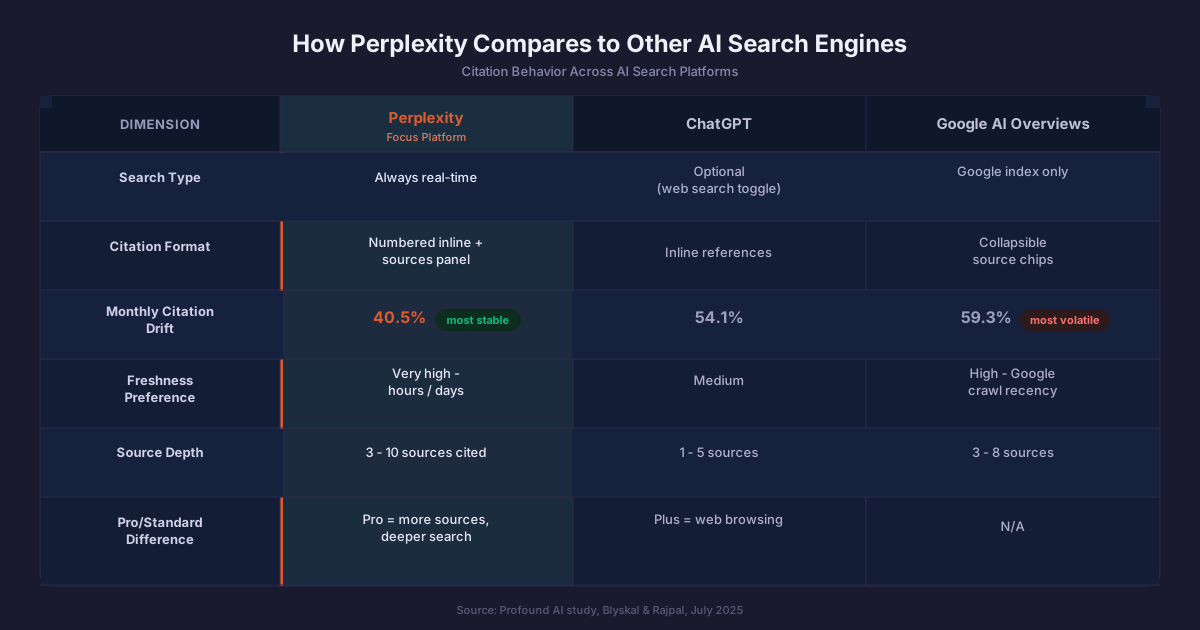
The citation volume difference is also significant. Perplexity averages 21.87 citations per response versus ChatGPT's 7.92, according to a Q3 2025 analysis of 118K+ answers by Qwairy. More citations per response means more surface area for your content to appear. On the other hand, it also means Perplexity's citation pool is larger, so competition for any individual citation slot is broader.
One more data point that shapes strategy: an audit of citation behavior across platforms found that ChatGPT and Perplexity share only 11% of their cited sources. The platforms draw from fundamentally different source pools. A content strategy built exclusively for ChatGPT visibility is largely missing Perplexity, and vice versa. Tracking both separately - not assuming that one implies the other - is necessary for an accurate picture of your AI visibility.
What Makes Content Citable by Perplexity
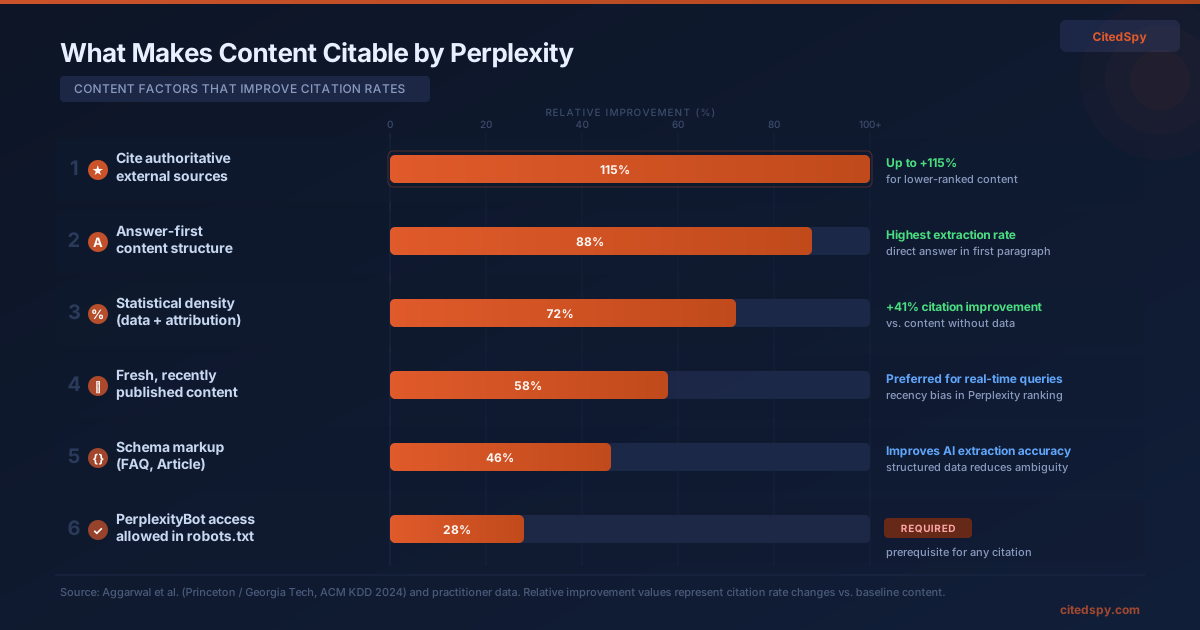
The Princeton GEO paper (Aggarwal et al., ACM KDD 2024) established the empirical foundation for AI citation optimization across engines. For Perplexity specifically, the findings map cleanly to what the retrieval and ranking pipeline rewards:
Statistical density. Adding statistics to content improves AI citation rates by 41% (Princeton GEO study, 2024). Perplexity's reranker extracts quantified claims as citable facts. "The market is growing" cannot be cited. "The market grew 23% in 2025" can be cited directly and attributed to your page. Every 150 to 200 words, your content should contain a specific, attributed data point.
External authority citations. Citing authoritative external sources within your content improves citation rates by up to 115% for lower-ranked content, per the same Princeton study. Writing like a journalist - naming sources, attributing claims, linking to primary data - is the single highest-leverage tactic the research identified.
Bottom Line Up Front structure. Research tracking Perplexity citation behavior found that 90% of winning citations provide a direct definition or answer within the first 100 words. Opening with the answer is not just an AI citation technique - it is how Perplexity's retrieval architecture selects quotable passages. The opening 50 to 60 words of your article are the most citable words on the page.
Schema markup. The 47% vs 28% citation rate gap between pages with and without schema markup reflects how the reranker processes structured data. Article schema, FAQPage schema, and Organization schema all help Perplexity's system understand what your content covers, who created it, and what claims are being made. FAQ schema is particularly valuable because it pre-packages question-and-answer pairs in exactly the format Perplexity's synthesis step prefers.
Crawlability. If PerplexityBot cannot access your page, none of the above matters. Research from ziptie.dev found that approximately 27% of B2B SaaS sites accidentally block AI crawlers through CDN settings - not via robots.txt, but through WAF rules, bot filtering, or rate limiting that classifies AI crawlers as suspicious traffic. Check your Cloudflare, Akamai, or Fastly settings explicitly. PerplexityBot should be in your allow rules at the CDN layer, not just in robots.txt.
How to Get Cited by Perplexity
These are the highest-leverage tactics based on the retrieval pipeline structure and the available citation behavior data.
Implement a 60-day freshness loop. Because Perplexity's freshness signal is so strong (82% citation rate for content updated within 30 days vs 37% for older content), a systematic refresh schedule is more important here than for any other AI engine. The loop has three components: refresh the schema timestamp, update at least one statistic with newer data, and trigger a new PerplexityBot crawl by pinging the page through your sitemap. Do this on a rolling basis for your highest-priority pages.
Write BLUF-structured content. Bottom Line Up Front is the single most impactful structural change for Perplexity visibility. The opening 100 words of your page should contain: a direct answer to the article's core question, at least one specific statistic with a source attribution, and the entity name you want Perplexity to associate with the answer. Everything else in the article provides depth and builds the authority signal that gets you into the retrieval pool in the first place.
Embed citable numbers with source attributions inline. The Perplexity reranker extracts statistics as direct answers. "According to [Source] research published in [Year], [specific quantified claim]" is the format that gets extracted and cited. Vague claims and hedged assertions are filtered out at the synthesis stage. Every factual section of your content should have at least one attributed data point in this format.
Build your Reddit and LinkedIn presence. Reddit accounts for 46.7% of top Perplexity citations, and LinkedIn surged from outside the top 20 to the #1 most-cited domain for professional queries between November 2025 and February 2026. Authentic participation in relevant Reddit communities - answering questions substantively, contributing to discussions without promotional language - is the highest-leverage off-site tactic available. LinkedIn articles and posts on your brand's professional topics feed the same signal pool.
Target niche topic clusters where you can be the best answer. Content covering AI, science, and marketing receives a 3x ranking multiplier in Perplexity's scoring, per practitioner analysis of citation patterns. But more broadly, niche expertise and original data can earn citations regardless of domain authority metrics. A focused, data-dense article from a smaller domain on a specific question can outperform a broader piece from a high-DA competitor, because Perplexity's reranker weights topical precision highly.
Implement schema markup properly. Article schema on every piece of editorial content, FAQPage schema on articles with question-and-answer sections, and Organization schema with sameAs links to your profiles on LinkedIn, G2, and Wikidata. This combination establishes your brand as a recognized entity with verified identity across platforms - a signal that feeds both Perplexity's authority scoring and how the engine characterizes your brand in responses where you are mentioned but not directly cited.
Allow PerplexityBot in your robots.txt and CDN. The explicit robots.txt rule is: User-agent: PerplexityBot / Allow: /. Then audit your CDN. Cloudflare's Bot Management settings, in particular, have a default classification system that may rate-limit or block unfamiliar crawlers. Add explicit allow rules for PerplexityBot at the firewall level. A blocked bot produces zero citations regardless of content quality.
Perplexity vs ChatGPT vs Google AI Overviews: Citation Behavior Compared
The engines optimize for different things, and the tactical priorities that follow are different enough to warrant tracking separately.
Perplexity's always-on real-time retrieval makes freshness the dominant variable. ChatGPT's optional browsing mode means citation behavior varies significantly by how a user's session is configured - the same query can produce very different source selections depending on whether web search is active. Google AI Overviews draws from Google's own index, which means sites that rank well in traditional search have a built-in advantage that does not translate directly to Perplexity.
The 11% source overlap between ChatGPT and Perplexity, from a 2026 multi-platform citation audit by AuthorityTech, is the most actionable data point in the comparison. It means that brands measuring their AI visibility in only one engine are missing the majority of what is actually happening. A brand cited frequently in ChatGPT may be nearly absent from Perplexity, and vice versa.
For the full breakdown of ChatGPT's specific citation mechanism, see the ChatGPT citation guide. For how GEO and traditional SEO relate to each other as investment priorities, see the GEO vs SEO comparison.
How to Track Your Perplexity Citations
Measuring Perplexity citation rate manually is not practical once you have more than a handful of tracked queries. The citation behavior varies by query, by day, and by the specific Sonar model version running at the time. The only way to build an accurate picture of your Perplexity visibility is to run a consistent set of queries on a schedule and track the outputs over time.
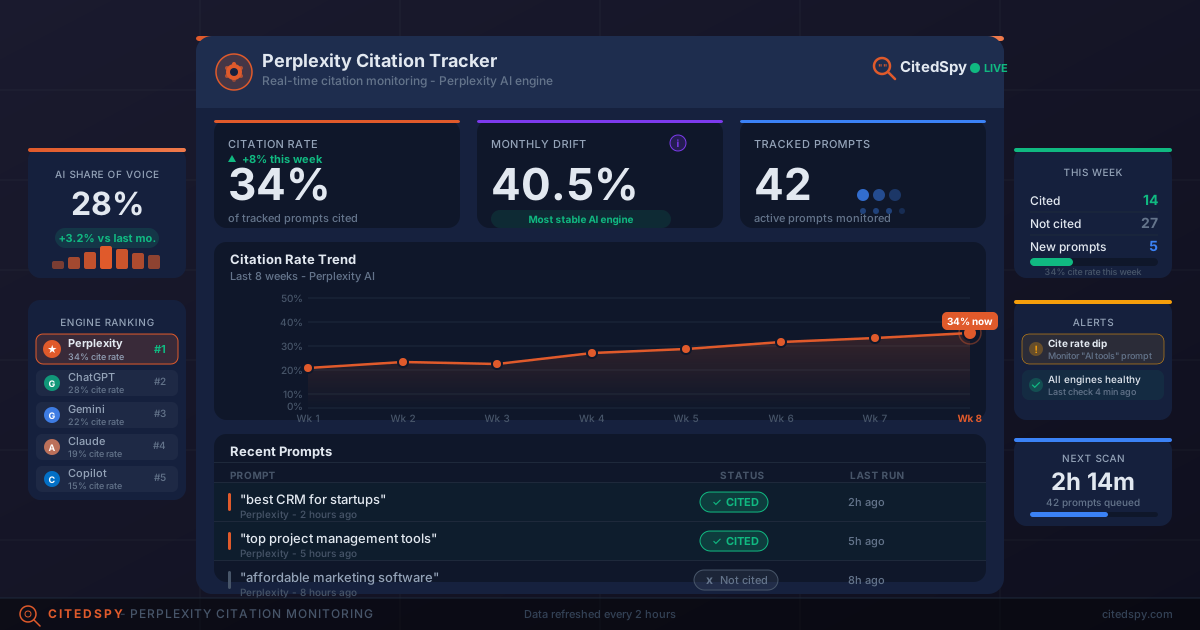
The metrics worth tracking specifically for Perplexity:
- Citation rate: What percentage of your tracked prompts produce a Perplexity response that includes your domain as a cited source?
- Monthly drift: How many of your current citations were also present last month? Remember that Perplexity's 40.5% monthly drift means roughly 4 in 10 citations change - better than other engines, but still significant.
- Share of voice: How does your citation frequency compare to competitors on the same prompt set?
- Coverage gaps: Which queries cite your competitors but not you? Those are your clearest content investment signals.
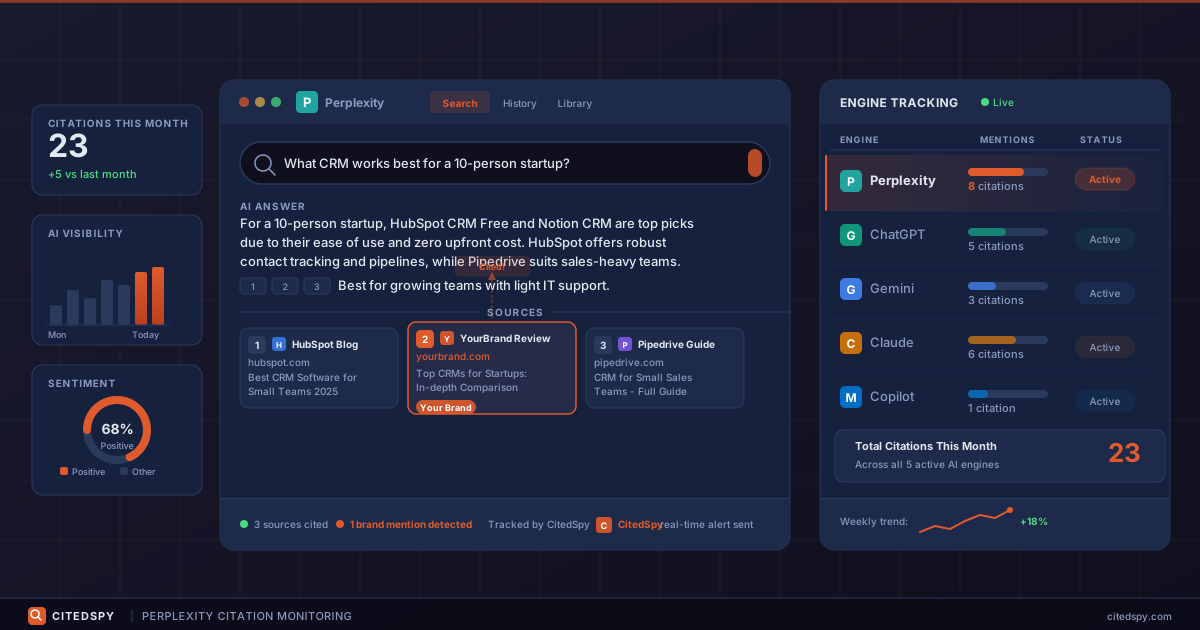
CitedSpy automates this tracking across Perplexity, ChatGPT, Gemini, Claude, and Copilot. You configure your brand, your competitor set, and the prompts you want monitored. CitedSpy runs them on a schedule, detects citations and mentions in every response, and reports your Perplexity citation rate and trend direction week over week. The monthly drift metric is particularly useful for Perplexity - it tells you which citations you are holding (content and authority signals are working) and which are cycling out (freshness or competitive displacement may be the cause).
Measuring before you optimize is the prerequisite. Without a prompt tracking baseline, you cannot tell whether your freshness loop, schema update, or new article actually moved your Perplexity citation rate - or whether it was unrelated volatility. Set the baseline first, then act on what the data shows.
For the broader context on measuring GEO performance across all AI engines, see the complete generative engine optimization guide.