Ranking on Google is no longer enough. As AI assistants become the first stop for product research, competitor comparisons, and buying decisions, the question that actually matters is: does Gemini cite you?
Gemini is not just another chatbot. It is the AI layer being built directly into Google Search through AI Overviews, Google AI Mode, and the standalone Gemini assistant at gemini.google.com. Brands that earn Gemini citations get a fundamentally different kind of visibility - a contextual endorsement woven into an answer, not just a blue link competing for a click. Brands that don't get cited are effectively invisible to a growing share of search intent.
This guide explains exactly how Gemini citations work at a technical level, what patterns the data shows, and what you can do to improve your chances of being cited.
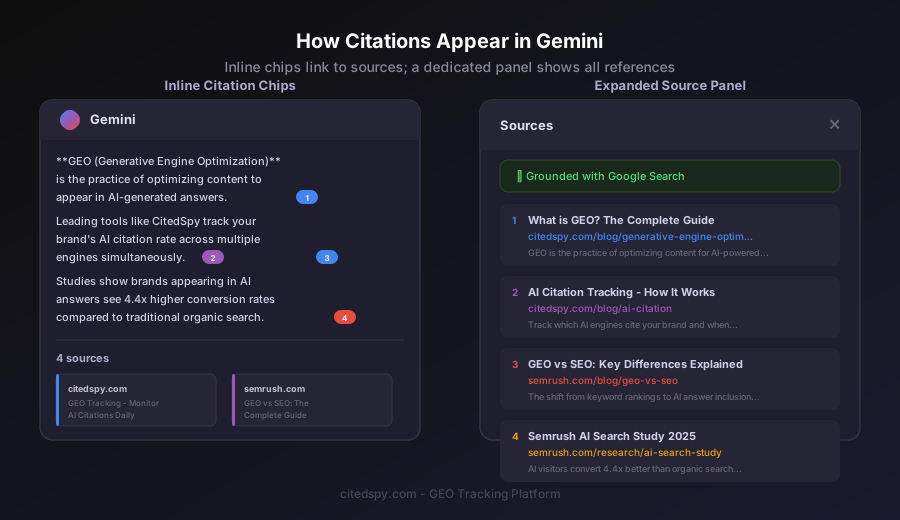
How Gemini Generates Responses (Google Search Grounding)
Unlike a static language model answering from training data alone, Gemini has a real-time web retrieval mechanism called Google Search Grounding. This is the engine behind every citation Gemini produces.
When Gemini receives a query, it runs a prediction classifier that scores the query from 0 to 1. If the score meets or exceeds a dynamic retrieval threshold (default around 0.7 in the API), grounding activates. Gemini then auto-generates one or more search queries, executes them against Google Search in real time, synthesizes the retrieved results, and produces a grounded response.
The API returns three key objects from this process:
- `groundingChunks` - an array of web source URLs and titles
- `groundingSupports` - mappings linking specific text segments in the response to specific source indices (by character offset)
- `searchEntryPoint` - a rendered Google Search chip that developers must display per Google's usage policy
One important restriction: sites that disallow Googlebot-Extended in their robots.txt are excluded from grounding entirely. If you block Google's AI crawler, you cannot be cited.
How Citations Appear in Gemini
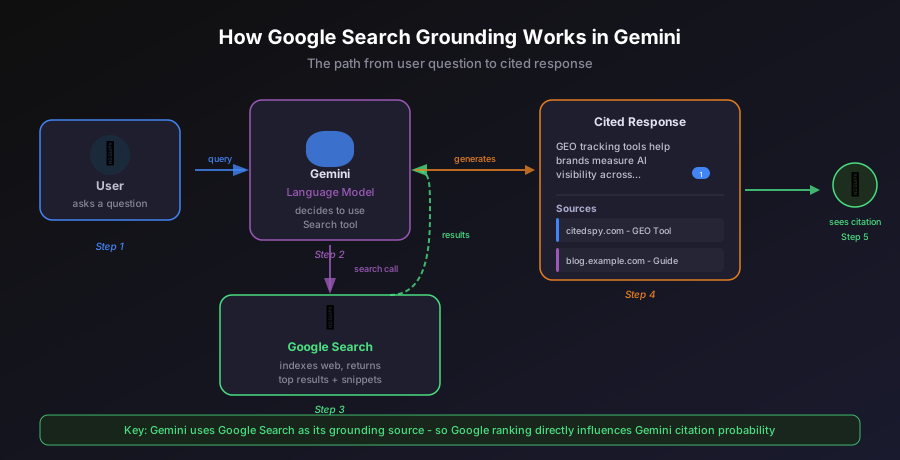
Gemini surfaces citations differently depending on the interface:
On gemini.google.com, fact-seeking responses include clickable arrow chips that open related content links. A sources panel appears alongside grounded responses listing the sources Gemini drew from. Users can click through to the original content.
In Google AI Overviews and AI Mode (embedded in Google Search), citations appear as inline linked text that expands to show source attribution. The visual treatment prioritizes the synthesized answer, with source links accessible but not dominant.
In Gemini Deep Research, the citation format shifts substantially. Deep Research formulates a multi-step research plan, breaks the query into parallel subtasks, browses many sources iteratively, and produces a structured report with:
- Numeric inline citations
[n]placed within the body text - A full Works Cited list appended at the end
- A sources panel where clicking any citation opens a sidebar showing the exact paragraph from the source document that Gemini drew on
- A "Regenerate with new sources" button if the sources seem outdated
The citation density difference is striking. Research comparing Gemini Deep Research to the base model found Deep Research generated an average of 32.42 references per report versus 4.27 for the base model, and 96.2 cited statements versus 6.58, with higher citation alignment (72.94% versus 59.24%).
If you want to understand how this compares to other platforms, the ChatGPT citations guide and Perplexity citations guide cover the equivalent mechanics for each.
What Types of Content Gemini Cites
The content-type breakdown from citation analysis reveals a clear hierarchy:
- Blog and article pages: approximately 32.74% of Gemini citations
- Review and comparison pages: approximately 12.17% of Gemini citations
- Together these two types account for roughly 45% of all citations
- Product pages, pricing pages, and FAQ pages: collectively under 0.6% of citations
What Gemini tends to ignore: commercial, product-pushing content. Pages designed primarily to convert rather than inform are significantly underrepresented. Gemini rewards informational value, not persuasion.
What Gemini prefers: comprehensive, structured, entity-rich content. The foundational GEO study from Princeton and Georgia Tech found content with statistics, expert quotes, and structured formats saw citation rates up to 40-59% higher than equivalent content without these elements. Content with inline citations and sourced statistics performed especially well.
Domain type patterns: Wikipedia, Forbes, Healthline, and Investopedia rank among the most cited specific domains. Government and journal sources cluster toward the top for authoritative topics. News and blogs surface prominently for current or niche queries. How-to queries favor tutorial content; market research queries favor data-heavy reports.
One notable characteristic of Gemini specifically: research suggests a meaningful share of Gemini citations link back to a brand's own official domain - significantly higher than Perplexity, which skews heavily toward third-party editorial sources (Reddit, news outlets). This makes Gemini a relatively favorable environment for brands with well-structured, authoritative content on their own domains.
How Gemini Differs from ChatGPT, Perplexity, and Claude
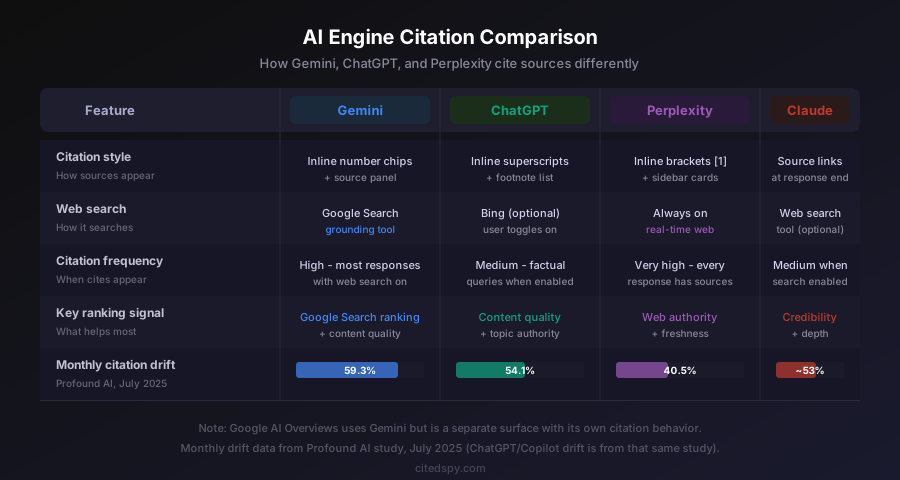
Each AI platform has its own citation logic. The differences matter more than most teams realize:
| Dimension | Gemini | ChatGPT | Perplexity |
|---|---|---|---|
| Citation style | Arrow chips + sources panel | Footnote-style (when browsing on) | Numbered inline markers, always shown |
| When citations appear | Conditionally, based on retrieval score | Only when browsing tool is active | Every response, RAG pipeline always on |
| Primary search source | Google Search | Bing (optional) | Custom web search, always on |
| Monthly citation drift | ~59.3% | ~54.1% | ~40.5% |
Research from Profound AI (July 2025) measured monthly citation drift across platforms: 59.3% of Gemini citations changed within a single month - meaning the majority of sources Gemini cited this week are different from what it cited last month. This alone makes one-off citation checks unreliable.
Only a small fraction of cited domains appear across multiple platforms for the same query. Each platform has a largely distinct source pool. A strategy that optimizes only for one platform leaves the majority of AI citation opportunity uncaptured.
Perplexity runs a full RAG pipeline on every query. ChatGPT only cites when the web browsing tool is explicitly activated. Gemini uses conditional grounding with a threshold - it doesn't always retrieve, and not every sentence in a grounded response gets a citation.
One structural difference that matters strategically: research suggests traditional Google search rank is a weaker predictor of Gemini citation than most marketers assume. Gemini can cite a page that ranks sixth if it contains the most relevant passage for a specific sub-query.
Passages now matter more than pages. A specific content section can be cited by Gemini even if the overall page ranks lower in organic search, because Gemini runs query fan-out - breaking one user query into multiple parallel sub-queries and retrieving the best passage for each independently.
For a broader framework on how AI citation differs across engines, the GEO guide covers the full landscape.
6 Tactics to Improve Your Gemini Citation Rate
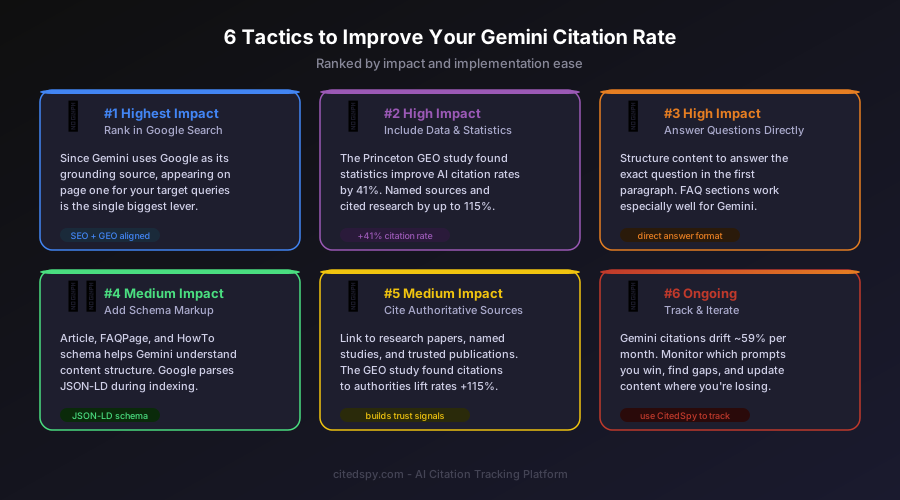
1. Build Third-Party Brand Presence
Research consistently shows AI search engines show systematic preference for earned media - third-party, authoritative sources - over brand-owned and social content. If your brand is not mentioned on Reddit, Wikipedia, G2, Capterra, or editorial publications your industry trusts, Gemini has insufficient corroboration to cite you confidently. Getting reviewed, covered, and discussed in third-party contexts is foundational.
2. Write for Passage-Level Retrieval
Each section of a long article should stand alone as an answer to a specific sub-question. Use descriptive H2 and H3 headers that match natural language queries. Lead with the direct answer, then add context. Informational queries typically receive 8-12 citation sources in Gemini responses; structure your content to serve that granular retrieval pattern.
3. Add Statistics and Citations Within Your Content
The Princeton and Georgia Tech GEO study (Aggarwal et al., 2024) found that adding statistics improved AI citation rates by 41% and citing authoritative external sources improved rates by up to 115% for lower-ranked content. Name specific institutions, studies, and dates. Link to primary sources rather than secondary summaries. This is the single highest-ROI tactic supported by controlled research.
4. Implement Schema Markup
An AccuraCast analysis of AI citations found the majority of cited web pages included schema markup. Structured data helps Gemini's underlying Google indexing understand content structure. FAQPage, HowTo, and Article schema types have the most direct impact on AI retrieval. JSON-LD is the recommended format - Google's guidance recommends it for AI-optimized content. If your site doesn't have schema, this is a high-leverage technical investment.
5. Publish Comprehensive Long-Form Guides
Thin content that touches a topic gets passed over. Content that answers every related sub-question in one place can be retrieved for multiple parallel sub-queries simultaneously. Include expert quotes and named sources throughout. Gemini appears to reward sourcing rigor - attributing claims to specific researchers, studies, or practitioners signals epistemic quality.
Content that is visibly fresh - with updated publication dates and recent statistics - also appears to perform better. AI engines prefer citing current information over evergreen content that hasn't been updated in years.
6. Ensure Technical Crawlability
- Do not block
Googlebot-Extendedin your robots.txt - this directly excludes your site from Gemini's grounding process - Use semantic HTML so content structure is machine-readable
- Maintain visible publication dates and update timestamps
- Target fast server response times - crawl coverage correlates with site speed
- Confirm your CDN and security settings aren't blocking AI crawlers (WAF rules sometimes misclassify them as malicious traffic)
How to Track Your Gemini Citations
Knowing whether Gemini is citing you requires systematic tracking, not one-off manual checks. Citation rates shift and Gemini's citation behavior can change materially when Google updates the underlying model. If you're not monitoring continuously, you won't catch these shifts.
CitedSpy tracks Gemini citations automatically across your brand's target queries, capturing which URLs Gemini cites, how often your domain appears, and how your citation rate compares to competitors. It runs prompts through the Gemini API with Search Grounding enabled and extracts the sources for every response - giving you an auditable record of exactly when and where Gemini cited you.
For a structured process to assess your current AI visibility, the GEO audit guide walks through how to benchmark your citation rate across Gemini, ChatGPT, and Perplexity. For broader competitive positioning, see the AI Share of Voice guide and the Google AI Overviews guide.