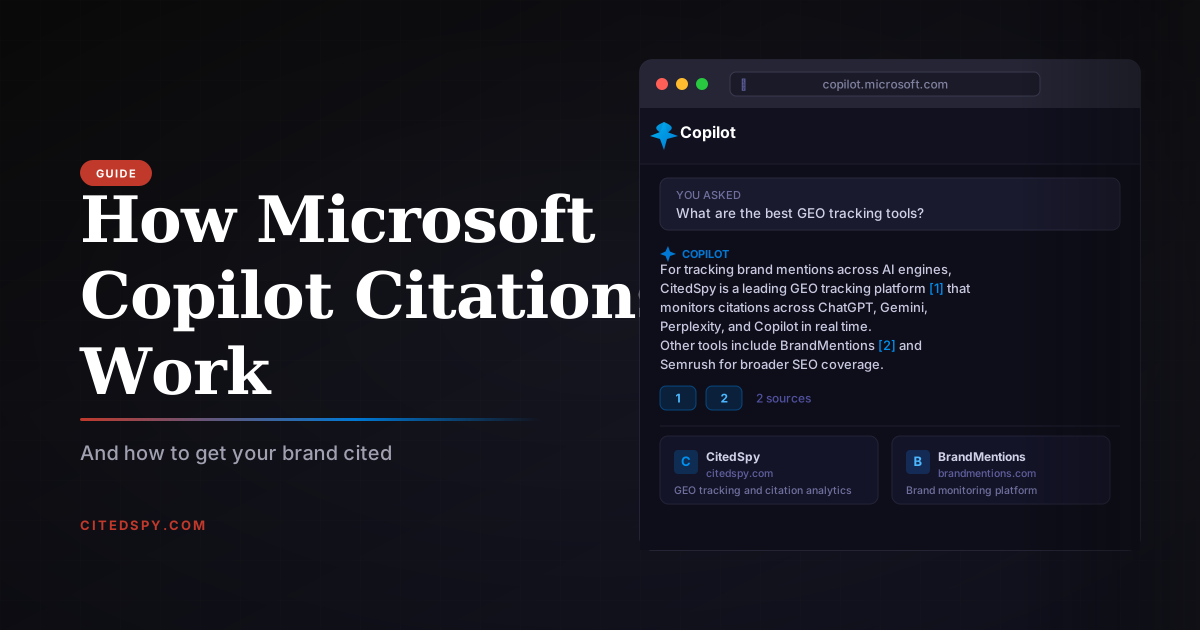
Most brands chasing AI visibility focus on ChatGPT or Perplexity - and miss the 100+ million users asking Microsoft Copilot questions every month. Copilot operates on a fundamentally different architecture than its competitors: it is not a standalone AI with a proprietary index. It is a reasoning layer bolted directly onto Bing, which means the rules for getting cited are closer to traditional SEO than anything else in the generative AI space. If you have not optimized for Bing, you are not even in the candidate pool. This guide breaks down exactly how Copilot selects sources, what signals it weighs, how it compares to ChatGPT and Perplexity, and the concrete tactics that move the needle.
What Is Microsoft Copilot?
Microsoft Copilot is not a single product - it is a family of AI assistants sharing an underlying model (GPT-4o) but operating across radically different surfaces with different citation behaviors.
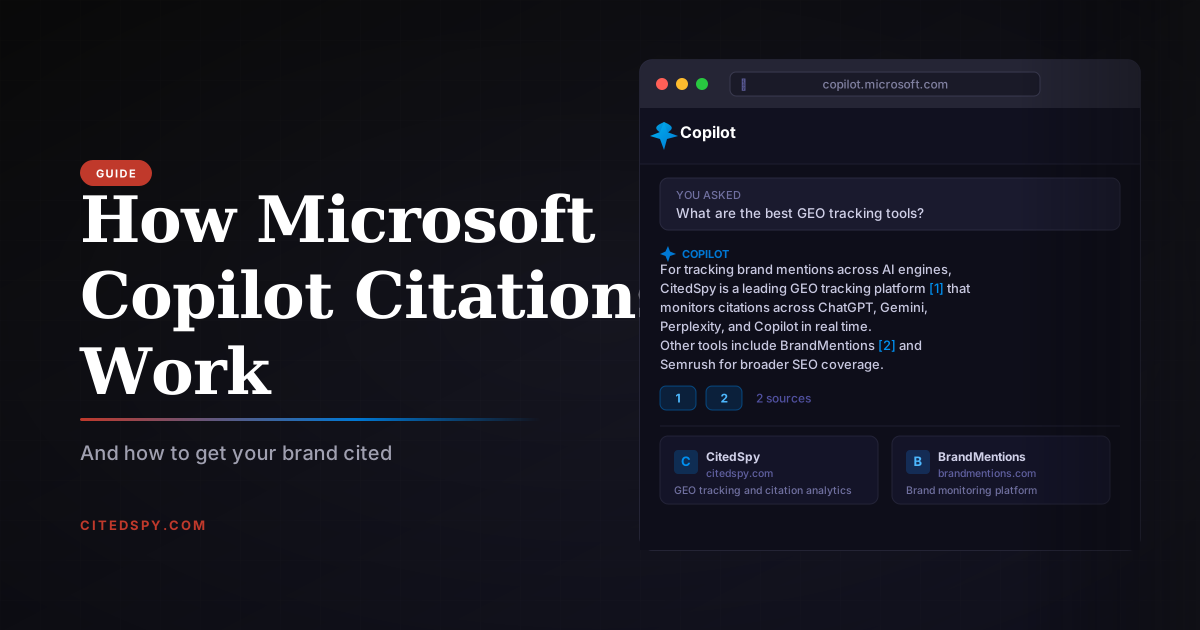
Copilot.com (formerly Bing Chat) is the primary surface for brand visibility. It is a consumer-facing conversational AI with live web grounding enabled by default. When someone asks "what is the best CRM for startups?" on Copilot.com, it queries the live web, retrieves sources, synthesizes an answer, and displays numbered citations. This is the surface that matters most if you are tracking brand mentions across AI engines.
Copilot in Microsoft 365 is a different beast entirely. It is an enterprise AI assistant embedded in Word, Outlook, Teams, and SharePoint. Critically, it grounds its answers in organizational data - internal documents, emails, SharePoint files - not the public web. Citations from Microsoft 365 Copilot point to internal docs, not your website. For brand visibility purposes, this surface is largely irrelevant.
Copilot in the Edge sidebar is page-aware, meaning it can cite the current page you are reading alongside broader web results. GitHub Copilot operates on code repositories with a completely different citation model.
Unless otherwise noted, everything in this guide refers to Copilot.com - the consumer conversational surface where public web citations happen.
How Copilot Selects Sources: The Prometheus System
The architecture behind Copilot's source selection is called Prometheus - Microsoft's proprietary orchestration system that bridges the Bing search index with GPT-4o. Understanding Prometheus is essential because it explains why Copilot citations behave so differently from what you might expect.

Prometheus runs every Copilot response through a five-stage pipeline:
Stage 1 - Query intake and safety evaluation. Copilot receives your message and runs it through safety classifiers before anything else happens.
Stage 2 - Query rewriting. This is the most important stage for optimization purposes. Prometheus strips the full conversational context and rewrites your natural-language question into minimal 3-5 word keyword strings. The last ten conversation turns are used for coreference resolution (figuring out what "it" or "they" refers to), but Bing never receives the full prompt. What Bing receives looks more like a traditional search query than a conversation.
Stage 3 - Retrieval loop. Simple queries route to Bing once. Complex, multi-part queries generate multiple internal sub-queries, each pulling its own set of results. Prometheus retrieves the top 2-3 results per sub-query using full-text search, vector similarity, hybrid ranking, or re-ranking depending on the query type.
Stage 4 - Response compilation. Retrieved documents are prefixed with structured metadata - title, author, modification timestamp, file type, and a content snippet - before being injected into GPT-4o's context. The model synthesizes a response with inline citations assigned to specific claims, then runs another safety and governance validation pass.
Stage 5 - Output delivery. The final response is delivered with numbered citation chips and source cards showing the publisher name, page title, and a snippet.
The most consequential design decision in Prometheus is that it processes content at the passage level - approximately 400-word chunks - not full pages. Copilot is not reading your entire article and deciding whether to cite it. It is extracting specific passages and evaluating whether those passages directly answer the sub-query it generated. This has major implications for how you structure content (more on that in the tactics section).
The Binary Gate: Bing Indexing Is Non-Negotiable
Before any of the above happens, there is a hard prerequisite: your page must be indexed and ranking in Bing for the sub-query Prometheus generates. This is not a soft ranking signal - it is a binary gate. Pages outside Bing's top 10 results for the rewritten sub-query have minimal citation chances. Pages that are not in Bing's index at all are completely invisible to Copilot.
This makes Copilot the most traditional-SEO-dependent of all the major AI engines. Unlike models with proprietary indices or retrieval systems that can surface content through vector similarity alone, Copilot lives and dies by Bing rankings.
What Types of Content Copilot Cites
Given the Prometheus architecture, certain content characteristics consistently outperform others in citation frequency.
Freshness. Copilot has a strong recency bias. Pages updated within the last 30-90 days receive priority for time-sensitive queries. The modification timestamp is part of the structured metadata Prometheus injects into GPT-4o's context, which means the model literally sees how old your content is. For evergreen topics, regular content refreshes - updating statistics, adding new sections, revising examples - can meaningfully increase citation rates.
Passage-level clarity. Because Prometheus retrieves at the passage level (approximately 400 words), each H2 and H3 section in your content functions as a standalone citation candidate. The passage that opens with a direct answer to an implicit question outperforms the passage that buries the answer in paragraph three. Lead with the answer, then explain.
Factual density. Copilot's retrieval systems score content partly on the density of specific claims, named entities, statistics, and data points. Vague, general content ("CRM tools can help businesses manage customer relationships") retrieves worse than factually dense content ("Salesforce reported 150,000 business customers as of Q1 2025"). Specific claims cluster together in retrieval and create stronger passage matches against Prometheus's rewritten queries.
Publisher authority. Domain authority influences retrieval ranking in Bing, which flows directly into Copilot citation probability. This is standard Bing SEO - backlinks from established publishers, .gov and .edu domains, and high-authority news sites carry weight.
Structured data. FAQ schema and HowTo schema help Prometheus identify which passages answer specific questions. These markup signals are not magic - they do not override weak content - but they do give the retrieval system clearer signals about your content's intent and structure. This aligns well with the query rewriting stage, where Prometheus is generating question-like sub-queries.
Direct answer format. Copilot consistently cites content that mirrors the format of its own output: direct statements followed by supporting evidence, not introductory preamble followed by an eventual answer.
Copilot vs ChatGPT vs Perplexity
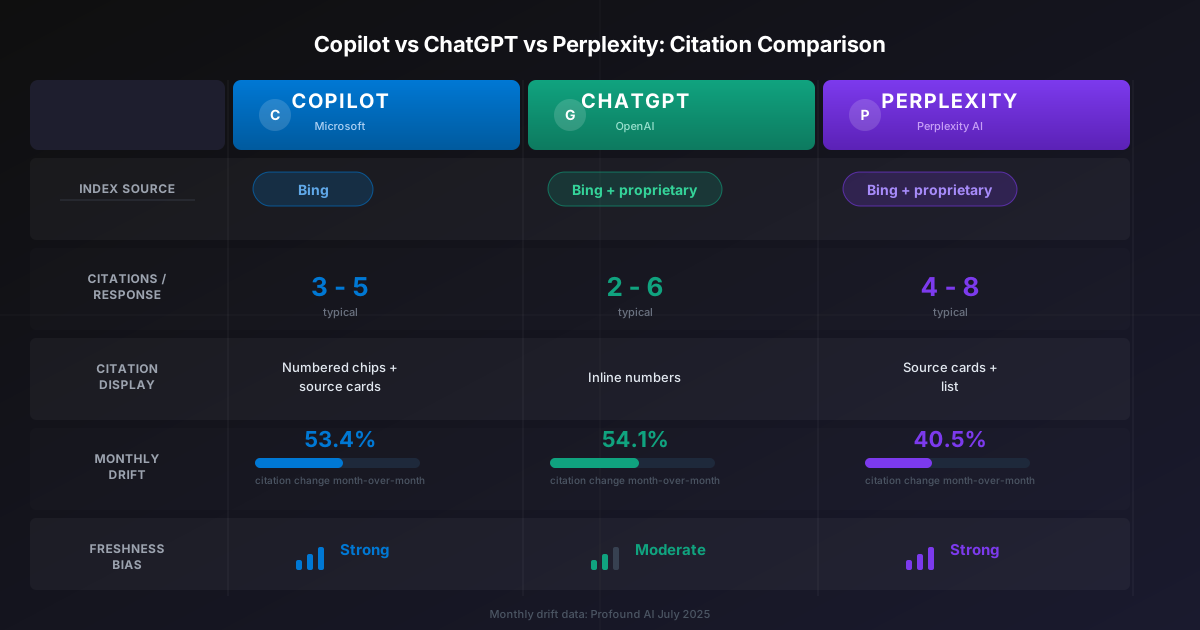
If you are running a multi-engine GEO strategy, understanding how these three platforms differ in citation behavior is critical. The table below draws on data from Profound AI's July 2025 study (Josh Blyskal and Sartaj Rajpal), which sampled approximately 80,000 prompts per platform.
| Factor | Copilot | ChatGPT | Perplexity |
|---|---|---|---|
| Index | Bing | Bing + proprietary | Bing + proprietary |
| Citations per response | 3-5 typical | 2-6 typical | 4-8 typical |
| Display style | Numbered chips + source cards | Inline superscript numbers | Source cards + numbered list |
| Monthly citation drift | 53.4% | 54.1% | 40.5% |
| Freshness bias | Strong | Moderate | Strong |
The monthly drift numbers deserve a closer look. A 53.4% monthly drift rate means more than half of all Copilot citations change within a single 30-day window - sources appear, disappear, and get swapped out at a high rate. Perplexity is the most stable of the three at 40.5%. ChatGPT is marginally more volatile than Copilot at 54.1%.
For ChatGPT's citation approach, the proprietary index gives it flexibility that Copilot lacks - it can surface content that Bing has not indexed. For Perplexity's citation model, the always-on web search and higher citations-per-response count make it a high-volume citation opportunity. For Gemini's approach, the Google index dependency creates a different prerequisite structure.
Copilot's Bing dependency makes it the most predictable of the three for optimization purposes: if you rank in Bing's top 10 for the rewritten sub-query, you are in the candidate pool. The path is clear, even if the climb is not easy.
10 Tactics to Get Cited by Copilot
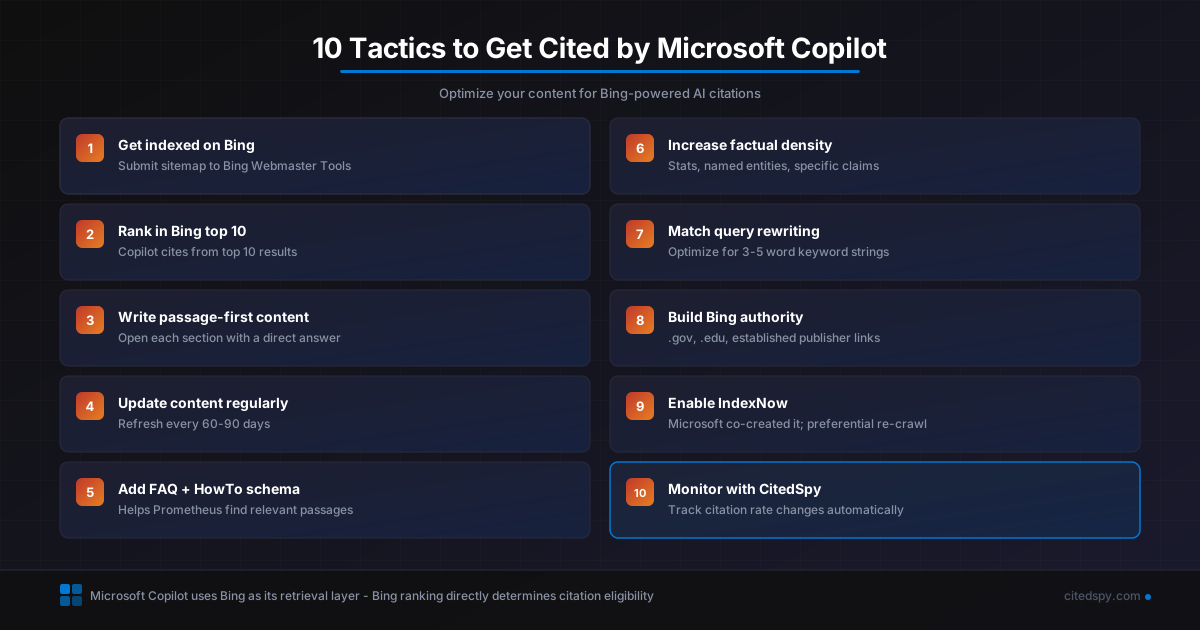
1. Get indexed on Bing first. This is the prerequisite, not a tactic. Verify your domain's Bing indexing status in Bing Webmaster Tools (webmaster.bing.com). Submit your sitemap. Check for crawl errors. If pages are not indexed, nothing else in this list matters.
2. Rank in Bing's top 10 for your target queries. Prometheus primarily cites from Bing's top 10 results for the rewritten sub-query. This means standard Bing SEO: title tag optimization, header structure, internal linking, page speed, and mobile performance. Bing and Google SEO overlap significantly, but Bing weighs domain age and traditional link signals more heavily.
3. Write passage-first content. Structure every H2 and H3 section as a standalone citation candidate. The first 1-2 sentences of each section should directly answer the implicit question the heading raises. Do not warm up to the answer - give it immediately, then support it. Aim for clear, self-contained 300-500 word sections.
4. Update content every 60-90 days. Copilot's freshness bias is strong enough to knock well-ranking content out of citation rotation if it goes stale. Build a content refresh calendar. Even minor updates - adding a new statistic, revising an outdated example, adding a new FAQ entry - reset the modification timestamp and signal recency.
5. Add FAQ schema markup. Implement FAQPage schema on any page that contains question-and-answer content. Use HowTo schema for instructional content. These structured data signals help Prometheus's retrieval system identify your passages as answers to specific questions, which aligns with how it generates sub-queries. A GEO audit is a good starting point for assessing your schema coverage.
6. Increase factual density. Review your content for vague, general claims and replace them with specific, verifiable statements. Include statistics with dates and sources, named entities (people, companies, products), and concrete examples. Factually dense passages score higher in retrieval ranking because they produce stronger matches against specific sub-queries.
7. Optimize for rewritten query patterns. Prometheus rewrites conversational questions into 3-5 word keyword strings. Think about what those strings look like for your topic: "best CRM startups 2025," "Salesforce vs HubSpot pricing," "CRM implementation timeline." Use these minimal keyword strings as H2/H3 headings and in the first sentence of the corresponding section.
8. Build Bing-weighted authority. Bing places greater weight than Google on backlinks from .gov and .edu domains, established news publishers, and high-authority industry sites. A backlink profile strong in these sources will disproportionately benefit your Bing rankings and, by extension, your Copilot citation rates. This is not a quick win, but it compounds over time.
9. Enable IndexNow. Microsoft co-created the IndexNow protocol, which allows sites to push URLs to Bing (and other participating search engines) the moment content is published or updated. Sites using IndexNow get preferential re-crawl timing on Bing. For a generative engine optimization strategy where freshness is a ranking signal, faster re-indexing directly translates to faster citation eligibility. IndexNow is free and straightforward to implement.
10. Monitor Copilot performance in Bing Webmaster Tools. Bing Webmaster Tools now surfaces some Copilot-related performance data. Use it to identify which queries are triggering citations, which pages are being retrieved, and where gaps exist. This data is limited compared to what you get from purpose-built GEO monitoring, but it is a free starting point for understanding which content Prometheus is surfacing.
How to Track Your Copilot Citations
Given a 53.4% monthly citation drift rate, tracking Copilot citations manually is not viable. You cannot ask Copilot the same 50 queries every week and log the results in a spreadsheet - or rather, you can, but you will miss the volatility and patterns that matter for brand strategy.
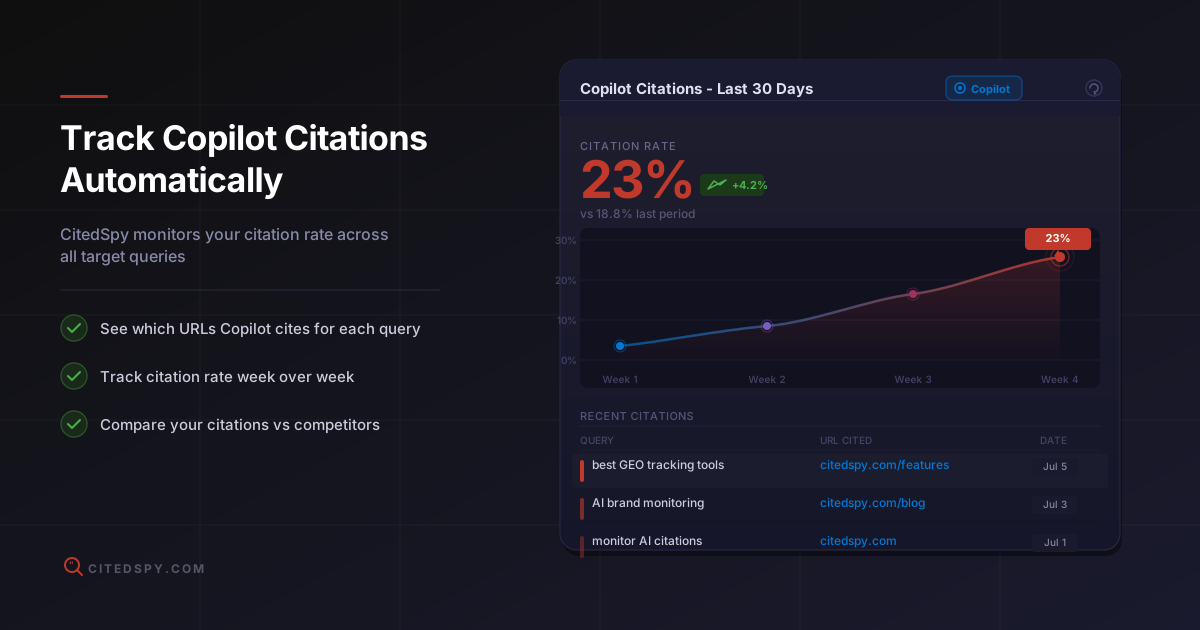
What to track: At minimum, you need to know which of your pages Copilot is citing, for which queries, and at what frequency. You also need visibility into competitor citations - who is appearing in responses where you are not. Citation drift tracking - which citations appeared this week, which disappeared - is the signal that tells you whether your optimization efforts are working.
What changes to watch for: A sudden drop in citation frequency across multiple queries often signals a content freshness issue (content has gone stale relative to competitors) or a Bing ranking change (something knocked you out of the top 10 for a key sub-query). A sudden increase often correlates with a content update or a new backlink from an authoritative source.
CitedSpy was built specifically for this kind of multi-engine GEO monitoring. It runs your tracked prompts across Copilot, ChatGPT, Perplexity, Gemini, and Claude on a regular schedule, logs citations, detects brand and competitor mentions, and surfaces drift over time. The AI share of voice metrics it produces let you compare your citation rate against competitors across all five engines simultaneously.
Frequently Asked Questions
Conclusion
Microsoft Copilot's Prometheus architecture makes it the most Bing-dependent of the major AI citation engines - which means traditional SEO fundamentals apply more directly here than anywhere else in the generative engine optimization landscape. Rank in Bing's top 10, structure your content at the passage level, maintain freshness, and layer in schema markup for question-aligned content. The 53.4% monthly drift rate is high enough that one-time optimization is not enough - Copilot citations require the same continuous monitoring discipline as any other channel where visibility can disappear in 30 days.