Most agency clients have never heard the phrase "generative engine optimization." By the end of your next discovery call, they will understand exactly why it matters - and why they need your help with it.
This guide covers the full arc of selling GEO services: how to position the service, structure the discovery conversation, package deliverables, set pricing, and retain clients month over month. It's written for agency owners, account directors, and senior strategists who want to add GEO to their service stack in 2026.
Why Agencies Are Adding GEO to Their Service Stack
The client conversation has changed. Three years ago, a CMO asking "are we showing up in search?" meant Google. Today it means ChatGPT, Perplexity, and Google AI Overviews.
The numbers explain the urgency. Semrush research found that AI search visitors convert at 4.4 times the rate of traditional organic visitors. When a buyer asks an AI engine "what project management software should I use?" and receives a named recommendation, they arrive at that brand's site already persuaded. That's the conversion advantage your clients are either capturing or missing entirely - and most don't know which.
The agency opportunity is significant because most marketing teams don't have the workflow to optimize for AI citations. It requires a combination of content strategy, technical SEO, schema implementation, and ongoing measurement that naturally fits an agency retainer model. Unlike one-time projects, GEO results drift - Profound AI found that more than 50% of AI citation positions change within a single month - which means ongoing management is genuinely required, not manufactured.
For agencies already delivering SEO and content marketing, GEO is a natural expansion. The skills overlap substantially. The difference is the measurement layer and the content optimization patterns specific to how AI engines select sources.
Understanding What You're Actually Selling
Before you can sell GEO services effectively, you need a sharp answer to the question clients will inevitably ask: what exactly is GEO, and how is it different from what you already do for us?
GEO (generative engine optimization) is the practice of optimizing content and technical signals so that AI-powered answer engines - ChatGPT, Perplexity, Google AI Overviews, Claude, Microsoft Copilot - cite and recommend your brand when users ask questions related to your category.
The key distinction from traditional SEO is the output format. SEO earns a position in a ranked list of links. GEO earns a named mention inside a synthesized answer. A user reading an AI answer doesn't choose which link to click from ten options - they receive a recommendation. That recommendation either includes your client's brand or it doesn't.
The practical implication is that brands can have strong SEO rankings and near-zero AI visibility simultaneously. Your existing SEO clients are almost certainly in this position. They've invested in ranking for keywords, but they haven't optimized for the content signals that predict AI citation.
The Princeton GEO study (Aggarwal et al., ACM KDD 2024) identified the specific content interventions that increase citation rates: adding statistics with cited sources (+41% citation lift), adding expert quotes (+28% lift), and citing authoritative external sources (large positive effect). These are not vague best practices - they're empirically tested interventions you can apply systematically.
For a thorough explanation of the discipline, the complete GEO guide covers the research foundations in detail.
The Discovery Call Framework
The fastest way to create urgency around GEO in a discovery call is to demonstrate the problem live. Don't describe what AI visibility is - show the client what their brand looks like (or doesn't look like) in an AI answer right now.
Open your laptop, navigate to ChatGPT or Perplexity, and type a prompt that mirrors how their buyers search. If you're talking to a B2B software company: "what's the best [category] tool for [their typical buyer]?" If you're talking to a professional services firm: "who are the best [service type] firms for [their industry]?"
The result does one of two things: it names them or it doesn't. If it names them, congratulations - you have a baseline and a story about protecting it. If it doesn't name them (the more common outcome), you've just made the abstract concrete. No amount of explanation creates urgency the way a live gap does.
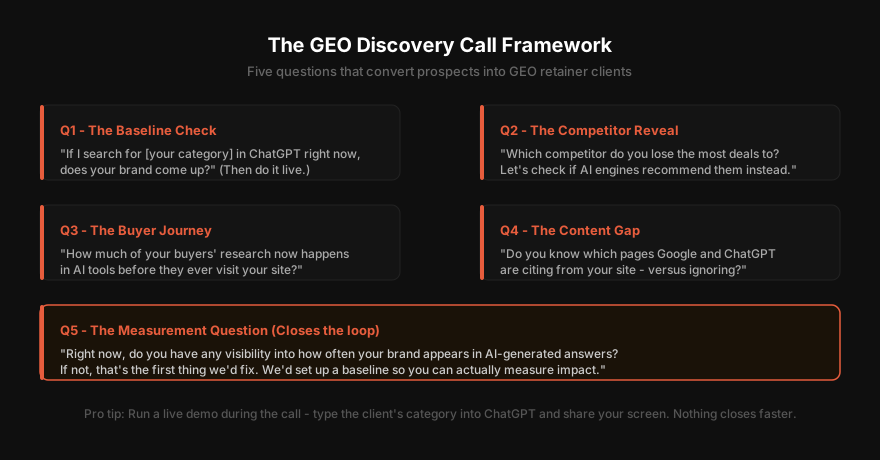
After the live demo, move through these five questions:
Question 1 - The Baseline Check: "If I search for [your category] in ChatGPT right now, does your brand come up?" You've already answered this visually, but the question forces them to sit with the result.
Question 2 - The Competitor Reveal: "Which competitor do you lose the most deals to? Let's check if AI engines recommend them instead of you." This extends the demo and creates direct competitive context. Clients who see a competitor named in an AI recommendation have an immediate emotional response that abstract statistics don't generate.
Question 3 - The Buyer Journey: "How much of your buyers' research now happens in AI tools before they ever visit your site?" Most clients don't know the answer - and that uncertainty is itself a signal that they're flying blind on an increasingly important channel.
Question 4 - The Content Gap: "Do you know which pages ChatGPT and Perplexity are citing from your site versus which pages they're ignoring?" This surfaces the technical and content audit need that becomes the foundation of your engagement.
Question 5 - The Measurement Question: "Right now, do you have any visibility into how often your brand appears in AI-generated answers?" The answer is almost always no. This opens the conversation about what measurement infrastructure looks like - and why it's the first deliverable in any GEO engagement.
The entire discovery framework works because it moves from abstract ("AI search is growing") to concrete ("your top competitor is cited in this response and you're not") to problem-aware ("we don't have measurement for this channel") in a single conversation.
Packaging GEO Services
The most natural GEO package structure for agencies follows a three-tier model: a one-time audit that converts to a retainer, a growth retainer for active optimization, and an enterprise tier for larger brands.
The GEO Audit (Entry Point)
A fixed-fee audit is the lowest-friction entry point. It solves the "show me what I'm dealing with before I commit to ongoing spend" objection and gives you a deliverable that creates urgency for the retainer.
A GEO audit covers six areas:
- Crawler access - verifying that AI engine bots (GPTBot, ClaudeBot, PerplexityBot, Google-Extended) can reach the site without robots.txt or Cloudflare blocks
- Prompt library construction - building a 25-50 prompt set that mirrors how the client's buyers search across awareness, consideration, and decision stages
- Citation baseline - running the prompt set across three to five AI engines and recording which responses cite the client
- Schema audit - checking Article, FAQPage, Organization, and Person schema on top pages against Google's Rich Results Test
- Content signal scoring - evaluating top pages for answer-first structure, statistical density, and external citation practices
- Entity signal check - assessing Knowledge Panel presence, Wikidata entry, and review platform profiles (G2, Capterra)
The audit delivers a prioritized fix list sorted by impact. The typical finding is a combination of crawler blocks that were never intentional, schema errors that suppress citation likelihood, and content pages that lack the specific signals (cited statistics, answer-first structure, FAQ markup) that AI engines extract.
Price range for an audit: $1,500 to $3,500 depending on site size and scope. The right framing is that this is a fixed-fee diagnostic that most clients convert into a retainer after seeing the findings.
For a detailed walkthrough of the audit methodology, the 30-minute GEO audit guide covers each section in a format you can adapt for client delivery.
The Monthly GEO Retainer
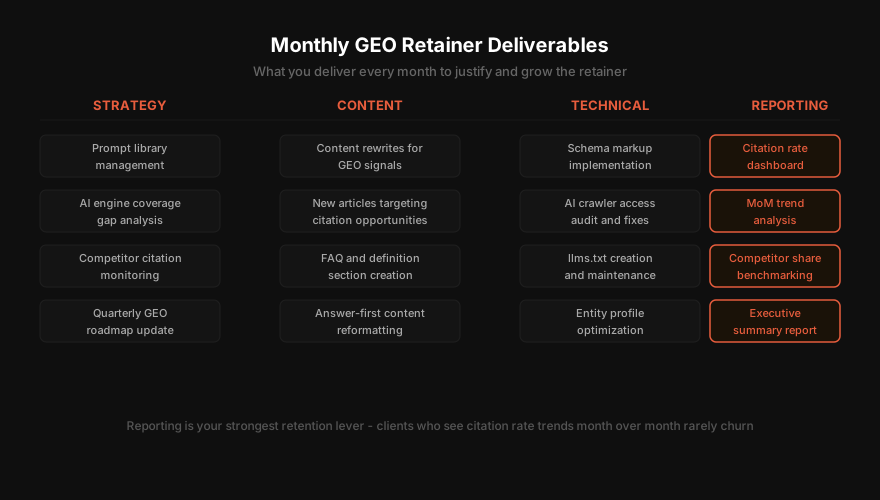
A GEO retainer has four categories of work: strategy, content, technical, and reporting. The ratio between them depends on the tier.
Strategy work includes maintaining the prompt library (adding new prompts as the client expands, removing stale ones), conducting competitive analysis to identify citation gaps where competitors are named and the client isn't, and producing a quarterly roadmap update.
Content work is the highest-leverage activity. Based on the Princeton GEO research, adding cited statistics to existing pages produces the largest measurable citation lift of any single intervention. Content work means rewriting pages to add specific sourced data points, restructuring content to lead with direct answers rather than context, creating FAQ sections that AI engines can extract directly, and publishing new articles targeting citation opportunities identified in the prompt library analysis.
Technical work includes schema implementation on pages that lack it, maintaining the client's llms.txt file so AI crawlers have a curated map of their content, and monitoring crawler access as CDN configurations change.
Reporting is the most important component for retention. Clients who see their citation rate trend month over month understand the value of the engagement viscerally. Clients who receive only an activity report - "we wrote four articles this month" - churn because they can't connect the work to an outcome.
Suggested Pricing by Tier
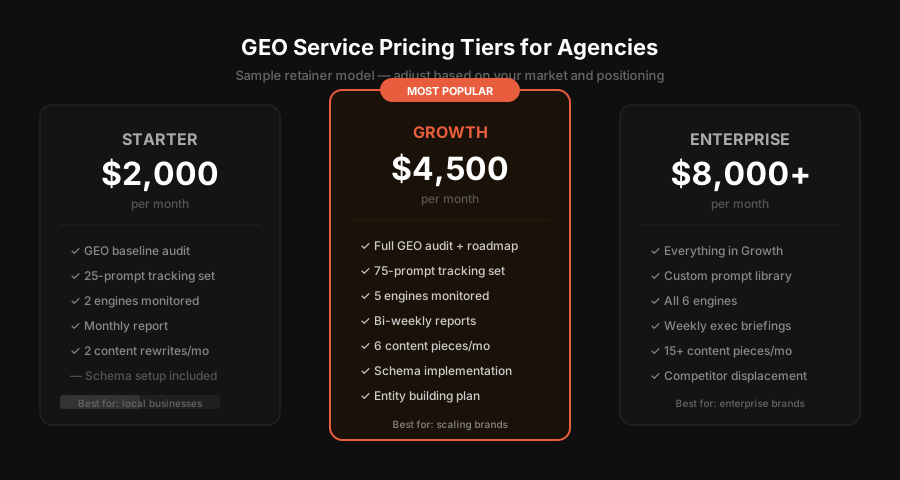
Pricing for GEO retainers varies significantly by market, agency positioning, and client size. These ranges are starting points for agencies entering the space:
| Tier | Monthly Range | What's Included |
|---|---|---|
| Starter | $1,500 - $2,500 | Audit, 25-prompt tracking, 2 engines, monthly report, 2 content rewrites |
| Growth | $3,500 - $6,000 | 75-prompt tracking, 5 engines, bi-weekly reports, 6 content pieces, schema work |
| Enterprise | $7,000 - $15,000+ | Custom prompt library, all engines, weekly briefings, 15+ content pieces, entity building |
Price positioning matters more than the absolute numbers. GEO should be positioned alongside SEO retainers, not beneath them. The measurement complexity, the content production requirements, and the ongoing optimization cadence justify retainer fees comparable to a mid-market SEO engagement.
Handling the Common Objections
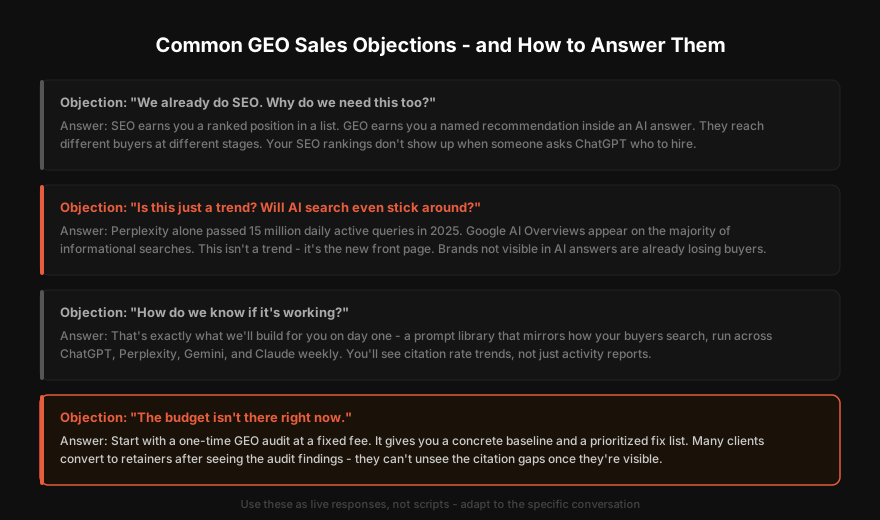
You will hear the same objections repeatedly in the first few months of selling GEO. Having crisp answers prepared makes the difference between closing and stalling.
"We already do SEO. Isn't this the same thing?"
SEO and GEO optimize for different outputs and different surfaces. SEO earns a ranked position in a list of links that users choose between. GEO earns a direct recommendation inside an AI-generated answer. The same piece of content can rank on page one of Google and never appear in a single ChatGPT response - because AI engines select sources based on citation signals (statistics, expert quotes, authoritative references, structured schema) that traditional SEO doesn't specifically optimize for.
The practical proof: take any of their well-ranking pages and run the target query in ChatGPT. In most cases, the page won't be cited despite ranking well. That gap is GEO.
"Is this just a trend?"
The behavioral data doesn't support the "just a trend" framing. Google AI Overviews appear on the majority of informational searches. Perplexity's query volume crossed 15 million daily active queries in 2025 and continues to grow. The conversion rate advantage - AI search visitors converting at 4.4x the rate of traditional organic visitors, per Semrush research - means that even brands with relatively low AI search exposure are leaving meaningful revenue on the table.
More practically: even if the specific platforms shift, the direction of travel toward AI-synthesized answers is not reversing. Brands that build citation authority now will be better positioned regardless of which engines win long-term.
"How will we know if it's working?"
This is the right objection to get, because the answer sells the value of your measurement infrastructure. Walk them through what the reporting looks like: a tracked prompt set run weekly across five engines, a citation rate percentage per engine, a month-over-month trend chart, and a competitor citation share comparison.
Clients who've never had this measurement in place immediately understand what they've been missing. The question shifts from "how do we know if GEO works?" to "how did we operate without knowing this?"
"We don't have budget for another retainer right now."
Offer the entry audit as a budget-appropriate first step. A fixed-fee diagnostic at $2,000 to $3,000 is accessible to most marketing budgets. The audit findings create the urgency for the retainer - after seeing specific pages blocked from AI crawlers, schema errors across top content, and a citation rate baseline of 5% across their prompt set, clients rarely need additional convincing about why ongoing optimization matters.
Delivering the Monthly Retainer
The first 90 days of a GEO retainer determine whether it expands or churns. There's a predictable arc.
Month 1: Foundation
The priority in month one is infrastructure. Build the prompt library - 50 to 75 prompts across three intent tiers (awareness: "what is [category]", consideration: "best [category] for [use case]", decision: "compare [client] vs [competitor]"). Run the full baseline. Fix any crawler blocks (these have immediate impact - you can't earn citations from content AI engines can't access). Implement or fix schema on the top 10 pages. Deliver a baseline report.
Set expectations clearly at the kickoff: month one results will show the baseline, not improvement. Improvement becomes visible in month two and three as content changes propagate.
Month 2-3: First Optimization Pass
Focus content work on pages with the highest gap between traditional search traffic and AI citation rate. These are pages that clearly have demand (people are searching for them) but AI engines aren't citing them. Applying the Princeton GEO interventions - adding cited statistics, restructuring to answer-first, adding FAQ markup - to these pages typically produces measurable citation rate improvement within four to six weeks.
Share comparison data in the monthly report: citation rate this month versus last month, broken down by engine. Even modest improvements (say, from 8% to 14%) are visible and meaningful when the trend is upward.
Month 4+: Expansion
By month four, you have three months of trend data, a prioritized fix list, and a client who has seen their citation rate move. This is when the retainer conversation naturally expands - more content volume, additional engines, competitive displacement work. Clients who've seen growth in their citation rate are the easiest upsell conversations in agency work.
The Reporting Layer is Your Retention Engine
The single most common reason GEO retainers churn is reporting that shows activity rather than outcomes. "We published four articles and updated three pages" is not a retainer justification. "Your citation rate on Perplexity increased from 11% to 28% month-over-month, and you now appear in two ChatGPT responses where Competitor A was previously the only named brand" - that's a retainer justification.
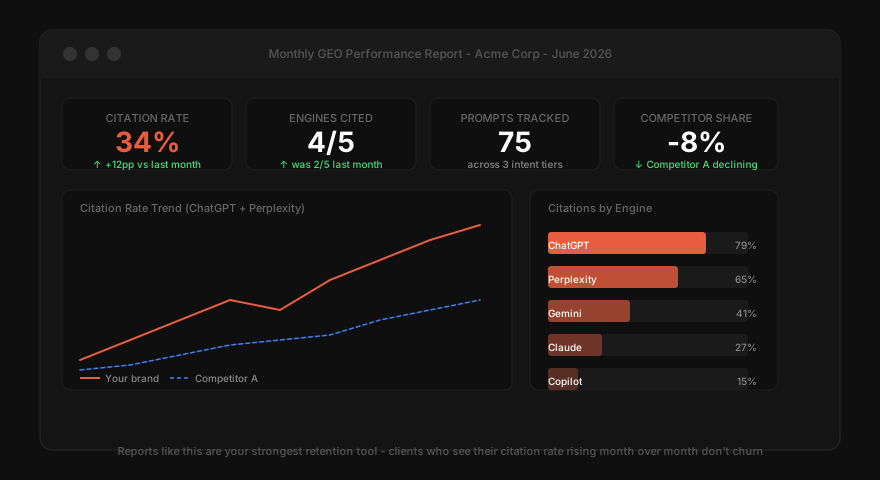
Build your reporting around four metrics:
Citation rate by engine - the percentage of your tracked prompts that return a response citing the client, per engine. This is the core GEO metric.
Month-over-month trend - citation rate change. This is the metric clients will anchor their renewal decision on.
Competitor citation share - how often competitors appear in the same prompt set. Clients who see their share increasing relative to competitors feel the strategic value of the work.
Citation-driving pages - which specific pages are being cited and which aren't. This connects content decisions to outcomes.
The practical infrastructure question is how you gather this data at scale across five engines and 75 prompts each week. Manual collection doesn't scale past a handful of clients. Most agencies at this stage either build internal tooling or use purpose-built GEO tracking software that can run prompt sets automatically and export the citation rate data for client reports.
CitedSpy is built specifically for this workflow - it runs tracked prompt sets across ChatGPT, Perplexity, Gemini, Claude, and Copilot continuously and surfaces citation rates, trends, and competitor comparisons in a shareable dashboard. For agencies managing multiple clients, having per-client workspaces with automated citation tracking makes the reporting layer operationally feasible.
Building Your GEO Capability
The fastest path to GEO service delivery competency is to run the audit and retainer workflow on your own agency website first. This gives you:
- A real dataset to reference in discovery calls ("here's what we found when we ran this on ourselves")
- A working understanding of where the work is harder or easier than you expected
- A case study in progress that becomes your first public proof point
The learning curve is real but not steep. If you already deliver SEO and content marketing, you have 80% of the underlying skill set. The additions are: understanding how AI engines select sources differently than search engines, implementing schema types you may not have used before (especially FAQPage and Person schema), and building the measurement infrastructure to track citation rates rather than just keyword rankings.
For the underlying strategy and how GEO compares to SEO as a channel at different company growth stages, those guides cover the strategic framing you'll want to reference in client conversations.
The market for GEO services is early. Most agencies don't offer it yet, most clients don't know they need it yet, and the gap between AI search behavior and brand visibility investment is large. That combination - early market, clear client need, measurable outcomes - is exactly when agencies build lasting competitive advantages.