Share of voice and competitor rankings
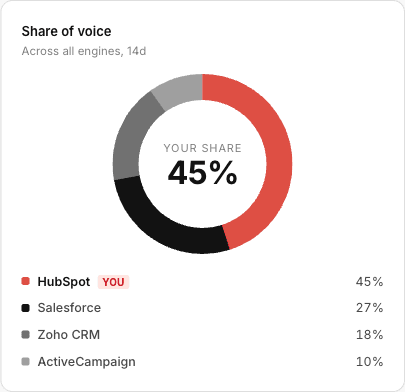
Share of voice is the number customers question most often, because the figure on the donut is not the figure that was first calculated. Here is exactly what happens.
It is calculated in two steps
Step 1 - the raw share
                your discovery mentions
Raw share =  ------------------------------  x 100
             ALL company mentions in those
                same discovery runs
The bottom of that fraction counts every company you track, including the ones not shown on the chart.
Step 2 - rescaling to fit the chart
The donut only shows your top competitors, five by default. Their raw shares add up to well under 100%, because the rest of the field was cut. So the chart rescales the shares it is showing until they total exactly 100%.
Leftover whole numbers go to whichever shares had the largest fractional remainders, which is why the legend never reads 99% or 101%.
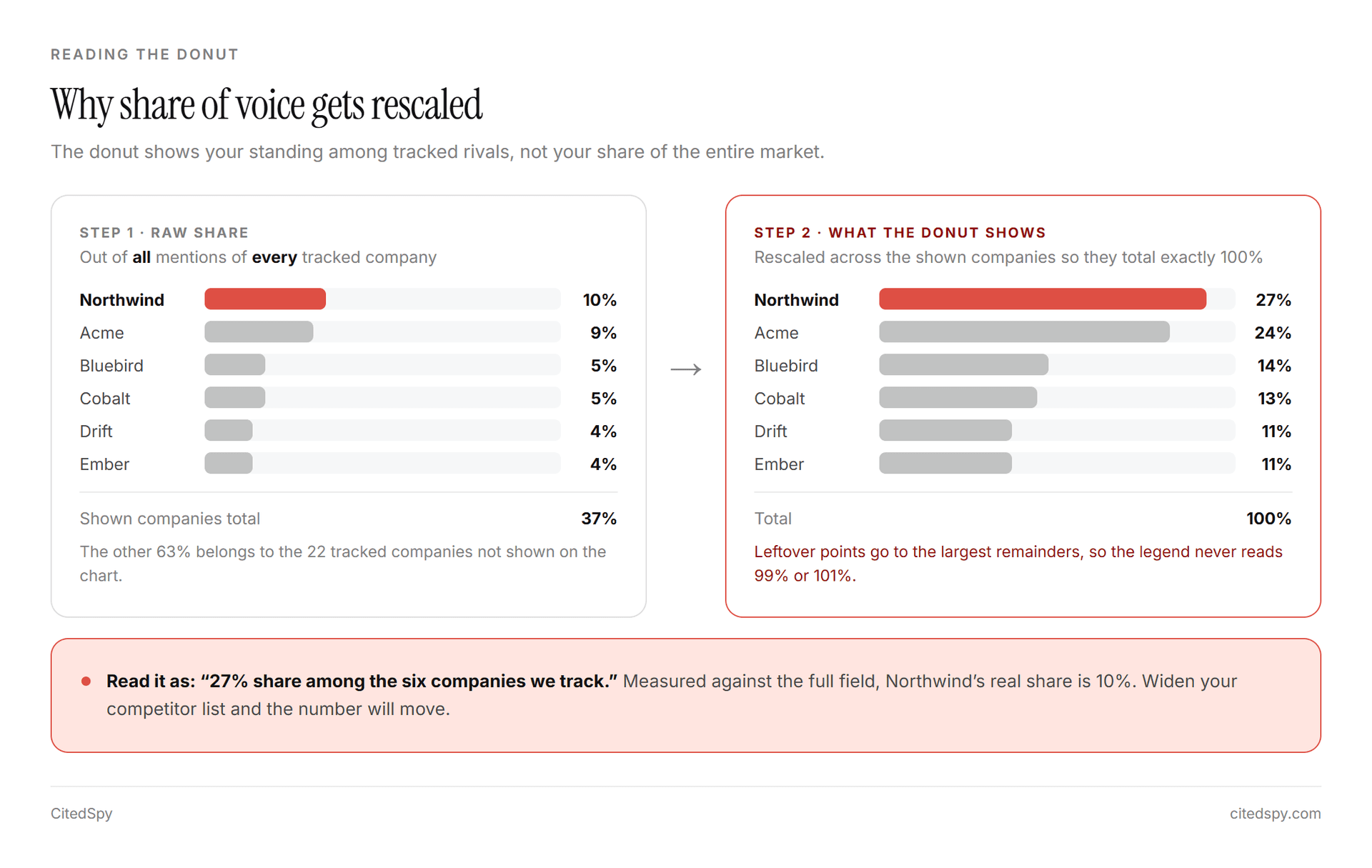
| Company | Raw share | Shown on donut |
|---|---|---|
| Northwind (you) | 10% | 27% |
| Acme | 9% | 24% |
| Bluebird | 5% | 14% |
| Cobalt | 5% | 13% |
| Drift | 4% | 11% |
| Ember | 4% | 11% |
| Total | 37% | 100% |
How to read it correctly
The donut says: "27% share of voice among the six companies being tracked."
It does not say you hold 27% of all AI mentions in your category. Measured against the full field of tracked companies, the real figure in this example is 10%.
This is not a flaw - it is what makes the chart useful. Comparing yourself against a fixed set of named rivals is far more actionable than a share of an unbounded market. Just describe it accurately when you put it in a client report.
One practical consequence: if you widen your competitor list from five to fifteen, your displayed share will go down, even though nothing about your actual visibility changed. The denominator got bigger.
Which competitors appear
The chart surfaces your top rivals ranked by discovery mention volume, so the list matches the discovery-only share shown beside it. You can change how many appear from the Brands page, choosing Top 5, 10, 15 or 25.
Rivals beyond the cap are still tracked and still counted in the raw totals. They are just not drawn, to keep the chart readable.
Top competitors card
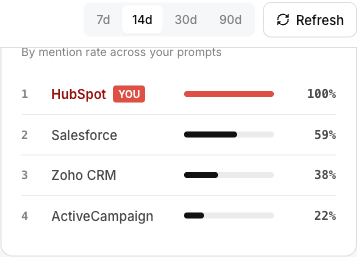
This card uses the identical rescaled list, so the two can never disagree. One display note: each bar is drawn relative to the leader, not to 100%. The top competitor's bar is always full width. The printed percentage is the true value.
Brand rankings
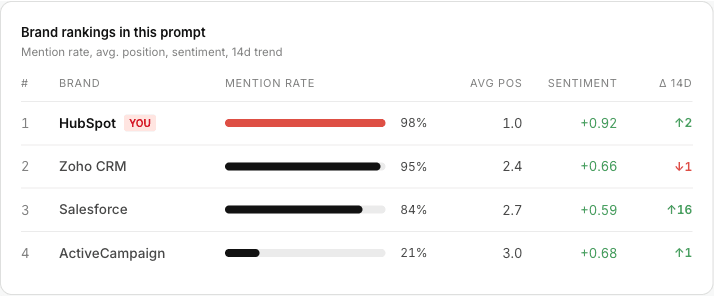
On a prompt report you also get a rankings table, which is where share of voice becomes genuinely diagnostic.
| Brand | Mention rate | Avg position | Sentiment |
|---|---|---|---|
| Northwind (you) | 92% | 2.6 | +0.27 |
| Acme | 92% | 3.3 | +0.27 |
| Bluebird | 83% | 3.8 | +0.30 |
| Cobalt | 67% | 10.0 | +0.75 |
Read across, not just down. Northwind and Acme are tied on visibility at 92%, but Northwind is named earlier in the sentence, at position 2.6 versus 3.3. Cobalt is the opposite case: it appears in two thirds of answers, but typically as the tenth name in a list. High visibility, very low prominence.