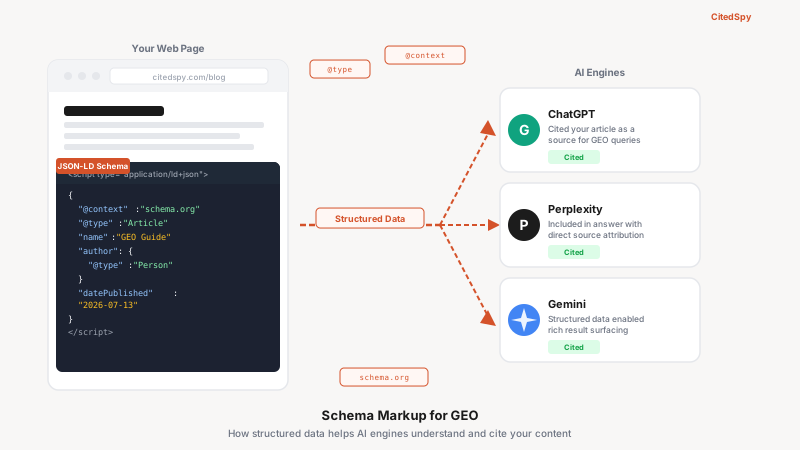
Schema markup for GEO is structured data (usually JSON-LD) added to your pages so AI engines like ChatGPT, Perplexity, and Google AI Overviews can parse your content, understand entity relationships, and trust it enough to cite it. In plain terms: schema markup for GEO is how you translate your content into a language machines read fluently, and machine-readable content gets cited more often.
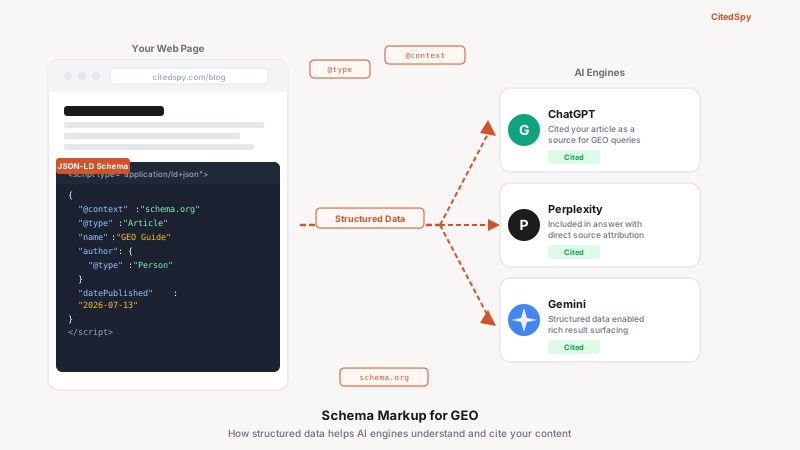
I have spent the last year auditing structured data on sites that get cited by AI engines and sites that do not, and the pattern is consistent. The pages that win citations are rarely the ones with the flashiest copy. They are the ones that hand AI systems clean, structured signals about who wrote the content, when, what it claims, and how it connects to a real entity. That is what schema markup for GEO does.
This guide walks through every schema type that matters for generative engine optimization, why it works, the exact JSON-LD you should ship, the mistakes I see constantly, and how to validate it all. If you want the broader strategic picture first, start with the generative engine optimization guide, then come back here for the technical implementation.
What Schema Markup for GEO Actually Does
Schema markup is a vocabulary from schema.org that labels the meaning of your content. Without it, an AI crawler sees a wall of text and has to *infer* what is a headline, what is an author, what is a step, and what is a fact. With schema markup for GEO, you tell it explicitly.
Here is why that matters for citations specifically. AI engines do not just need to *read* your page - they need to *trust* it enough to attribute an answer to you. Structured data feeds three things AI systems care about deeply:
- Content hierarchy - what the page is about, what its sections mean, and how they relate.
- Entity relationships - who published it, who wrote it, and what real-world entities (companies, people, products) it connects to.
- Credibility signals - publication dates, author credentials, and external validation links that establish trust.
The research backs this up. The Princeton GEO study (Aggarwal et al., ACM KDD 2024) found that citing authoritative sources increased a page's citation likelihood by up to 115%, and adding statistics lifted it by 41%. Schema markup does not create those facts, but it structures them in a way AI systems extract reliably. On the engine side, analysis of Perplexity's citation behavior found that pages *with* schema markup achieved a 47% top-3 citation rate versus 28% without schema - a meaningful gap for the same underlying content.
That is the whole thesis of structured data for AI citations: same content, more signal, more citations.
JSON-LD Is the Only Format You Should Use
Schema.org supports three syntaxes: JSON-LD, Microdata, and RDFa. For GEO, you should use JSON-LD and ignore the other two.
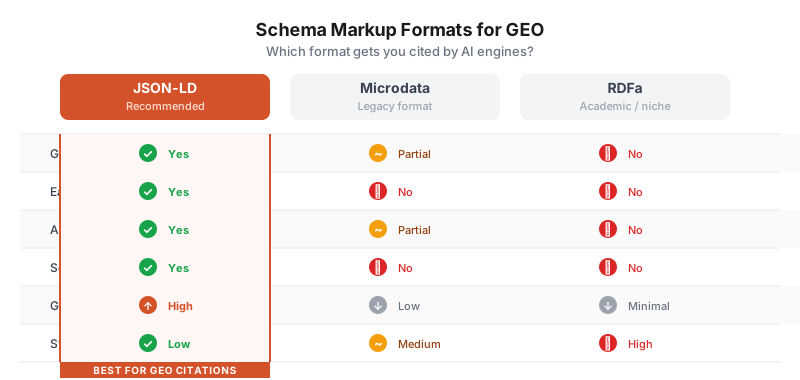
JSON-LD (JavaScript Object Notation for Linked Data) is Google's officially recommended format, and it is by far the easiest for AI systems to parse. It lives in a single <script> block in your page <head> or <body>, completely separate from your visible HTML. That separation is exactly why it wins.
| Factor | JSON-LD | Microdata | RDFa |
|---|---|---|---|
| Google recommended | Yes | No | No |
| Separated from HTML | Yes | No (inline attributes) | No (inline attributes) |
| Ease of AI parsing | High | Medium | Medium |
| Maintainability | High - one block | Low - scattered | Low - scattered |
| Risk of breaking on redesign | Low | High | High |
With Microdata and RDFa, your structured data is woven into HTML tags as attributes. Every time a developer touches the template, the markup can break silently. I have seen this happen on more sites than I can count - a redesign ships, and six months of carefully built Microdata quietly stops validating.
JSON-LD sits in one isolated block. You can generate it programmatically, template it, validate it independently, and it survives redesigns. For JSON-LD GEO work, there is genuinely no reason to choose anything else.
The Schema Types That Matter for GEO
Not every schema type moves the needle for AI citations. After auditing dozens of sites, here is how I rank them by GEO impact.
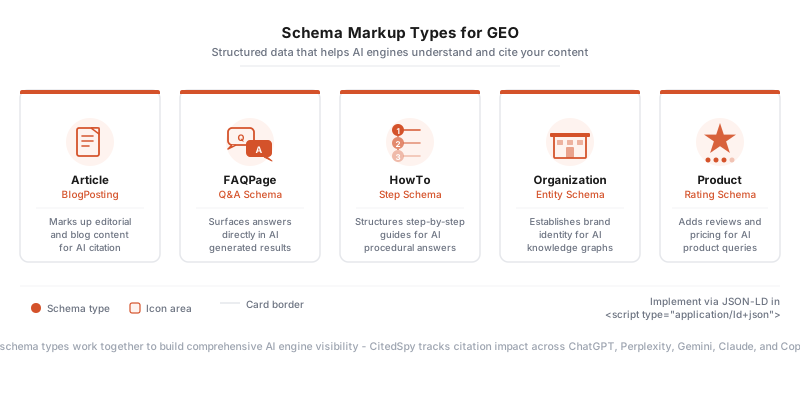
| Schema Type | Best For | GEO Impact |
|---|---|---|
Article / BlogPosting | All editorial content | High - establishes authorship and freshness |
FAQPage | Q&A content, help pages | High - maps directly to AI answer format |
HowTo | Step-by-step guides | High - maps to process-oriented answers |
Organization | Company / brand pages | High - establishes entity identity |
SoftwareApplication | SaaS products | Medium-High - defines the product entity |
Product + AggregateRating | Tools, physical products | Medium - adds ratings and review signals |
WebPage | Any page | Medium - baseline page context |
BreadcrumbList | Site structure | Low-Medium - clarifies hierarchy |
The three with the highest direct impact on structured data AI citations are Article/BlogPosting, FAQPage, and HowTo. I will give you full JSON-LD for each of those below, plus the entity-level Organization schema that ties your whole site together.
Article and BlogPosting Schema
Every editorial page you publish should carry Article or BlogPosting schema. This is the single most important schema markup for GEO on a content site, because it establishes the four signals AI engines weigh most: headline, author, datePublished, and dateModified, plus a publisher with a logo.
Here is a complete example:
{
  "@context": "https://schema.org",
  "@type": "BlogPosting",
  "headline": "Schema Markup for GEO: The Complete 2026 Guide",
  "description": "How to use structured data to earn AI citations.",
  "image": "https://example.com/blog/schema-markup-geo-hero.jpg",
  "datePublished": "2026-07-13T09:00:00Z",
  "dateModified": "2026-07-13T09:00:00Z",
  "author": {
    "@type": "Person",
    "name": "Jane Doe",
    "url": "https://example.com/about",
    "sameAs": [
      "https://www.linkedin.com/in/janedoe",
      "https://twitter.com/janedoe"
    ]
  },
  "publisher": {
    "@type": "Organization",
    "name": "Example Co",
    "logo": {
      "@type": "ImageObject",
      "url": "https://example.com/logo.png"
    }
  },
  "mainEntityOfPage": {
    "@type": "WebPage",
    "@id": "https://example.com/blog/schema-markup-geo"
  }
}
The author block is the part most sites get wrong. An anonymous post signals far less trust than one attributed to a named Person with sameAs links to LinkedIn or other profiles. Those sameAs links connect your author to a real, verifiable identity - which is exactly the E-E-A-T signal that AI engines and Google's quality systems reward. If you take one thing from this section: never ship Article schema without a real author entity and sameAs links.
FAQPage Schema
FAQPage schema converts your question-and-answer content into structured data AI engines can lift directly. This is powerful for GEO because AI answers *are* question-and-answer content - the format maps one-to-one. FAQPage schema AI extraction is about as frictionless as it gets.
{
  "@context": "https://schema.org",
  "@type": "FAQPage",
  "mainEntity": [
    {
      "@type": "Question",
      "name": "What is schema markup for GEO?",
      "acceptedAnswer": {
        "@type": "Answer",
        "text": "Schema markup for GEO is structured data added to pages so AI engines can parse content, understand entities, and cite it reliably."
      }
    },
    {
      "@type": "Question",
      "name": "Does schema markup increase AI citations?",
      "acceptedAnswer": {
        "@type": "Answer",
        "text": "Yes. Pages with schema markup show higher top-3 citation rates in engines like Perplexity than pages without it."
      }
    }
  ]
}
Add FAQPage schema to any page that answers common questions - product pages, help articles, and the FAQ section of blog posts. This is also the schema type most closely tied to Google AI Overviews, since Overviews frequently surface Q&A style answers.
HowTo Schema
HowTo schema structures step-by-step instructional content into discrete, numbered steps. AI engines use this for process-oriented queries - "how do I set up X," "steps to do Y" - and structured steps are far easier to extract than steps buried in prose.
{
  "@context": "https://schema.org",
  "@type": "HowTo",
  "name": "How to add schema markup for GEO",
  "step": [
    {
      "@type": "HowToStep",
      "position": 1,
      "name": "Choose the schema type",
      "text": "Match the page to Article, FAQPage, or HowTo."
    },
    {
      "@type": "HowToStep",
      "position": 2,
      "name": "Write the JSON-LD",
      "text": "Build the structured data block with all required fields."
    },
    {
      "@type": "HowToStep",
      "position": 3,
      "name": "Validate and ship",
      "text": "Test with Google Rich Results, then deploy to the page head."
    }
  ]
}
Use HowTo schema wherever your content genuinely describes a process. Do not force it onto conceptual content - AI engines and Google both penalize schema that misrepresents the page.
Organization and Entity Schema for Brand Identity
Beyond page-level schema, you need Organization schema to establish your brand as a coherent *entity*. This is foundational to GEO because AI engines increasingly reason about entities, not just pages. When someone asks an AI engine "what is the best tool for X," it is comparing entities it recognizes.
Organization schema defines your name, URL, logo, and - critically - sameAs links to your authoritative external profiles:
- LinkedIn company page
- G2 or Capterra listing
- Wikidata or Wikipedia entry
- Crunchbase profile
- Your verified social accounts
Those sameAs links are the connective tissue that tells AI systems "this brand is the same entity referenced across the web." Missing sameAs links is one of the most common gaps I find in schema markup for GEO audits. Without them, your brand looks like an island instead of a recognized entity in a knowledge graph.
If you sell software, layer SoftwareApplication schema on top of Organization to define the product itself - its category, operating system, and offers. For tools and products with reviews, add Product schema with an AggregateRating to surface star ratings and review counts, which reinforce credibility signals AI engines pick up on. This is especially relevant if you are doing GEO for SaaS, where the product entity is what you most want cited.
Common Schema Markup Mistakes That Kill Citations
I audit a lot of structured data, and the same mistakes show up over and over. Here are the ones that actively cost you AI citations.
- Using Microdata instead of JSON-LD. Microdata breaks on redesigns and is harder for AI systems to parse. Migrate to JSON-LD.
- Incomplete Article schema. Missing
dateModified, nopublisherlogo, or a bareheadlinewith nothing else. Fill every recommended field. - Missing the author entity. Attributing a post to a plain string instead of a full
Personobject withsameAslinks. This is the biggest E-E-A-T miss. - No `sameAs` links on Organization. Your brand floats disconnected from LinkedIn, G2, and Wikidata, so AI engines cannot map it to a known entity.
- Schema that does not match visible content. If your
FAQPageschema contains Q&A that is not actually on the page, you risk penalties and lost trust. - Only marking up the homepage. GEO citations happen on deep content pages. Every editorial page needs
ArticleorBlogPostingschema, not just the front page. - Never validating. Shipping schema and never checking whether it parses. Broken schema helps no one.
Fixing these is usually a fast, high-leverage win. Structured data is one of the few GEO levers you fully control - unlike rankings or model behavior, you can ship correct schema this afternoon. If you are running a broader GEO audit, schema validation should be one of the first checks.
How to Validate Your Schema Markup
Never ship schema you have not validated. There are three tools I use on every implementation, and each catches different problems.
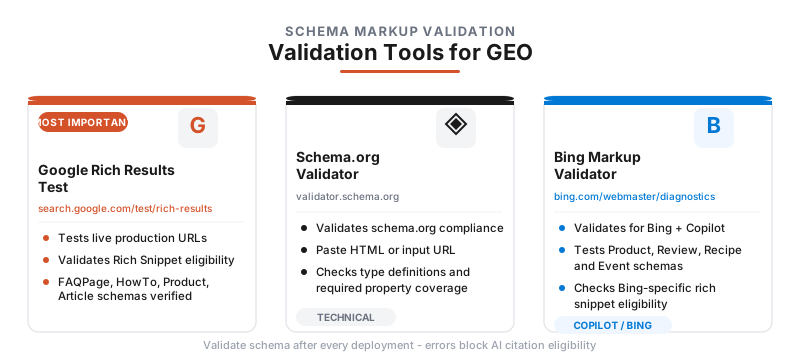
| Tool | What It Checks | Best For |
|---|---|---|
| Google Rich Results Test | Whether schema is eligible for Google rich results | Article, FAQ, HowTo eligibility |
| Schema.org Validator | Raw schema.org syntax correctness | Catching structural and type errors |
| Bing Markup Validator | Bing / Copilot-oriented markup checks | Copilot and Bing-facing validation |
My workflow is simple:
- Draft the JSON-LD.
- Paste it into the Schema.org Validator to catch syntax and type errors first.
- Run it through the Google Rich Results Test to confirm rich-result eligibility.
- Check the Bing Markup Validator if Copilot visibility matters to you.
- Deploy, then re-test the live URL to confirm it parses in production.
That last step matters. Schema that validates in a paste box can still break once your CMS or framework renders it. Always test the live URL.
Putting It All Together: A GEO Schema Rollout
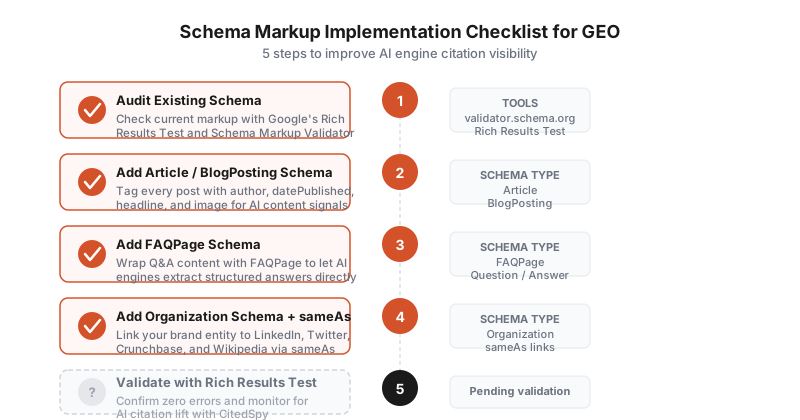
If you are starting from scratch, here is the order I would implement schema markup for GEO across a site:
- Ship
Organizationschema site-wide with completesameAslinks. - Add
WebSiteandBreadcrumbListschema for baseline structure. - Add
ArticleorBlogPostingschema to every editorial page, each with a realPersonauthor. - Add
FAQPageschema to help pages and blog FAQ sections. - Add
HowToschema to every genuine step-by-step guide. - If you sell software, add
SoftwareApplication; if you sell products, addProductwithAggregateRating. - Validate everything, then re-validate the live URLs.
Schema markup does not *guarantee* citations - content quality, authority, and freshness still matter enormously. But it removes friction from the entire citation pipeline, and in a space as competitive as AI search, removing friction is often the difference between being cited and being skipped.
Once your structured data is live, the next question is whether it is actually working. That is where measurement comes in. You want to know which engines cite your schema-optimized pages, how your AI share of voice compares to competitors, and whether a schema change moved your citation rate. CitedSpy tracks exactly that across ChatGPT, Perplexity, Gemini, Claude, and Copilot, so you can connect a structured data change to a real citation outcome instead of guessing.
Frequently Asked Questions
Schema markup for GEO is one of the highest-leverage, most controllable tactics in generative engine optimization. You cannot force an AI engine to like your brand, but you can hand it clean, structured, trustworthy signals - and the research shows those signals move citation rates. Ship Article, FAQPage, HowTo, and Organization schema in JSON-LD, connect your entity with sameAs links, validate everything, and then measure the outcome. CitedSpy tracks your citations across every major AI engine so you can prove your schema markup for GEO is actually earning the mentions it is designed to win.