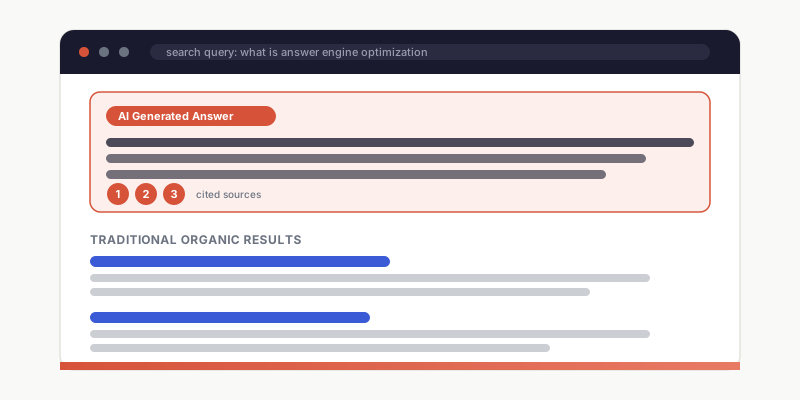
Answer engine optimization (AEO) is the practice of structuring your content so AI-powered answer engines - ChatGPT, Perplexity, Google AI Overviews, and voice assistants - can extract and cite it when generating responses to user queries. Where SEO earns you a blue link, AEO earns you the answer itself.
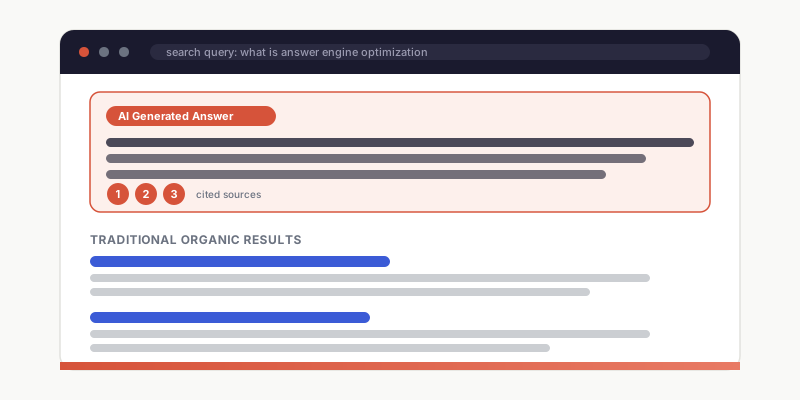
If you have noticed your organic traffic declining despite stable or improving rankings, you are experiencing the AEO effect firsthand. Zero-click searches reached 68% of all U.S. Google searches in early 2026, up from 60.45% in 2024 - the fastest acceleration SparkToro has ever recorded. The question is no longer whether AI is changing how people find information. It is whether your content is structured to be cited when it does.
What Is Answer Engine Optimization?
Answer Engine Optimization is the process of creating and formatting content so that AI answer engines can easily understand and surface it to answer user questions. The term was coined by Jason Barnard in January 2018, introduced in a Trustpilot white paper titled "The New Face of SEO: Answer Engine Optimization" and formalized at BrightonSEO in April 2018.
Barnard originally applied it to voice assistant responses and Google's featured snippets. The concept has since expanded to cover every surface where an AI system generates a synthesized answer instead of returning a list of links - Google AI Overviews, ChatGPT, Perplexity, Microsoft Copilot, and Gemini.
AEO is also the oldest of the three terms you may encounter: AEO predates both GEO (Generative Engine Optimization) and AIO (AI Optimization) as labels. If you want to understand where each sits in relation to the others, the GEO vs AEO vs LLMO comparison breaks down the definitional differences clearly.
Why AEO Matters Right Now
The traffic data makes the case bluntly.
A Pew Research Center study (July 2025) tracked 68,879 real U.S. Google searches by 900 adult participants. When a Google AI Overview appeared, only 8% of searches led to a click on a traditional result. Without an AI Overview, the click rate was 15% - a 47% relative reduction. An additional 26% of users ended their browsing session entirely after viewing the AI Overview, compared to 16% without one.
Ahrefs studied 300,000 keywords and found that when an AI Overview is present, position 1 CTR dropped 58% - from 0.073 to 0.016. The falloff continues down the page: position 2 dropped 50.8%, position 3 dropped 46.4%.
The response to this is not panic - it is adaptation. Brands cited in AI Overviews earn 35% more organic clicks than uncited competitors on the same queries (Seer Interactive, November 2025). Being the cited source turns the AI answer into a referral, not a dead end.
AEO vs SEO: The Core Differences
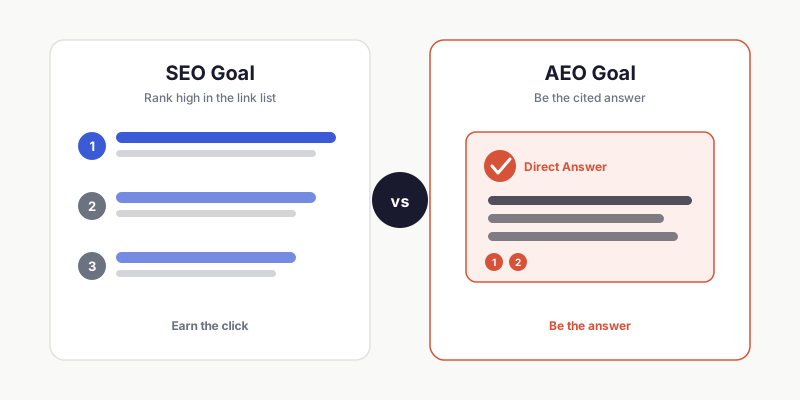
AEO does not replace SEO. The two are complementary, with SEO providing crawlability and domain authority that feeds directly into AEO citation likelihood. But they optimize for fundamentally different outcomes.
| Dimension | SEO | AEO |
|---|---|---|
| Primary goal | Rank high in traditional SERPs | Get cited in AI-generated answers |
| Content approach | Keyword-rich, long-form depth | Structured, concise, directly answerable |
| Target surfaces | Blue links, knowledge panels | AI Overviews, ChatGPT, Perplexity, voice |
| User interaction | Browse and click links | Read AI answer, optionally visit source |
| Success metrics | Rankings, organic traffic, CTR | AI mentions, citation frequency, brand visibility |
| Query type | Text-based keyword queries | Conversational, question-format, long-tail |
The practical implication: you need both. Strong domain authority built through SEO is one of the signals AI systems use to determine citation-worthiness. But rank position alone no longer predicts AI citation. OmniBound's 2026 data found that only 17% of AI Overview citations come from pages ranking in the organic top 10 - down from 76% in mid-2024. Rank and citation are decoupling fast.
For a deeper look at how these disciplines interact at scale, the GEO vs SEO comparison covers the strategic tradeoffs in more detail.
Featured Snippets: Still the Gateway to AI Citation
Before AI Overviews, winning a featured snippet was the peak of AEO. That is still true - and now it is also the highest-leverage path into AI citation.
Pages with existing featured snippets are cited in AI Overviews at roughly 2x the rate of non-snippet pages. Win the snippet, and you dramatically improve your odds of appearing in the AI answer too.
Ahrefs tracked featured snippet prevalence across approximately 112 million U.S. keywords and found snippets appear on 12.29% of queries. Semrush puts the figure higher at around 19%. What both sources agree on: featured snippet frequency declined 64% between January and June 2025 (Ahrefs), coinciding with Google's expansion of AI Overviews, which often replace snippets on the same queries.
The Four Types of Featured Snippets
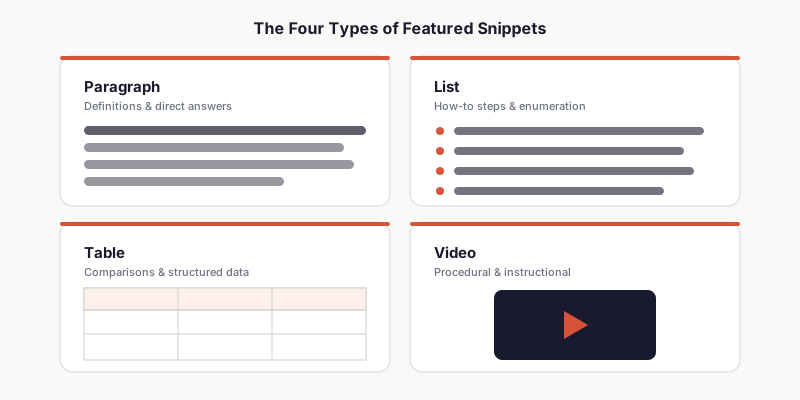
Each snippet type requires a different content structure:
Paragraph snippets - for definitions and direct answers. Write 40-60 words, lead with the direct answer, no preamble.
List snippets - for "how to" and enumeration queries. Use ordered lists (for steps) or unordered lists (for options). 5-8 items is the typical extraction range.
Table snippets - for comparisons and structured data. Use proper table markup with header and body rows. Google's extractor requires semantic HTML, not CSS-styled divs.
Video snippets - for procedural and instructional queries. Less directly controllable; requires YouTube hosting with precise timestamps.
The Non-Negotiable Formatting Rule
Bury the answer and you are disqualified. Google's extractor requires the answer to be the first content after the heading - no throat-clearing, no "in this article we will explore," no context-setting preamble. The pattern is: question-format H2 heading, direct answer sentence, then elaboration.
Voice search makes this even more critical. Featured snippets supply 40.7% of voice assistant answers (Backlinko), and voice queries average 29 words vs. 3-4 for text. Conversational, snippet-format content wins both.
Schema Markup for AEO
Google's official documentation states explicitly: "There are no additional requirements to appear in AI Overviews or AI Mode, nor other special optimizations necessary." Standard crawlability and helpful content principles apply for AI Overviews specifically.
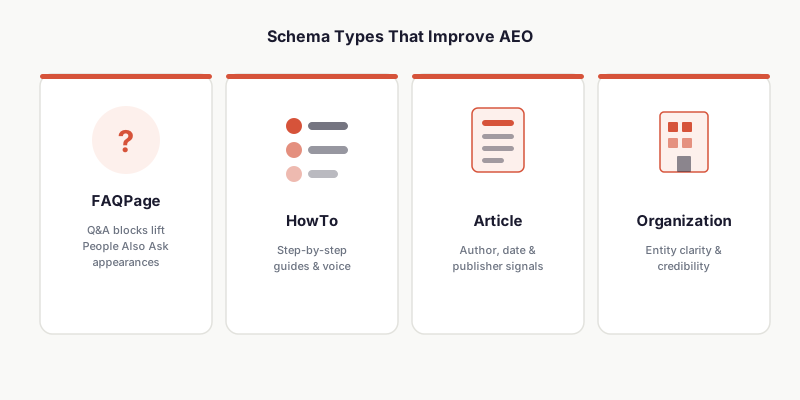
That said, structured data remains high-value for other AEO surfaces - voice search, People Also Ask, rich results, and the entity understanding that underpins AI citation decisions. Here is what actually moves the needle:
| Schema Type | Best For | AEO Impact |
|---|---|---|
| FAQPage | Support pages, comparison pages, product pages | Pages with FAQ schema are 3x more likely to be cited by AI search engines (seoscore.tools, 2026); 45% increase in People Also Ask appearances |
| HowTo | Step-by-step guides, tutorials | Pairs with ordered list formatting for featured snippet capture; surfaces in voice and AI answers for procedural queries |
| Speakable | FAQ sections, definition passages | Marks passages as suitable for voice assistant reading; directly relevant for voice AEO |
| BreadcrumbList | All non-root pages | Improves entity clarity and hierarchical context across all AI surfaces |
| Article / BlogPosting | Editorial content | Establishes authorship, publication date, and publisher entity - signals AI systems use to assess credibility |
Implementation rules:
- JSON-LD format only - Google's required format, and the easiest to maintain
- FAQPage: 3-8 questions per page, answers 50-200 words each, one FAQPage schema per URL
- Schema must match visible page content exactly - Google validates this and will not display rich results where markup diverges from what users see
- Validate everything with the Google Rich Results Test before deployment
One important caveat from March 2026: Google's core update reduced rich results for sites using schema as a decoration layer without genuine content alignment. Sites with authentic, structured content retained rich results. Schema amplifies good content; it does not substitute for it.
Content Signals That Drive AI Citation
The Princeton / Georgia Tech / IIT Delhi GEO study (published at ACM KDD 2024) tested nine content interventions across 10,000 queries to measure what actually increases AI citation visibility. The results:
| Tactic | Visibility Lift | Notes |
|---|---|---|
| Statistics addition | +41% | Adding specific numbers, percentages, dates |
| External source citations | +115% | Effect strongest for lower-ranked pages (5th position and below) |
| Quotation addition | +28% | Direct attributed quotes from credible third parties |
| Keyword density / repetition | Negative | LLMs penalize thin, repetitive content |
Additional signals from the ConvertMate GEO Benchmark 2026:
- Pages over 20,000 characters receive 4.3x more AI citations than pages under 500 characters
- Content updated within 30 days yields 3.2x more citations than stale content
- 44.2% of all LLM citations come from the first 30% of content (SparkToro, January 2026) - front-load your key claims
On the authority side, an Ahrefs study of 75,000 brands (August 2025) found that brand mentions correlate with AI visibility at 0.664, versus 0.218 for backlinks. Earned media dominates: 82% of AI citations come from earned media, not owned or paid content (Muck Rack, December 2025).
Distribution breadth matters too: sites present on four or more platforms are 2.8x more likely to appear in ChatGPT recommendations.
For a deeper look at the tactics specific to individual AI engines, the GEO guide covers the broader generative engine landscape, and the ChatGPT citations guide and Perplexity citations guide go engine-by-engine.
Measuring AEO Performance
Traditional SEO metrics - rank position, organic click-through rate, impressions - do not capture AEO outcomes. You need a separate measurement layer.
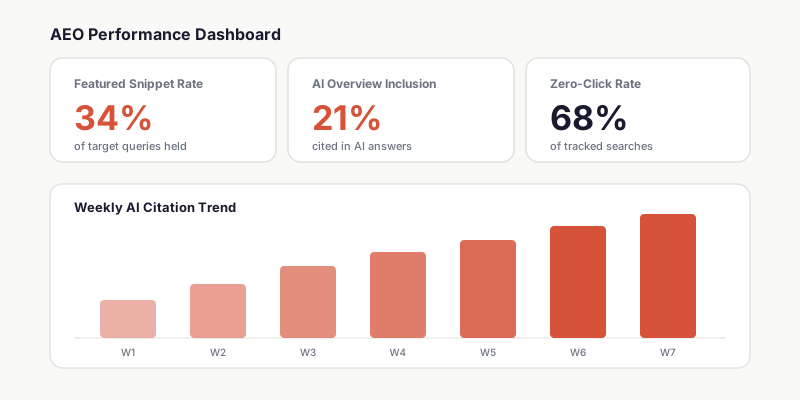
What to track:
- Featured snippet win rate - what percentage of your target queries return a snippet where you hold the position
- AI Overview inclusion rate - how often your domain appears as a citation in AI Overview responses for tracked queries
- AI citation share by engine - your brand mention frequency across ChatGPT, Perplexity, Gemini, Claude, and Copilot separately
- Zero-click rate by query segment - informational queries have a 74% zero-click rate; transactional queries only 31% (Semrush Intent Study). This split tells you where to focus traffic-driving vs. citation-driving efforts
- Cited vs. uncited brand visibility - the gap between these tells you the opportunity cost of not being cited
AI Overview citation tracking requires querying the AI engines directly at scale across your tracked queries - not something Google Search Console surfaces. Tools like CitedSpy track brand mention and citation frequency across AI engines automatically, so you can see citation rate trends without manually querying each engine.
For a structured approach to auditing your current AEO baseline, the GEO audit guide walks through a repeatable measurement process.
AEO Action Checklist
Content (immediate):
- Audit your top informational pages: add a direct 40-60 word answer in the first sentence after every H2 heading
- Add statistics with named source attributions to every key claim
- Add attributed quotes from credible third parties
- Move key information into the first 30% of each page
- Refresh any content older than 6 months that targets informational queries
Schema (technical):
- Implement FAQPage JSON-LD on support, product, and comparison pages (3-8 questions each, 50-200 word answers)
- Add HowTo schema to step-by-step guides
- Add Speakable schema to FAQ and definition passages
- Ensure BreadcrumbList is on all non-root pages
- Validate all schema with Google Rich Results Test
Distribution and authority:
- Target earned media placements in publications AI systems cite frequently
- Maintain consistent entity presence across four or more platforms
- Track AI citation share separately from organic rank - they are now largely independent signals
Query targeting:
- Prioritize transactional queries (31% zero-click) over purely informational ones (74% zero-click) for content where driving traffic is the goal
- Target question-format queries ("who/what/why/how") with direct answer structure - these trigger AI summaries at high rates, and being cited in that summary is the new rank one