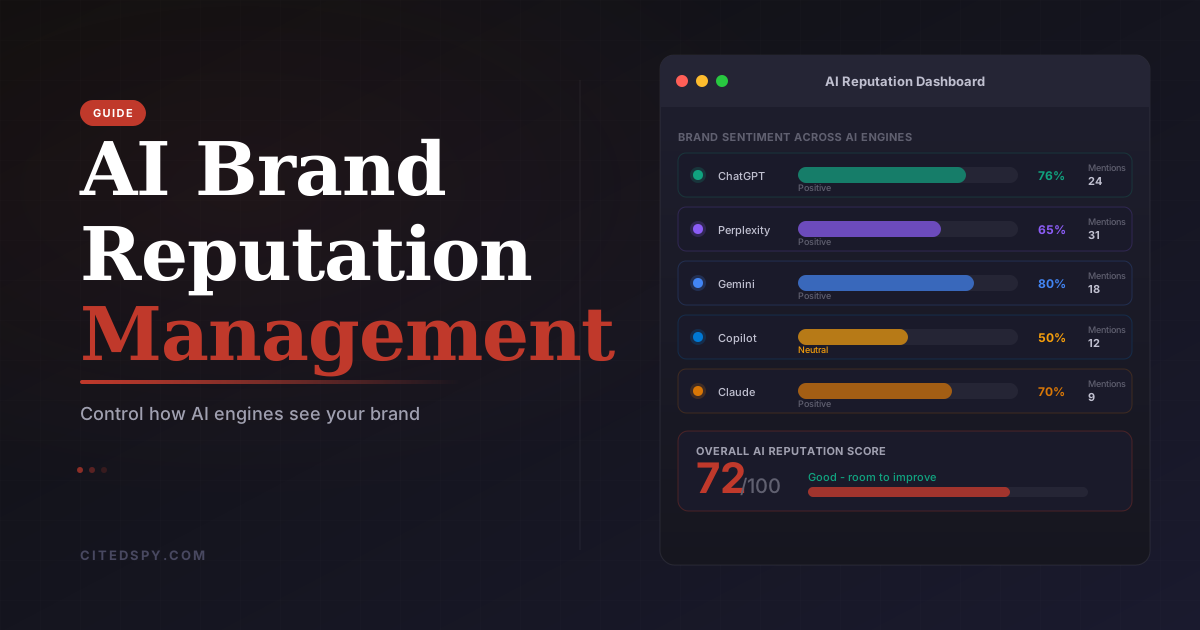
Every buyer who asks ChatGPT "what's the best tool for X" is making a purchasing decision shaped by what an AI engine thinks about you. They are not reading your homepage. They are not browsing your G2 reviews. They are reading a synthesised answer that may or may not accurately represent your brand - and in many cases, you have no idea what that answer says.
This is the new reputation battleground. AI brand reputation management is the discipline of understanding, shaping, and monitoring how AI engines perceive and present your brand. Unlike traditional online reputation management - which focused on Google results, review sites, and social media sentiment - AI reputation requires a completely different set of tools, signals, and strategies.
This guide covers everything: what AI brand reputation is, how it works mechanically, how to audit your current standing, and the specific actions that move the needle.
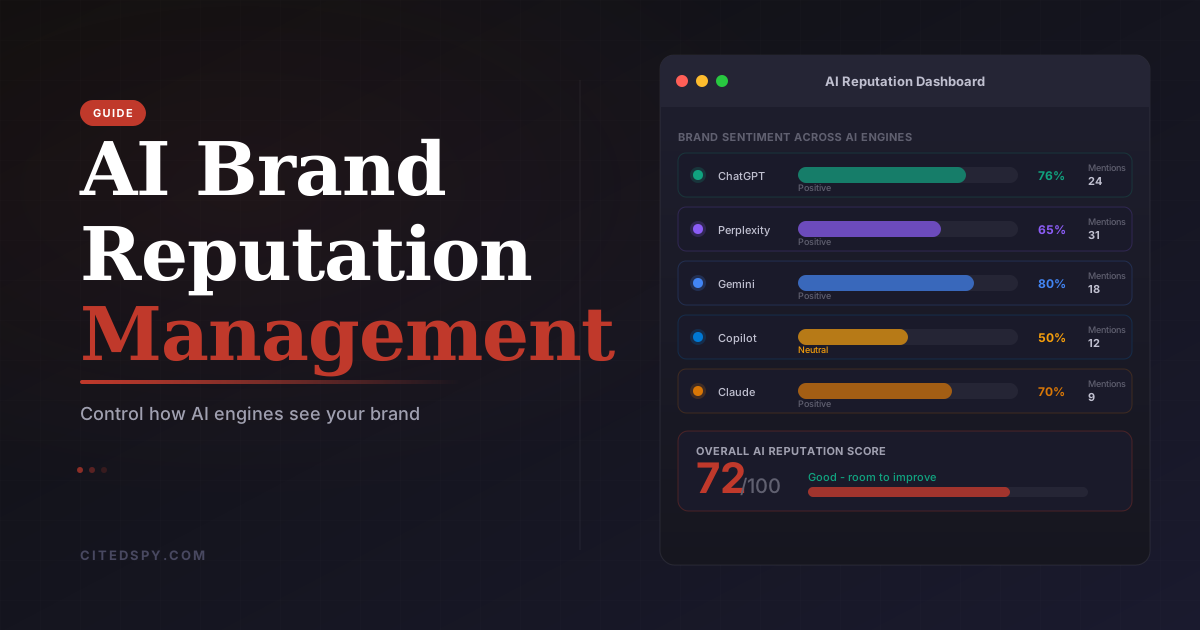
What Is AI Brand Reputation?
AI brand reputation is the aggregate perception of your brand that AI engines hold and communicate to users. It encompasses:
- Whether AI engines mention your brand at all for relevant queries
- How they describe your products, strengths, and weaknesses
- Whether they recommend you, ignore you, or position you negatively relative to competitors
- How accurately they represent your current offering versus an outdated or incomplete version
AI brand reputation is not static. It is shaped by the content AI engines can access - both the data encoded in their training and the live web content they retrieve when generating responses. This means it can be measured, influenced, and improved with deliberate effort.
The distinction from traditional reputation management is important. Traditional online reputation management focused on managing Google's first page of results for your brand name: suppressing negative articles, generating positive reviews, and maintaining a professional social media presence. The signals that mattered were visible to human users navigating search results.
AI reputation management operates differently. AI engines synthesise many sources into a single response. A brand can have ten excellent review articles online and still be described inaccurately by ChatGPT if the training data contained outdated information that outweighs the recent positive coverage. Conversely, a single authoritative piece of content in the right place can meaningfully improve how Perplexity describes you within weeks.
Why AI Reputation Differs from Traditional Reputation
Understanding the mechanics of AI reputation requires understanding how AI engines form their views. There are two distinct pipelines - and most brands are unaware of either.
The Training Data Pipeline
Language models like ChatGPT learn about brands from the text they trained on. If your brand was discussed, reviewed, cited, and mentioned extensively in high-quality publications before the model's training cutoff, those associations are encoded in the model's parameters. When a user asks about your category without web search, the model draws on this embedded knowledge.
The implication: training-data reputation is historical. What the model "knows" about you reflects how you were covered months or years ago. A brand that went through a major product pivot in 2025 may still be described by ChatGPT in terms of its 2023 positioning. Correcting training-data reputation requires generating so much fresh, accurate, authoritative coverage that the next model version's training data reflects the updated picture.
The Real-Time Retrieval Pipeline
Perplexity, Copilot, Gemini, and ChatGPT with web search enabled all retrieve live content before generating responses. For these engines, what you published recently matters enormously. A guide published last month can outrank an otherwise identical guide from two years ago.
This pipeline is directly manageable in near-real-time. Publish the right content in the right format, get it indexed and linked to from authoritative sources, and you can see Perplexity's description of your brand change within two to four weeks.
The practical consequence: most brands need a split strategy. Managing training-data reputation requires a sustained, long-term content and PR presence. Managing retrieval reputation requires fresh, structured, authoritative content published consistently.
The 4 Types of AI Brand Presence
Not all AI brand presence is equal. There are four distinct states your brand can be in for any given query, and each requires a different response.
1. Positive recommended mention. The AI engine mentions your brand by name, describes you accurately, and recommends you as a solution. This is the target state. It means you appear, your description is correct, and the AI is doing your sales pitch for you.
2. Neutral or passive mention. Your brand is mentioned but without a recommendation - listed as one of many options without distinction, or referenced as an example without endorsement. Neutral mentions are better than absence but represent an optimisation opportunity. The goal is to add enough authoritative content and third-party endorsements that mentions become recommendations.
3. Negative or inaccurate mention. The AI describes your brand negatively, inaccurately, or in terms that no longer match your current offering. This is the most urgent situation to address. Negative AI mentions are particularly damaging because users tend to trust AI-synthesised answers more than a single review article.
4. Absence. Your brand does not appear at all for queries where you should be a relevant option. Absence is often more damaging than a negative mention for growth-stage brands, because buyers never even encounter you in the decision process.
Most brands have a mix of all four states across different engines and query types. A structured AI brand monitoring practice is the only way to map where you stand.
How to Audit Your Current AI Brand Reputation
Before you can improve your AI brand reputation, you need a clear picture of your current standing. Here is a systematic process.
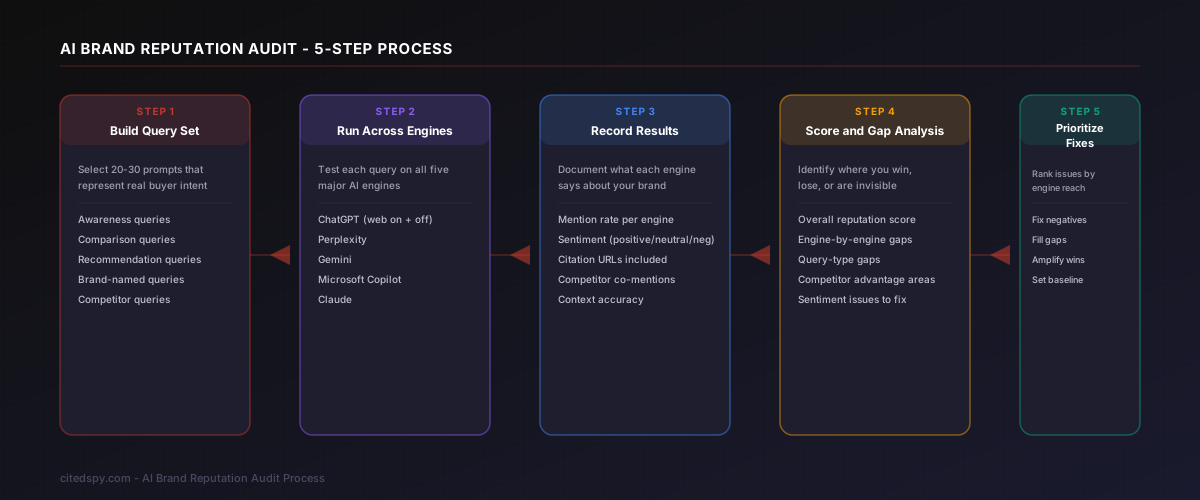
Step 1: Build Your Query Set
Select 20 to 30 queries that represent real buyer intent for your category. These should span:
- Awareness queries - "What is [solution category]?" "How does [problem] work?"
- Comparison queries - "[Your brand] vs [Competitor]", "best [category] tools"
- Recommendation queries - "What should I use for [specific problem]?"
- Brand-direct queries - "[Your brand name]", "what is [your brand]"
- Competitor queries - "alternatives to [competitor]", "[competitor] competitors"
Use the GEO prompt library framework to structure this set. A well-constructed prompt library is the foundation for both the audit and ongoing monitoring.
Step 2: Run Across All Five Engines
Test each query on ChatGPT (with and without web search enabled), Perplexity, Gemini, Copilot, and Claude. Record the full response for each engine-query combination - not just whether your brand appears, but the exact language used to describe you.
Step 3: Score Each Result
For each response, capture:
- Mention (yes/no)
- Sentiment (positive / neutral / negative)
- Accuracy (does the description match your current reality?)
- Position (are you recommended first, second, or buried?)
- Competitor co-mentions (which competitors appear in the same response?)
Step 4: Calculate Your Baseline Score
Aggregate your results into an overall AI reputation score across engines. There is no universal scoring standard - the simplest approach is a weighted average of positive mention rate, with heavier weighting for engines that drive more of your buyer traffic.
Your baseline is not a pass/fail. It is the starting point for measuring improvement.
Step 5: Identify Priority Gaps
Look for patterns: Are you invisible on Perplexity but visible on ChatGPT? Are you well-represented for recommendation queries but described inaccurately on direct brand queries? Are competitors mentioned positively in responses where you are absent?
For a deeper methodology, the GEO audit guide covers a full audit framework you can adapt for reputation-specific needs.
The Key Signals That Shape AI Brand Reputation
Six categories of signals determine how AI engines perceive and describe your brand. Understanding them tells you where to invest your effort.
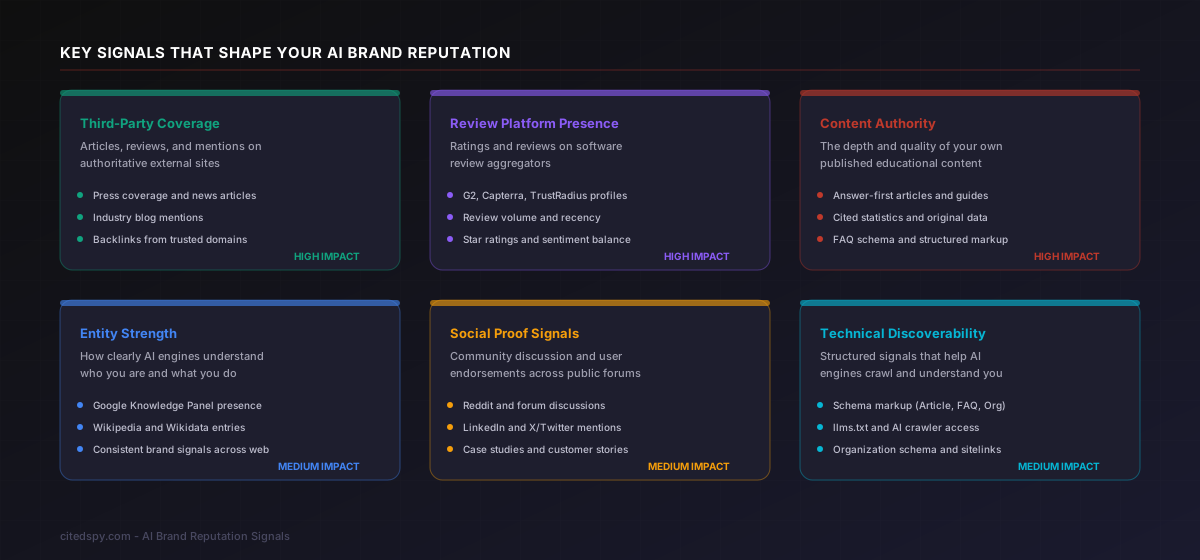
1. Third-Party Coverage
Articles, reviews, and mentions on authoritative external sites are the single highest-impact signal for both training-data and retrieval-based reputation. AI engines treat content from well-linked, established publications as more authoritative than content on your own site.
*What moves the needle:* feature articles in industry publications, product reviews on tech or SaaS-specific outlets, interviews that establish your brand as an expert in the category, and digital PR that generates coverage on high-domain-authority sites.
2. Review Platform Presence
Perplexity heavily retrieves G2, Capterra, and TrustRadius content when responding to recommendation queries. ChatGPT with web search shows similar behaviour. A brand with no review platform presence is nearly invisible for "best [category] tool" type queries - regardless of how good the product actually is.
*What moves the needle:* active profiles on the two or three most relevant review platforms for your category, a meaningful number of reviews, and recent reviews (recency matters because Perplexity weights freshness).
3. Content Authority
The depth and quality of your own published content sends strong signals to retrieval-based engines. Content that answers questions directly, uses cited statistics, and is structured with clear headings gets extracted and attributed more reliably.
*What moves the needle:* answer-first articles that lead with direct responses to the target query, guides that include specific data points from credible sources, FAQ sections with schema markup, and consistent publication cadence. See schema markup for GEO for the technical implementation details.
4. Entity Strength
AI engines maintain internal representations of entities - companies, products, people. The clearer and more consistent your entity signals, the more confidently an AI engine will identify, describe, and recommend you.
*What moves the needle:* a Google Knowledge Panel for your brand, a Wikidata entry for your company, consistent brand descriptions across LinkedIn, Crunchbase, AngelList, and your own structured data (Organization schema).
5. Social Proof Signals
Community discussion - Reddit threads, LinkedIn posts, Twitter/X mentions, podcast features - feeds into training data and appears in retrieval pipelines. Brands with active community discussion are described more richly by AI engines than brands that exist only on their own properties.
*What moves the needle:* genuine community engagement, customer success stories shared publicly, and discussions that use natural language to associate your brand with specific problem-solution patterns.
6. Technical Discoverability
If AI crawlers cannot access your content, your content does not exist for retrieval-based reputation. This is basic but surprisingly common.
*What moves the needle:* ensuring your robots.txt allows AI crawlers, publishing a well-structured llms.txt file that maps your most important content for AI systems, and implementing schema markup that makes your content machine-readable.
How to Improve Your AI Brand Reputation
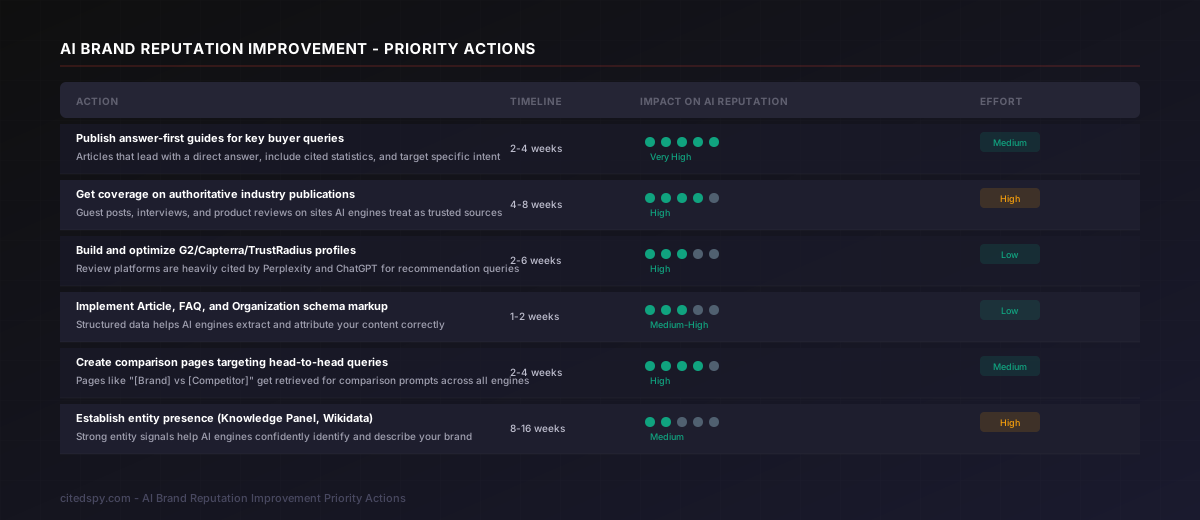
With your audit complete and signal categories understood, the improvement strategy follows a clear priority order.
Fix the Foundation: Content and Technical Setup
Before any outreach or PR work, make sure your own content is optimised for AI retrieval. This means:
- Restructure your most important pages to lead with answers. The first paragraph of a key page should directly state what your product does, who it is for, and what problem it solves. AI engines extract openings preferentially.
- Add cited statistics throughout your content. According to Princeton's GEO research, pages with cited statistics produce measurably higher citation rates across AI engines than pages without them. This is one of the highest-impact single changes you can make.
- Implement FAQ schema on pages that answer questions. Schema markup creates structured data that AI engines can extract cleanly, improving both citation accuracy and frequency.
- Publish your `llms.txt` file. This signals to AI crawlers which of your pages contain the most important information and how your content is organised.
Build Third-Party Authority
Once your own content is solid, shift focus to external coverage. The highest-leverage activities in order:
- Guest posts on authoritative publications. A single in-depth feature on a well-regarded industry site carries more reputation weight than dozens of mentions on lower-authority properties.
- Review platform optimisation. If you do not have profiles on G2, Capterra, or the relevant review aggregators for your category, create them. If you do have profiles, actively solicit recent reviews - recency matters for retrieval engines.
- Comparison content. Publish dedicated pages comparing your product to major competitors. Write them honestly. These pages get retrieved consistently when buyers use comparison prompts.
- Podcast and interview coverage. Transcripts from interviews and podcast episodes appear in retrieval pipelines and contribute to training data. Prioritise shows with published transcripts on their own domains.
Establish Entity Signals
Entity-building is slower but has a compounding effect, especially for improving ChatGPT's parametric recall:
- Apply for and manage a Google Knowledge Panel for your brand
- Create or update a Wikidata entry for your company with accurate structured data
- Ensure your Organization schema on your homepage is complete and consistent with your other entity descriptions
Managing Negative AI Brand Mentions
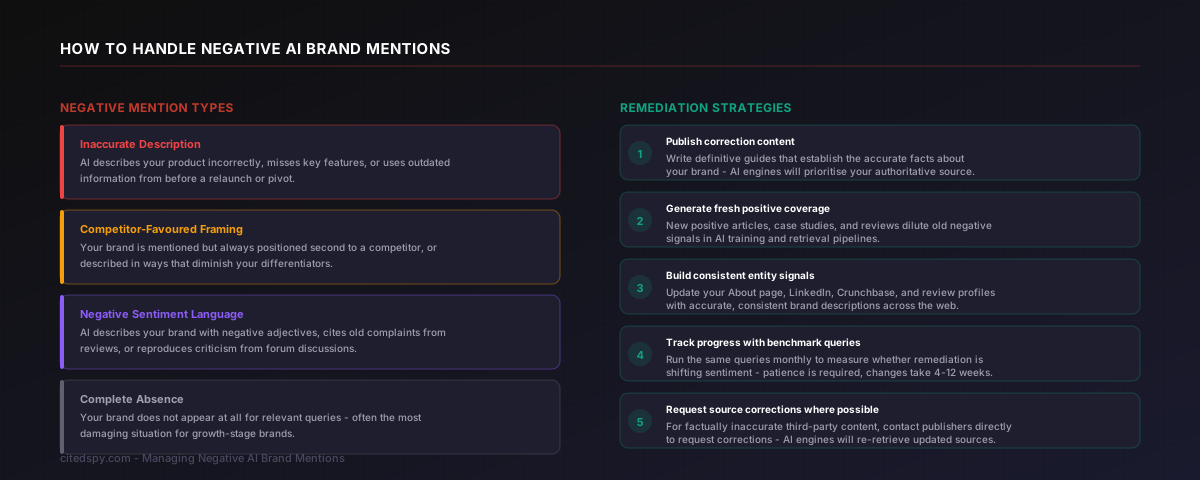
When you discover negative, inaccurate, or misleading AI brand mentions in your audit, the response strategy depends on the type of problem.
Inaccurate Descriptions
If AI engines are describing your product in ways that are factually wrong - wrong pricing, outdated features, incorrect positioning - the fix is to create authoritative counter-content. Write a clear, direct "What is [Brand]?" article that accurately describes your product, its core use cases, and who it is for. Optimise it as the definitive source. For retrieval-based engines like Perplexity, this can shift descriptions within weeks.
Also check for third-party sources that may be propagating the inaccuracy. If a widely-cited comparison article describes you incorrectly, contact the publisher to request a correction. Retrieval engines will pull the updated version.
Competitor-Favoured Framing
If your brand is consistently mentioned second - or framed as "the alternative to [competitor]" rather than a primary recommendation - the fix requires building independent brand authority for your specific differentiators.
Publish comparison content that positions your brand accurately and highlights where you win. Get coverage from sources that discuss your strengths specifically, not just in the context of competition. Over time, this shifts retrieval patterns away from competitor-anchored framing.
Negative Sentiment
If AI engines are surfacing negative reviews or critical coverage as representative of your brand, the solution is volume and recency. New positive content - reviews, case studies, feature articles - dilutes old negative signals in retrieval pipelines. Training-data negative signals take longer to dissipate, but sustained positive coverage does eventually outweigh historical negatives.
> Important: never attempt to flood review platforms with fake reviews to counteract negative sentiment. This is both ethically wrong and algorithmically counterproductive - review platforms have detection systems that can penalise accounts for suspicious activity, making the situation worse.
Complete Absence
If you simply do not appear for relevant queries, the problem is typically a combination of insufficient third-party coverage, weak content authority signals, and low domain authority. The improvement plan above applies directly - focus on content first, then third-party authority, then entity signals.
AI share of voice tracking gives you the most accurate picture of absence: it shows your mention rate relative to competitors across the full query set, making it possible to quantify the gap and track improvement over time.
Monitoring Your AI Brand Reputation Over Time
A one-time audit gives you a baseline. What creates durable value is ongoing monitoring - a systematic practice of running your query set on a regular cadence and tracking changes.
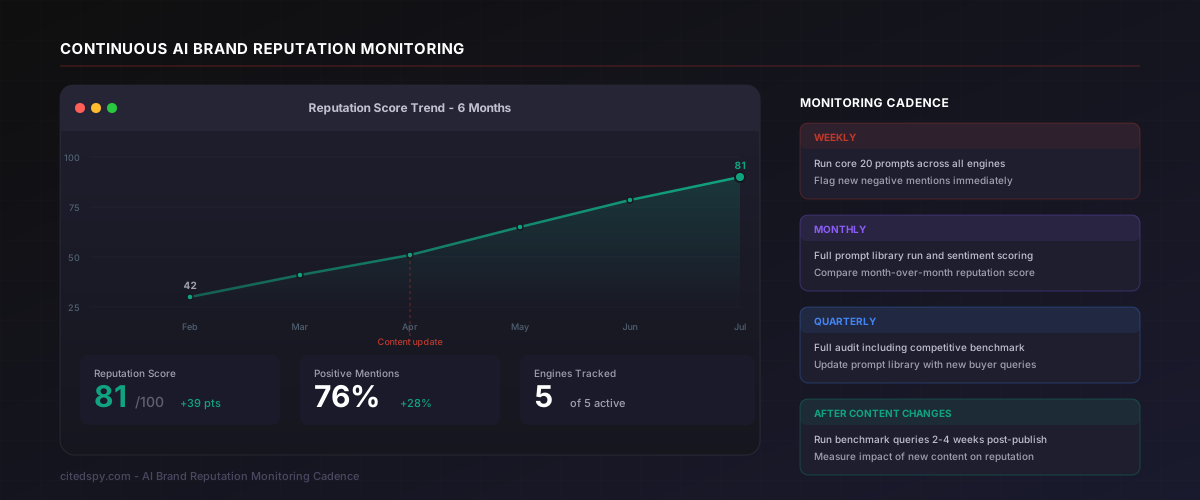
The Monitoring Cadence
Weekly: Run your core 20 prompts across all engines. Flag any new negative mentions immediately. This is the early-warning layer - catching reputation problems before they compound.
Monthly: Run the full prompt library, score results, and calculate your reputation score. Compare month-over-month. The monthly score is the primary metric for measuring whether your reputation-improvement activities are working.
Quarterly: Full audit including competitive benchmarking. How are competitors' AI reputations evolving? Which engines are you gaining or losing ground on? The quarterly review informs your strategy for the next quarter.
After major content changes: Run benchmark queries two to four weeks after publishing significant new content or receiving major third-party coverage. This attribution check tells you whether specific actions are moving the needle.
What to Track
Beyond the overall reputation score, track:
- Mention rate by engine - some engines will improve faster than others based on your content strategy
- Sentiment distribution - the ratio of positive to neutral to negative mentions
- Accuracy rate - how often AI descriptions match your actual current product
- Competitor co-mention patterns - when competitors appear alongside you, which framing wins?
- Citation URLs - when engines retrieve your content, which specific pages are they citing?
The citation URL tracking is particularly valuable. It shows you which of your pages AI engines consider most authoritative - and which pages you should prioritise for content updates. Read How ChatGPT Citations Work and How Perplexity Citations Work for a detailed breakdown of the citation mechanics on each engine.
Setting Realistic Timelines
AI reputation improvement is not instant. Retrieval-based engines like Perplexity show changes within two to four weeks of a significant content update. Training-data-based reputation in ChatGPT without web search changes on the timescale of model updates - months to over a year.
This means:
- Short-term (2-4 weeks): Perplexity citation changes from content and schema updates
- Medium-term (4-12 weeks): Broader retrieval improvement across Gemini, Copilot, and ChatGPT web search
- Long-term (6-18 months): Parametric reputation improvements in ChatGPT as new model versions incorporate updated training data
Patience combined with consistent tracking is the key. The brands that win at AI reputation management are those that establish a monitoring practice, set baselines, and measure improvement systematically - rather than running one-off audits and guessing at impact.
Frequently Asked Questions
Your brand's AI reputation is being formed right now, whether you are managing it or not. Every buyer who uses ChatGPT or Perplexity to research your category is receiving a synthesised assessment of your brand - one shaped by the content AI engines can access, the entity signals they can interpret, and the coverage patterns they have learned to trust.
The brands that invest in understanding and managing this channel now will have a compounding advantage as AI search usage continues to grow. Those that ignore it will find their reputation increasingly difficult to recover - not because of anything they did wrong, but because competitors locked in the authoritative AI mentions first.
*CitedSpy tracks your brand's mentions, sentiment, and citations across all five major AI engines on a consistent schedule - so you always know what AI is saying about you and whether your reputation is trending in the right direction.*